
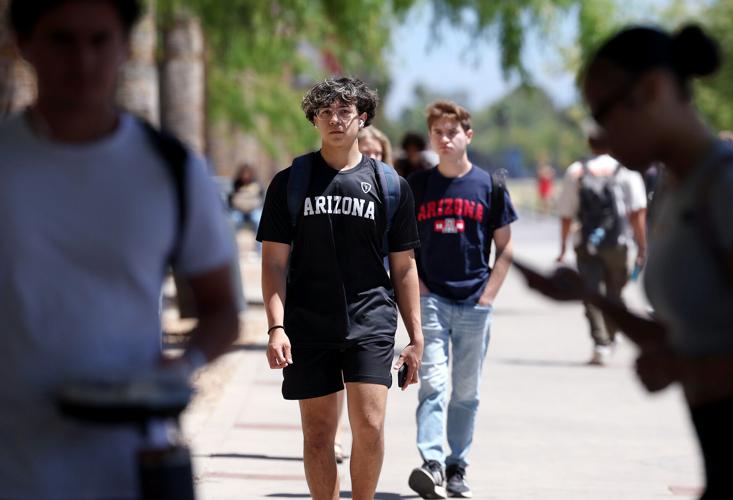
University of Arizona economics professors and career officers say universities should recognize talent in marginalized communities, recruit in-state students to retain local talent, conduct AI-focused education and training and integrate traditional education with industry training.
Mark Stegeman, an associate professor of Economics at UA’s Eller College of Management, said the single-most consistent message he’s gotten from school superintendents was that UA isn’t doing enough to recruit talented Hispanic students, especially first-generation college students.
The UA is a big, complicated institution, and it can be intimidating and scary to anyone if their family isn’t familiar with that world and if they haven’t grown up with that expectation, Stegeman said.
“In southern Arizona especially, this particularly impacts Hispanic students, partly because we have a lot of Hispanic students in the region from families that do not have a background of going to college,” Stegeman said.
People are also reading…
Various barriers to getting academically talented students from those populations exist, such as language issues, and superintendents say the university needs to try harder.
Stegeman said the UA needs to have fewer orientation days on campus and go into schools instead, develop relationships with teachers and principals, and talk to students and provide meaningful support. He said they have a program with the Sunnyside School District that’s been successful, and superintendents from other school districts say this should be more widespread.
He said Tucson benefits from bringing in talented students statewide of any background and graduating them with degrees that will help them get jobs in the state and support the state and local economy. He said Tucson has a strong tradition in aerospace-related industries and computer-related industries with technology companies like IBM and Raytheon.
Justin Jarvis, a senior lecturer in economics at UA’s Eller College of Management, said he doesn’t know what the UA is doing to retain students in-state and that he hasn’t seen many initiatives.
Jarvis said the UA has a heavy focus on training up Arizona students, but not much effort into keeping them in-state. He also said he doesn’t necessarily think it’s the best option for students to stay in-state but to go where they can be successful. He said it’s the government’s responsibility, along with the labor market, to create opportunities to absorb these graduates.
At Eller, they were trying to fill the gap where they were seeing students come out with a bachelor’s degree without knowledge of additional industry concepts and online tools.
Eller is trying to prepare students for an economy that is very dependent on artificial intelligence by not just training them to use AI tools, but to understand those tools and build them.
Jarvis called UA President Suresh Garimella's online-forward initiative with structural changes to its two online programs, Arizona Online and the UA Global Campus a “fantastic idea.”
Not only is online education more accessible to students, no matter where they are, and especially to non-traditional students, but certain tasks are better taught and learned online, especially since those skills will be used in an online environment.
Sarah Diaz, assistant dean of career and professional development in undergraduate programs, said specifically at Eller, they believe workforce training isn’t about replacing degrees but about using it as a resource to complement the student's degree.
Universities that thrive will be those that integrate traditional education and employer-responsive training.
“Ensuring we can stay ahead of rapidly changing tech skills is a constant challenge,” Diaz said. “While the specific tech skills will be ever evolving, the key is to help students adapt quickly, be flexible, and ‘learn how to learn.’
"The challenge isn’t just teaching a specific skill but helping our students apply in them in real-world contexts.”
Reporter Prerana Sannappanavar covers higher education for the Arizona Daily Star and Tucson.com. Contact her at psannappa1@tucson.com or DM her on Twitter.
Prerana Sannappanavar
Higher Education Reporter