

Four torn ACLs in the right knees, one MCL repair to the right knee, one micro-fracture surgery to the right knee, one torn meniscus and one fractured foot.
Oh, and six surgeries.
That’s a lot of injuries, especially when split among just two players.
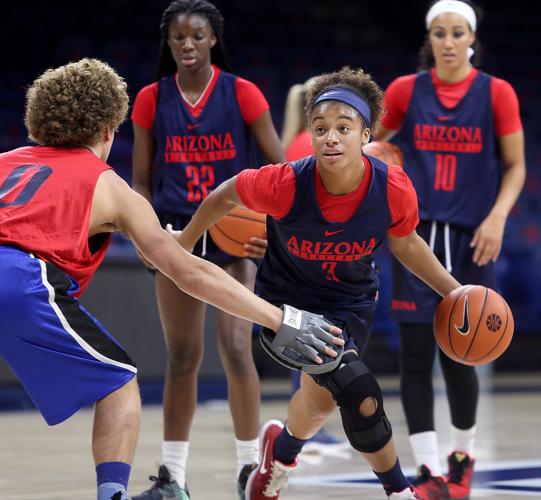
Yet, University of Arizona basketball players Taryn Griffey and Dejza James are still standing.
Last season, James played in 13 games before her season-ending injury. She was injured during her freshman season, as well.
“Before I got injured (in my freshman year), I thought basketball would last forever,” said James. “Sitting on that sidelines was eye-opening. I started focusing on school and became more open to what else I wanted to do.”
While Griffey played last season on a knee that felt off, she still contributed 36 three-pointers, 66 total rebounds, and averaged 7.6 points per game.
People are also reading…
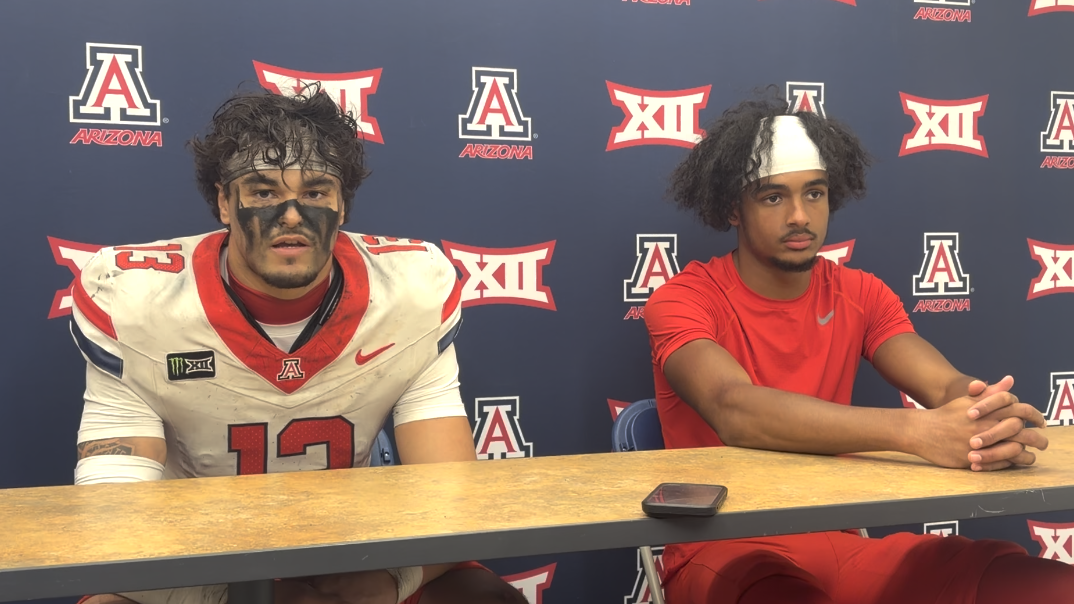
Her brother, Trey, a senior on Arizona’s football team, has been a key level of support for her away from home.
“When I came home (from surgery) my brother took care of me,” said Griffey. “And, he sends me (positive) messages before games. We lean on each other.”
Both players are back this season after bouts with rehab, and acknowledged how important the support from teammates has meant to them in their successful journeys back to the court.
While they are still on the mend, the Wildcats are happy to have them back.
“Twenty-four minutes is a lot (for Taryn in Tuesday’s game against North Texas), yet she is playing well and feeling good,” said Coach Adia Barnes.
“I have no problem monitoring their minutes in practice, yet it is a challenge for a player when you aren’t getting the reps. It’s hard.”
Against North Texas, Griffey, a redshirt sophomore guard, pulled down six rebounds and scored eight points, while against George Mason, she scored 14 points with a team-high four three-pointers.
In a win Saturday at Southern Utah, Griffey had nine points in 16 minutes.
It has been a long haul back from five surgeries and three missed seasons for Griffey, enough to make someone not as strong give up.
“I started playing because I love basketball so why stop?” she said.
She also credits her dad, Baseball Hall of Famer Ken Griffey Jr., for lots of advice along the way.
As she put it: “I look up to him as he overcame a lot of injuries.”
After last season, Griffey’s knee kept locking up and after an X-ray that didn’t reveal much because of all the metal in her knee, doctors took an MRI and determined it was time for one more surgery.
For six weeks, she couldn’t put pressure on her leg. After she was back on her feet, her rehab consisted of getting coordination back for daily tasks, then sport-specific work.
“We do a lot of rehab on the court,” said Carisa Raucci, associate athletic trainer for the UA women’s basketball team. “They have a ball in their hands so they don’t lose that tactile feedback and aren’t isolated from their teammates.”
James, who is a senior forward, has played only one full healthy season to this point and has been looking forward to her final year. The latest injury is one that has taken longer than expected to move on from.
She’s had to wear a boot for much of the year. However, she was promised that she’d make it to the first game of the season, and she made it with just a few weeks to spare.
“I was ready by the exhibition game — it was a small window,” James said. “This has been different from my knee injury. The foot stresses more. This is my last season, I’ll do whatever to get through, even if that means sitting out of some practice or drills.”
In the season opener, James scored eight points, had four rebounds and blocked four shots in 15 minutes. She added two more rebounds and a steal in six minutes against North Texas. She had four points in four minutes Saturday in the Wildcats’ 77-65 win.
This time out, rehab for both players looks different.
Yes, they are focusing on mobility, strength and conditioning, but not in the same way as in the past. Now everything is monitored — their iron and vitamin D intake for good bone health, hydration, time spent on their legs, and sleep hygiene (an area the NFL is starting to focus on — better habits that lead to healthy sleep).
“I bring the small details,” Raucci said. “You can’t throw a player on the court and say ‘Go.’ I count every minute, every hour they are on their legs.
“The newest research shows that glutes and ankles are the most important parts of the body. At first, when I had them sitting and working with bands, they thought I was wacky —wondering why I was working this.
“But, now they get it. This is so new that even two years ago there was nothing on glute activation for the lower leg. If women aren’t training their glutes, they are setting themselves up for issues. We have the whole team doing this to help them stabilize.”