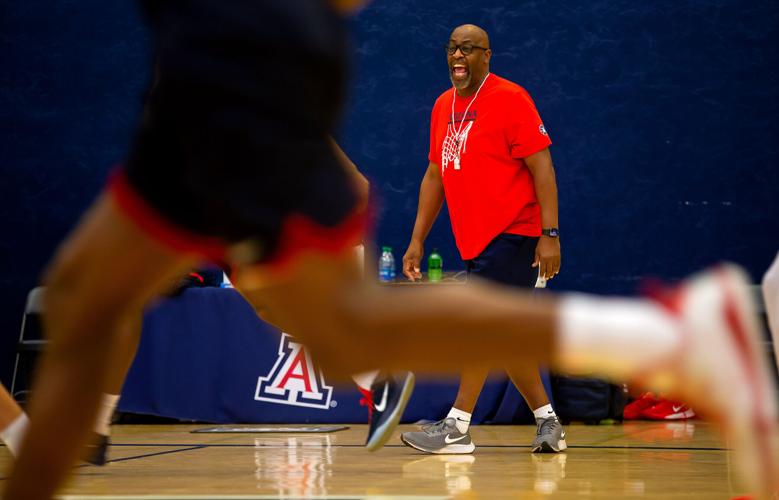
When longtime boss Roy Williams retired at North Carolina after the 2020-21 season, Steve Robinson could have easily done the same.
Robinson had already helped lead teams to 27 NCAA Tournaments, eight Final Fours and three national championships. He spent 27 seasons as an assistant to Williams at Kansas and North Carolina, sandwiched around seven combined seasons as a head coach at Tulsa and Florida State, both of which he led to the NCAA tournament.
Robinson was 63, with the chance to spend more time with family and to jump out of a sport facing rapid change after NIL became legal in July 2021.
But something still didn’t seem quite right.
“I kept all my options open,” Robinson said. “I wanted to have the opportunity to when I decided to quit, to be on my terms and not on other people’s terms.”
People are also reading…
So when then-new Arizona head coach Tommy Lloyd reached out late that summer, seeking help after UA assistant Jason Terry took off to become a G League coach, Robinson listened. Lloyd and Robinson had both been longtime assistants, knowing each other through a relationship North Carolina had with Gonzaga, where Lloyd worked before arriving at Arizona.

During Steve Robinson’s four seasons at UA, the Wildcats went 112-33. They won Pac-12 regular-season titles in 2021-22 and 2023-24, while also reaching the NCAA Sweet 16 three times.
Robinson took the job, wound up spending the last four seasons with the Wildcats, before opting himself to say goodbye this month. Robinson said he would serve out his Arizona contract through the end of June, and he expects to stay active in retirement but without the day-to-day grind of working on a staff.
When Arizona announced Robinson’s retirement on Thursday, Lloyd praised Robinson’s knowledge and experience, saying he was grateful Robinson “took a chance on me” as he built his own staff.
But Robinson said he didn’t see it that way.
“I didn’t think it was a gamble,” Robinson said. “I think everybody’s always fearful when they first take a job: ‘Can they get it done or not get it done?’ I really didn’t have that as a concern. I thought I’d come out, work, and we would be successful.”
During Robinson’s four seasons at UA, the Wildcats went 112-33. They won Pac-12 regular season titles in 2021-22 and 2023-24, while also reaching the NCAA Sweet 16 three times.
In an interview with the Star, Robinson reflected on working at Arizona and his earlier stops. Here’s an edited and condensed version of the conversation:
Do you feel you were able to offer a different perspective on Lloyd’s staff?
“I said this from day one: Tommy is very comfortable in his own skin, in what he knows and how he wants to go about doing things. I just tried to be a set of eyes for him a lot of times, see things that maybe some of the younger guys weren’t thinking about and he gave me a lot of freedom. I’m very appreciative of him giving me an opportunity to come out here to Arizona and be a part of his staff and work with him.
“Tommy’s a passionate worker. He has those qualities and those traits that spell success and I just never had a fear that he wasn’t going to be successful here. And I don’t think y’all have seen the best of him yet. He embraces the NIL and the transfer portal. He’s not shying away or running away from it. He’s hitting it head on, and you can see that from the success that he’s having, combining the recruiting of the high school kids, the portal and international players, too. He’s not afraid of the challenge, that’s for sure.”
Over your four years here, anything jump out or was surprising?
“I think the first year (2021-22), because you have so many moving parts, from staff to players and adjustments from Sean’s (Miller) era, dealing with things that went on before we got here, and trying to establish a culture in a very short period of time, getting the guys to accept his coaching, his style, his philosophy. That laid the foundation for who we were and how we were going to play, and those guys bought into it. We had success with that. We won the conference championship, and you get to the Sweet 16, and it’s like, ‘OK.’
“Then you have to continue but Tommy did a great job with that. And I think he did a great job of helping navigate this past year, especially with the start that we had and having some injuries. He came in staff meetings after those games and said ‘Hey, we’re gonna figure it out. We’re gonna part of something that’s going to be good.’ Instead of accepting what had happened, he attacked it head on. He set the tone and he was relentless about it. And that’s a separator, you know? That’s the qualities of a guy you know is going to be even more successful.”
What was it like experiencing the Pac-12 and then going back to the Big 12?
“Coming into the Pac-12, those arenas were different, whether it’s going to Oregon State, Washington State, Washington. I’d never been to those places before. I never understood the travel aspect of that, playing at USC, UCLA, those facilities, Cal and Stanford.
“Then coming back to the Big 12 was almost like nostalgia. I hadn’t been back in (Kansas’) Allen Fieldhouse since 2002-03, and after being part of that program for eight years at Kansas, knowing what that building and what that program has stood for over the test of time, it was eye-opening.
“Everywhere we went, I always had a story to tell. Going into Oklahoma State, I can remember being on the sideline and that Pistol Pete guy walks behind our bench and takes his little gun and shoots it in middle of a time out. Coach Williams was jumping like, ‘What the heck?’ The first time it scared the heck out of us. It’s those kind of things you remember.”
Speaking of Kansas, all those years with Williams, how did that influence you? Did any of it influence you as a head coach or in what you brought here?
“Our style of play, philosophy (with Williams) was different but — and no pun intended — coming out here, one thing I found out was that there’s more than one way to skin a cat. I’d spent 30 some years of running the Carolina system — we share the basketball, we run, we want to throw and utilize the big guys inside and out — and Tommy does it a totally different way, which was good for me. I said ‘Wow, this is good stuff.’”
What were one or two of the biggest differences?
“Tommy probably utilizes the ball screen more. Both programs like to throw the ball inside to the bigs and utilize some high-low type opportunities. But coach Williams’ system was more of a three-out, two-in motion and spacing is probably a bigger emphasis with us here (at UA). Because of Carolina’s motion, the space sometimes was not always good because movement was always drawing people (into) situations that would stop you from getting the ball inside or being able to have driving lanes. We have more driving and cutting lanes here because of the spacing that we play with.”

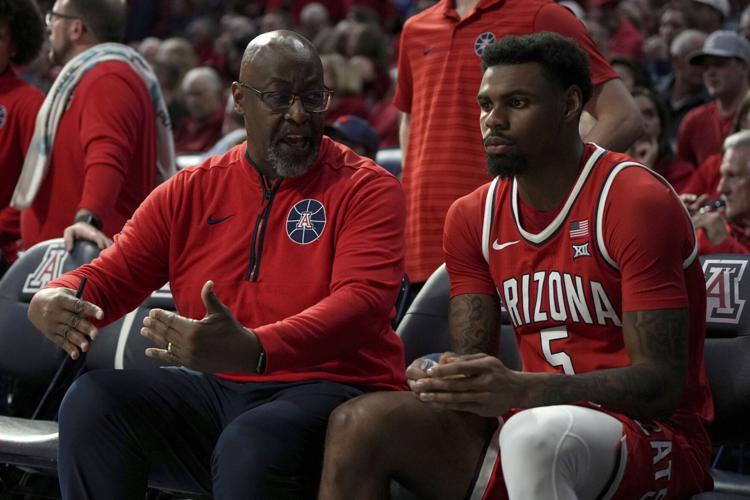
Arizona assistant coach Steve Robinson speaks with KJ Lewis during the first half against BYU, Feb. 22, 2025, in Tucson.
Did you run Carolina’s style when you were a head coach at Tulsa and Florida State? (Robinson was 110-104 in seven seasons between the two schools, with three NCAA Tournament appearances).
“Yes, yes, yes, yes. That’s the years of working with him and the success that he had. The difference was I wasn’t getting the level of player at Florida State I was getting at Kansas with him. It’s hard sometimes you’re competing against and trying to recruit against the Dukes and the North Carolinas and Maryland was in the ACC at that time too. So, you just couldn’t quite get to that level of player that’s needed to sometimes make those plays look a little prettier and executed a little better.”
When you look back at all of your career, what jumps out?
“I think the biggest thing for me is I look back and say, here’s a kid who grew up in Roanoke, Virginia, thankful that my high school coach used to go to the Final Four and the NCAA Tournament, and he’d bring back the game programs. I’d look at those, and I’d be just in awe of that whole concept. I’d watched it on television because I was a basketball junkie and then all of a sudden to get there and be a part of it in person just makes me be appreciative of the fact that I got an opportunity to do it.
“Looking at some of the numbers, I said, ‘Man, I got a chance to participate in eight Final Fours and play (in NCAA championship games) on Monday night six times — won three and lost three. And I’ve worked at some of the major college programs in Kansas, North Carolina, and Arizona.’
“That little guy from Roanoke, Virginia, I think, did OK. I did OK.”
Contact sports reporter Bruce Pascoe at bpascoe@tucson.com. On X(Twitter): @brucepascoe
Bruce Pascoe
Reporter