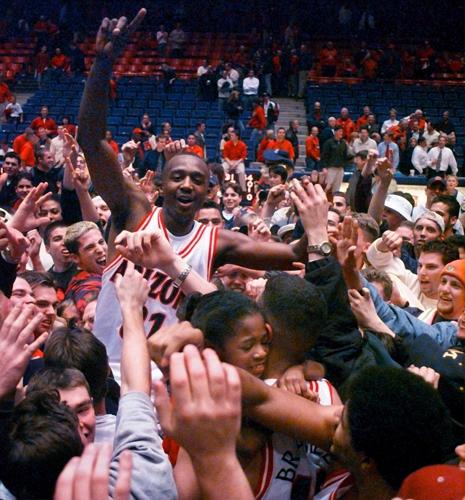
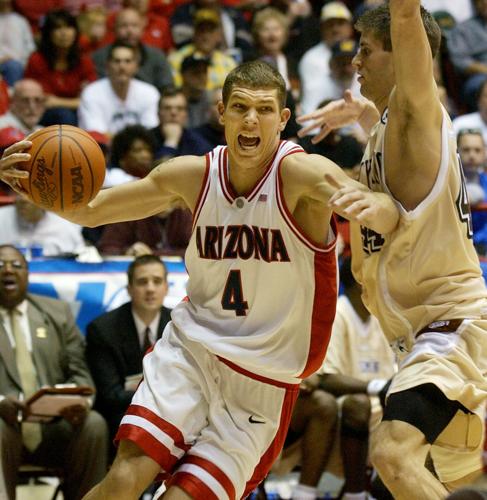
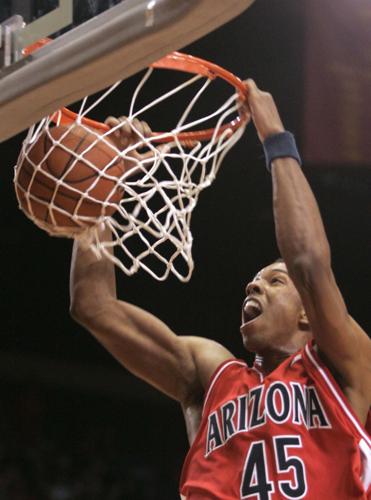
With Tommy Lloyd having set an NCAA record for most wins by a head coach over his first five seasons, we figured it was time to assemble an all-Lloyd-era team and for other coaches in the McKale Center era.
But doing so for the Lute Olson era is incomparably difficult. He was UA’s head coach nearly five times longer (1983-84 to 2006-07) than Lloyd has been, went to four Final Fours and picked up the 1997 national championship.
He happens to be in the Basketball Hall of Fame, too.
The talent Olson amassed and developed can be overwhelming to consider. Even if you only consider what his players did as Wildcats, not as NBA players, as we are. Nevertheless, here’s one look at the team of starters and reserves during the Olson era:
Starters
G Jason Gardner (1999-00 to 2002-03)
People are also reading…
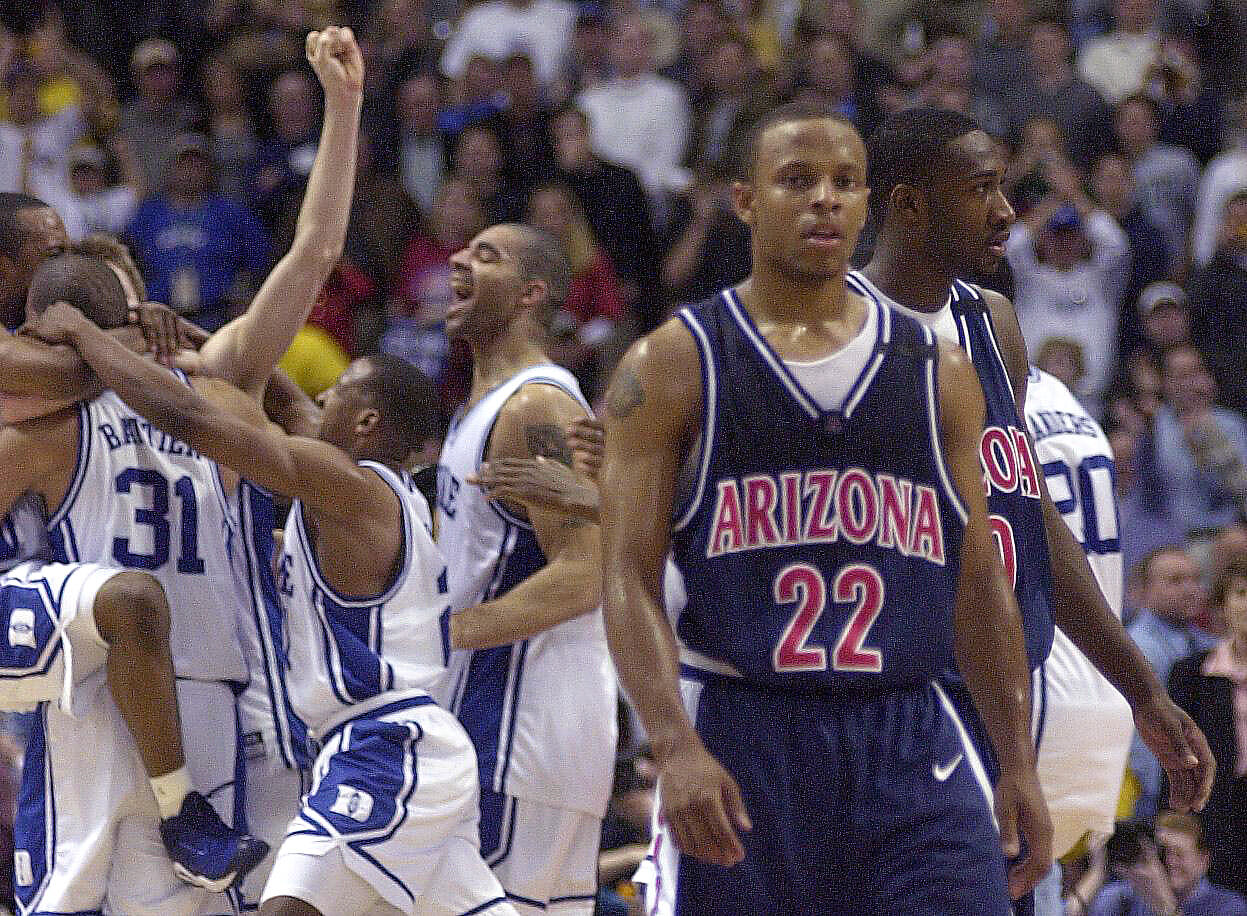
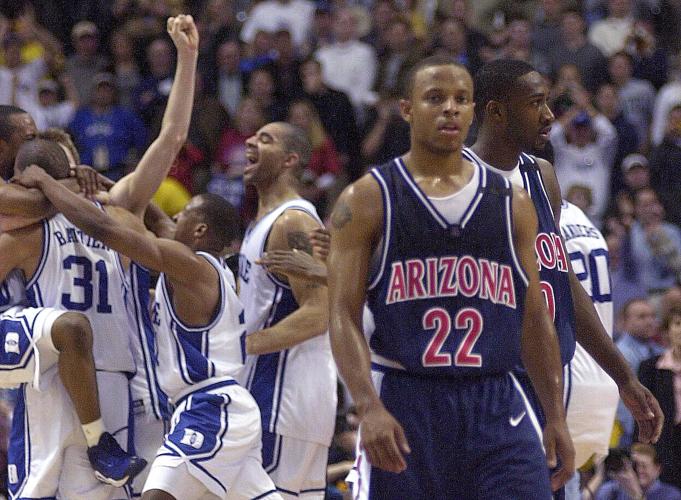
Arizona's Jason Gardner and Gilbert Arenas walk off the court as Duke players celebrate the 2001 NCAA Championship win in Minneapolis.
Because Arizona turned famously into Point Guard U as the Olson era gained steam, this guard-heavy list starts with an undersized but fearless four-year starter.
Gardner committed to the Wildcats after they ran through his hometown of Indianapolis to win the 1997 national title, showed up in the fall of 1999 and helped the Wildcats reach the 2001 Final Four. Also, with Gardner running the show, the talent-depleted Wildcats overachieved in 2001-02 and were just short of making the 2003 Final Four after putting together arguably the best season in program history.
Along the way, Gardner became UA’s third leading scorer of all time (1,984 points), and still ranks fourth in assists (622), third in steals (225). And in what speaks to his doggedness, Gardner ranks first in games started (135) and minutes played (4,825) while ranking third in trips to the free-throw line (663).
After playing seven years in Europe and twice becoming an All-Star in the German Bundesliga, Gardner began a coaching career that included five years as IUPUI’s head coach. He’s now UA’s player relations director.
G Damon Stoudamire (1991-92 to 1994-95)

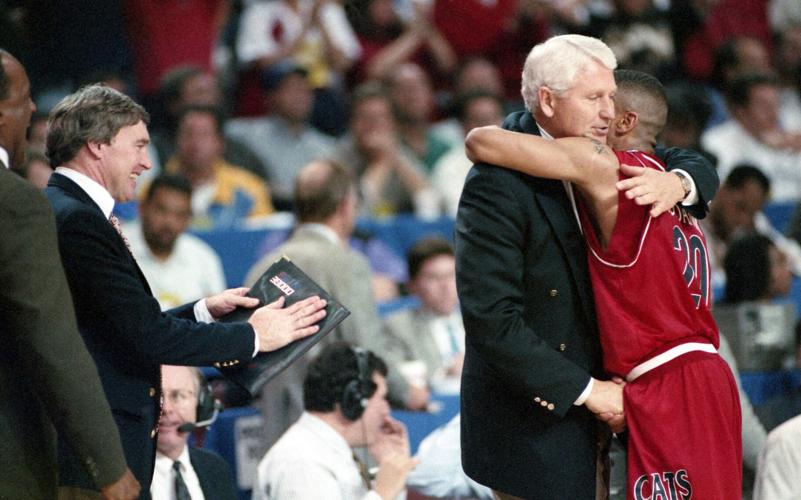
Arizona coach Lute Olson and star point guard Damon Stoudamire embrace during the Wildcats’ 1994 run to the Final Four in Charlotte, N.C.
In the months leading up to Arizona’s 1994 Final Four appearance, Stoudamire may have triggered a new trend and a new branding of himself, possibly without even knowing it, when he had a “Mighty Mouse” tattoo placed on his right arm.
He told the Los Angeles Times in 1997 that there was no significance to the tattoo, but that “people fell in love with it” as he became the NBA’s Rookie of the Year in 1996-97. He also noticed that more players started showing off tattoos, which is common today.
“I’m not saying I started the fad, I’m just saying what I’ve seen,” Stoudamire told the Times. “Am I right or wrong?”
Stoudamire also set a new standard at Point Guard U, with explosive athleticism and an electric playing style that made him difficult to stop at 5-10. A three-year starter, Stoudamire averaged 18.3 points and 5.9 assists during that 1993-94 season and became a first-team all-American while leading the Pac-10 in both scoring average (22.8) and assists (7.3) as a senior in 1994-95.
The No. 7 overall pick in the 1995 NBA Draft, Stoudamire spent 13 years in the NBA before beginning a coaching career that included leading Pacific and Georgia Tech. He’s now an assistant at LSU.
G Miles Simon (1994-95 to 1997-98)

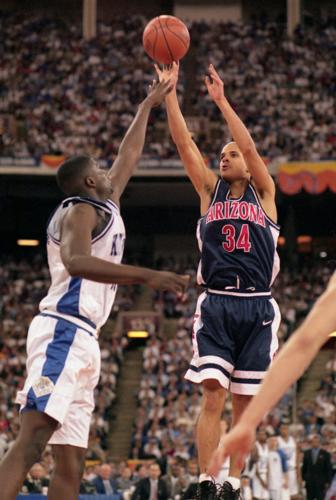
Arizona’s Miles Simon shoots over a Kentucky defender in the 1997 national championship game.
Because high-volume scorers such as Gardner, Salim Stoudamire (1960, ranking fourth) and Hassan Adams (1,818, seventh) pushed him from UA's Top 10 career scoring list, Simon ranks 12th overall with 1,664.
His name isn’t high on other lists inside the Arizona record book, either, but that doesn’t really matter: College basketball is defined by the NCAA Tournament and, in 1997, Simon owned it.
Despite missing the first 11 games of his junior year in 1996-97 because of academic ineligibility, Simon led the Wildcats to a historic run through the tournament. The Wildcats remain the only team to have beaten three No. 1 seeds (Kansas, North Carolina and Kentucky) — while also surviving a first-round scare against South Alabama and an overtime Elite Eight game with Providence — while Simon averaged 22.0 points and 4.0 rebounds during the six-game stretch.
Simon saved his best for the biggest moments, too: He had 17 points to help the fourth-seeded Wildcats knock off Kansas in the Sweet 16, then collected 30 points, six rebounds and four assists against Providence; had another 24 points against North Carolina and, in the championship game, scored 30 points while getting to the line 17 times, and hitting 14 free throws.
The images of Simon gripping the ball with both hands and holding it high in the final moments against Kentucky remain among the most iconic images of Arizona basketball.
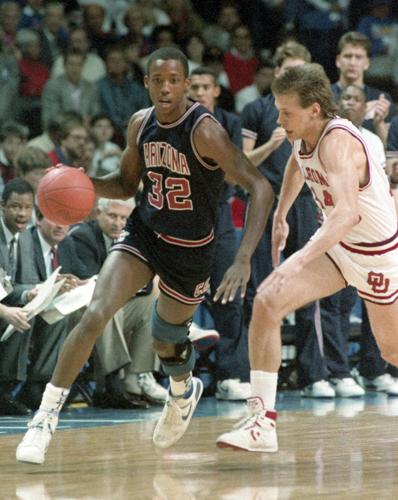
G Steve Kerr (1983-84 to 1987-88)

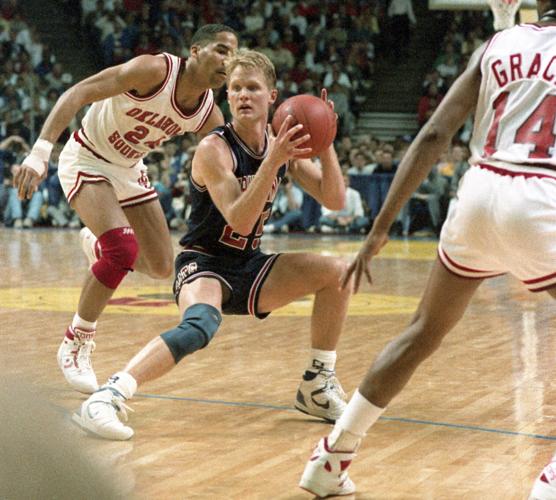
Arizona guard Steve Kerr looks for an outlet during the NCAA Final Four semifinal against Oklahoma on April 2, 1988, in Kansas City, Mo.
Because the Olson era produced so many great guards, this isn’t one of those hypothetical “teams” that is supposed to be able to take the floor together. We don’t even really have a big man in the starting lineup at all, actually.
But this team would have probably done pretty well anyway. Partly because Kerr would have likely figured out a way to make it work.
Though he still holds the all-time NCAA single-season record for 3-point percentage (with 100 or more made 3s) at an absurd 57.3% in 1987-88, Kerr is best known at Arizona for toughness, the way he made others around him better, and his general knack for winning.
All that despite significant doses of adversity: Kerr’s father was murdered during his freshman season and he blew out his knee while playing for the Olson-coached Team USA in the 1986 World Championship.
Kerr took the 1986-87 season off to recover, then came back to set the 3-point mark — and help push the Wildcats into the Final Four as a redshirt senior in 1987-88.
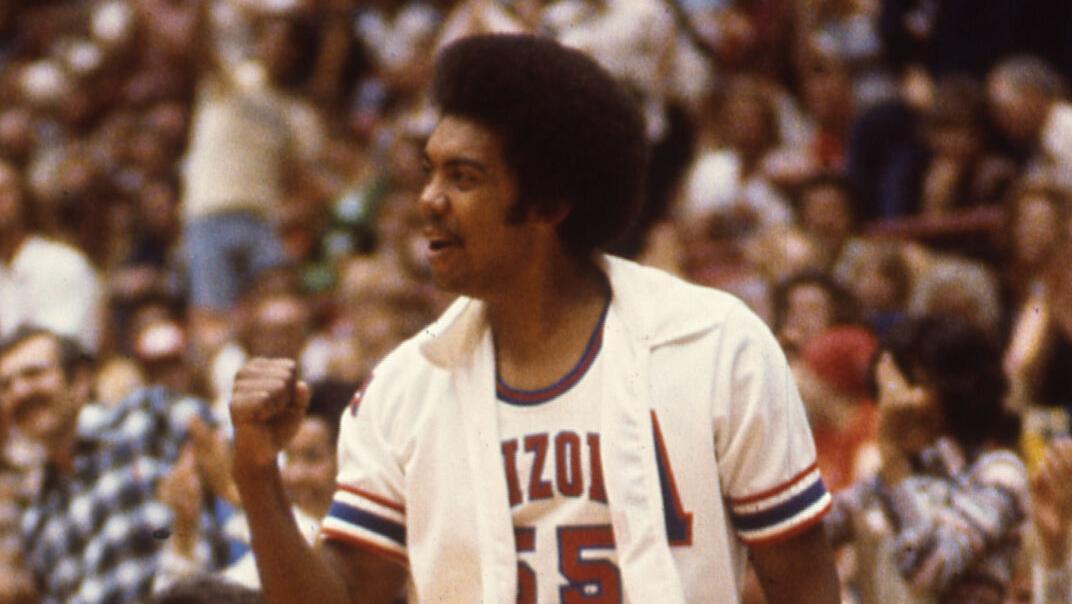
F Sean Elliott (1985-86 to 1988-89)

Arizona's Sean Elliott drives during the NCAA Final Four semifinal against Oklahoma on April 2, 1988, in Kansas City, Mo.
Among the great ironies in Arizona basketball history: The Wildcats haven’t always had the strongest recruiting turf, forcing them to recruit nationally and internationally … yet pulled their best-ever player out of Tucson’s Cholla High School.
Smooth, versatile and intelligent, Elliott led the Wildcats in scoring all four of his seasons and remains the school’s top all-time scorer (2,555 points). Along the way, he picked up two Pac-10 Player of the Year awards and was twice a consensus all-American (in 1987-88 and 1988-89). He was also the consensus national player of the year as a senior in 1988-89.
Maybe more importantly, Elliott led the Wildcats to their first Final Four in 1988 and, in a heartbreaking loss to UNLV in the 1989 Sweet 16, had 22 points and 14 rebounds to put the Wildcats in position to win before Anderson Hunt hit a 3-pointer to give the Rebels a one-point win that ended Elliott’s storied UA career.
The No. 3 overall pick in the 1989 NBA Draft, Elliott went on to become a two-time NBA all-star and helped lead the San Antonio Spurs to the 1999 NBA title – before having kidney transplant surgery two months later. He became the first active NBA player to return to the court after a kidney transplant in March 2000.
Reserves
G Mike Bibby (1996-97 to 1997-98)

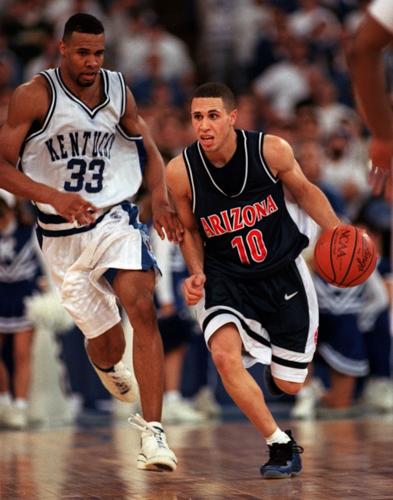
UA guard Mike Bibby is bringing the ball up the court with Kentucky player Ron Mercer, on the left, chasing him during the NCAA Championship game in Indianapolis.
The highly rated in-state point guard spent only two seasons at Arizona, making him an outlier for a list like this, but those two seasons simply can’t be overlooked.
Bibby ran the point guard with a poise and confidence not often seen in freshmen in his era, becoming the Pac-10 Freshman of the Year while helping the Wildcats win the national title. Then he dominated as a sophomore in 1997-98, averaging 17.2 points and 5.7 assists while becoming the Pac-10 Player of the Year and a first-team consensus All-American.
The Vancouver Grizzlies made Bibby UA’s highest draft pick ever in 1998 at No. 2, at least until Derrick Williams went second in 2011 and Deandre Ayton went first in 2018.
G Khalid Reeves (1990-91 to 1993-94)

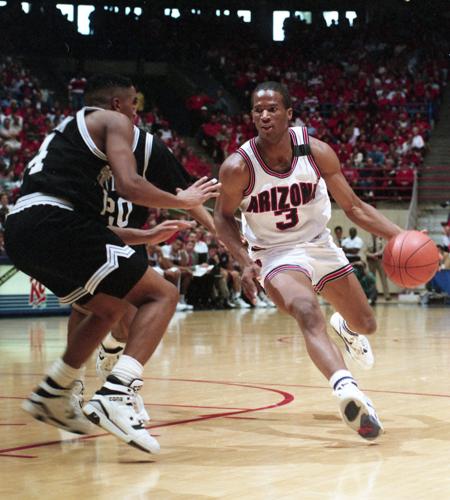
Arizona guard Khalid Reeves against Providence at McKale Center in Tucson on Dec. 23, 1990.
The McDonald’s All-American from New York did recruiting in reverse, reaching out to Olson via his high school coach to express interest in coming out West.
While Reeves had some bumpy moments over his first three seasons, his senior year in 1993-94 was one of the best in Arizona program history: He averaged 24.2 points, 4.3 rebounds and 2.6 assists while shooting 37.8% from 3-point range — and led the Wildcats into the 1994 Final Four along with Stoudamire.
“Every year at Arizona has gotten better,” Reeves told the New York Times in the middle of his senior season. “I have confidence in myself and the coaching staff. … now it's my turn.”
Reeves was the 12th overall pick in the 1994 NBA Draft and played a complete rookie season in Miami while bouncing around the league for six seasons afterward.
G Jason Terry (1995-96 to 1998-99)

Arizona guard Jason Terry celebrates a 78-76 victory over Stanford while riding on the shoulders of fans who stormed the court at McKale Center on Jan. 28, 1999.
Once a commit to Washington who flipped to Arizona in part because of his mother's intervention, the Seattle native gave serious consideration to returning home to play for the Huskies as a sophomore after a limited freshman season at Arizona.
He stuck it out, and his patience paid off. Terry started 18 games early in his sophomore season of 1996-97 while Simon was suspended, then played a key reserve role during the Wildcats’ national championship run.
He played off the bench again as a junior in 1997-98 and then scooted over to point guard in 1998-99, when the Wildcats’ championship core had otherwise departed. That season, he became a first-team All-American.
Still UA’s all-time steals leader (245), Terry became the No. 10 pick in the 1999 NBA Draft and, fittingly, went on to become the NBA's Sixth Man of the Year in 2008-09. He also picked up an NBA trophy in 2011 with Dallas and played a full 19 seasons in the league.
F Luke Walton (1999-00 to 2002-03)

Luke Walton drives around Wyoming's Marcus Bailey in the first half of the second round of the NCAA Tournament in Albuquerque on March 16, 2002.
Did we mention that it’s hard enough picking guards for a Lute Olson team? How about forwards? Gifted players such as Richard Jefferson, Andre Iguodala, Michael Dickerson and Chris Mills were among the possibilities, along with rugged Michael Wright, human pogo stick Hassan Adams and early Olson-era standout Pete Williams.
But we’ll go with Walton because of his “point forward” versatility, passing and court IQ, not to mention the significant role he played on Arizona’s 2001 national runner-up team and its dominant 2002-03 team.
Walton finished his career as one of only three players in Pac-10 history to collect 1,000 points, 500 rebounds and 500 assists, and was respected possibly just as much for the intangible glue he provided on the court. He especially elevated the Wildcats as a junior in 2001-02, after Arizona had been depleted by early NBA Draft departures, leading them to a Pac-10 Tournament title and surprise Sweet 16 appearance.
C Channing Frye (2001-02 to 2004-05)

University of Arizona's Channing Frye slams home and an easy two against USC in the first half at the Los Angeles, CA, Sports Arena, Thursday, Feb. 10, 2005.
How is it possible to leave off Arizona’s all-time blocked-shot leader, Anthony Cook, especially after the key role he played in Olson’s early years and in the run to the 1988 Final Four?
Only because Frye gets the edge in overall production, starting all four seasons, playing standout roles around the basket during UA’s Elite Eight seasons of 2003 and 2005, and becoming a two-team all-Pac-10 pick.
Also: Frye blocked just 20 fewer shots than Cook, sitting second on UA’s all-time blocks list with 258 while also ranking ninth in scoring (1,789), third in rebounding (975) — and 10th in field goal percentage (56.2).
What’s more, the 7-foot Frye didn’t even take 3-pointers — just 23 over his four-year career — even though that stat defined him in the NBA. As a valuable “stretch big,” Frye shot 38.8% from 3-point range while playing 12 seasons over 13 years in the NBA, missing the 2012-13 season with a heart condition.
“He does give me a hard time sometimes saying, ‘You should have let me shoot 3s,’ ” Olson told Suns.com in 2010. “I’ll say, ‘Yeah, then I could have had a 5-10 point guard rebounding underneath the basket while you were shooting those 3s.’ ”
It was vintage Olson: Among other things, he was known for a keen recruiting eye, player development, winning 75.9% of his games ... and issuing a quick, sharp reply whenever it might be needed.
Contact sports reporter Bruce Pascoe at bpascoe@tucson.com. On X(Twitter): @brucepascoe
Bruce Pascoe
Reporter