KANSAS CITY, Mo. — Even before the courts started allowing more talented players to join his roster this fall, Kansas coach Bill Self was already in pretty good shape.
“I liked our roster before three weeks ago,” Self said at Big 12 media days last week. “I think this team has a chance to be very, very good.”
Maybe even as good or better than Arizona, which was picked to defend its Big 12 title this season, because those three weeks resulted in well-regarded veterans Trey Kaufman-Renn, Melvin Council and Tre White joining the Jayhawks via a flurry of legal actions.
White is a “conventional” five-for-five player who graduated high school in 2022 and played four college seasons (at four different schools) but received a preliminary injunction allowing him to play this season. Kaufman-Renn graduated high school in 2021 before sitting out his freshman season and playing four others at Purdue – and Council graduated high school back when COVID had just infiltrated the world.
People are also reading…
Yep, Council actually graduated in 2020 … and is still playing college basketball. He sat out in 2020-21, played juco ball the following two seasons and then the past three at the Division I level.
With a case that is more complicated because he was forced to attend junior college while he fought since-vacated legal charges — one factor in his most recent appeal — Council became eligible last season because of a blanket waiver allowing an extra year of Division I eligibility in 2025-26 to those who played junior college ball.
The waiver is known informally as the “Diego Pavia” rule for the former juco and Vanderbilt quarterback, who sued to gain eligibility last season by arguing his junior college years shouldn't count against an NCAA cap.
The victory resulted in the NCAA issuing a waiver for everyone in Pavia's situation to play last season “in an effort to keep fairness among its competitive schools,” according to a Yahoo report.
UA coach Tommy Lloyd is wondering why there isn’t a similar blanket waiver for 2022 high school graduates, such as Arizona’s RJ Godfrey and several other “five-for-five” Big 12 players who remain ineligible while White and even some who began playing collegiately before 2022 are still eligible.

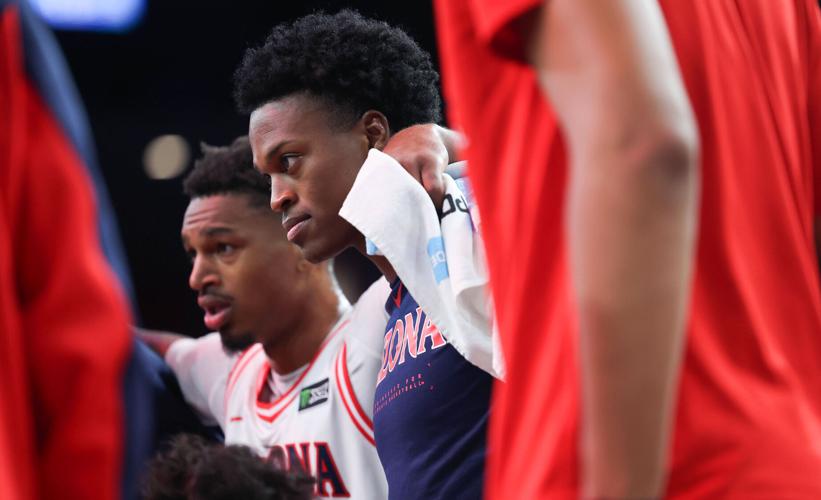
Arizona forward RJ Godfrey listens to head coach Tommy Lloyd during a media timeout against San Diego State, McKale Center at Alkeme Arena, Oct. 16, 2026.
“What's difficult when you sit in the coach's seat is they had a remedy for it back then, and they set a precedent doing that,” Lloyd said of the inconsistency. “Why are they not doing that now?”
Also wondering if the NCAA is intentionally trying to create chaos in order to prod lawmakers to help, Lloyd has particular reason to question the situation because Godfrey is so critical to the Wildcats’ rotation. Godfrey is literally the only true power forward on the roster — but several of Lloyd's Big 12 counterparts expressed the same sentiment during the conference’s media days in Kansas City last week.
“If you're in the five-year window, you should be able to play, whether it benefits your school or not. It benefits those kids,” Houston coach Kelvin Sampson said. “How can you tell the ‘22 kids they can't play when you just passed the five-year window? ... They are in the five-year window. So why not? Why would you not?
“But the NCAA is looking for wins too. They're looking to establish credibility for themselves because of what's happened over the year, the last couple years at least.”

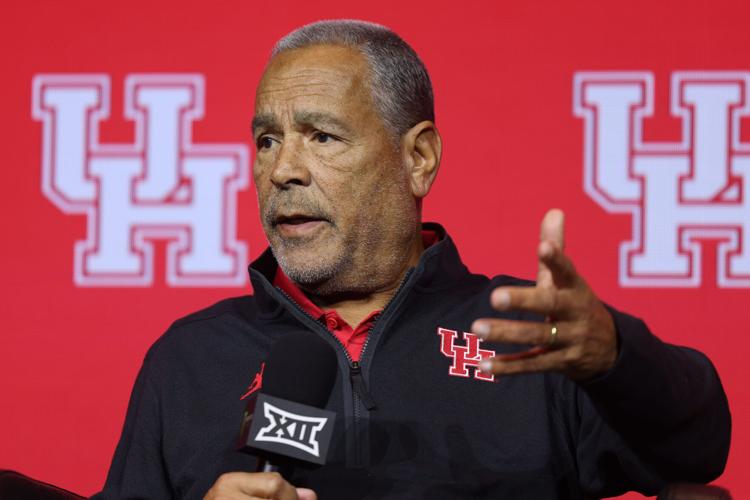
Houston coach Kelvin Sampson, shown during Big 12 media days on Wednesday in Kansas City, Mo., was among the Big 12 coaches expressing support for a blanket waiver that would allow four year college veteran athletes who graduated high school in 2022 to be able to play this season.
West Virginia coach Ross Hodge said anyone in that “clean five-year window” who began college sports in 2022 should be allowed eligibility and the corresponding NIL opportunities that now come with it.
“You're talking about life-changing money potentially, and opportunity that could shape different generations of these young guys' lives and their kids and their kids' kids,” Hodge said.
That was part of Lloyd's argument, too. He said repeatedly during Big 12 media day interviews that he can only hope “cooler heads will prevail,” and that all high school class of 2022 athletes will be allowed to play this season, when top players are routinely being paid seven-figure compensation packages.
“It just seems like there's real damage being done to these individual players,” Lloyd said. “It's not fair that these kids are getting penalized. Honestly, (it's about) life-changing opportunity and life-changing financial things.”
West Virginia has two currently eligible five-for-five players, forwards Brenan Lorient and Javan Buchanan, but Hodge says it “gets hard to defend” older players seeking eligibility — and he has one of those, too.
Guard Honor Huff, who graduated high school in 2021 and led the Mountaineers in scoring last season, filed a complaint against the NCAA seeking eligibility this season.
Huff has already exhausted his five-year window but only played four seasons because he sat out one after transferring to Chattanooga as a sophomore in 2022-23.
Under the NCAA's old eligibility rules, which allowed four seasons of play over a five-year window, Huff would have exhausted his eligibility. But Huff is seeking the same ability to play five years that athletes are now receiving under the NCAA's new "five for five" rule, which gives athletes an unlimited amount of eligibility to play within a firm five-year window when it passed in June.
Even if Huff were to succeed, West Virginia might not be able to accommodate him unless it received a roster exemption, making his case even more complicated.
“Fully supportive of Honor in his endeavor, and just like everything else, it's very fluid,” Hodge said. “We’re just going to support him through that process and see how it goes with him. You never want to say never.”
While Huff has been off the court while seeking his complaint, the many ineligible five-for-five players such as Godfrey and Houston guard Chandall Weaver are practicing but not playing in games.
Weaver is a plaintiff in a Tennessee lawsuit that generated a preliminary injunction allowing him to play, but the Tennessee Court of Appeals later granted a motion to stay the ruling, just as the Georgia Court of Appeals did in the Georgia lawsuit Godfrey is a part of.
Both players have remained in limbo since then.
“My conversation has been with him is real simple,” Sampson said of Weaver. It’s “if they grant you eligibility, I'm gonna look forward to coaching you. If not, I'll help you get to your next spot.”
Oklahoma State coach Steve Lutz is taking an optimistic approach to his five-for-five players. Both of them, forward Parsa Fallah and guard Kashie Natt, have received injunctions allowing them to play for now, without an overriding ruling, and Lutz said he expects them to hold up.
“The way I look at it is, you treat them just like they're a part of the team and a significant part of the team,” Lutz said. “If for some reason that changes, it would be like a season-ending injury. That's the way I would treat it.”

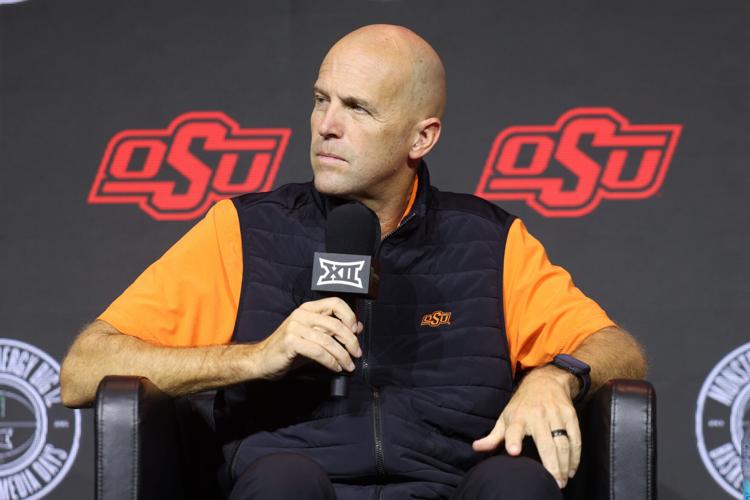
Oklahoma State coach Steve Lutz listens to a question during the Big 12 Media Days at T-Mobile Center on Wednesday, Oct. 21, 2026, in Kansas City, Mo.
Still, the whole situation doesn’t sit right with Lutz. Even as he says he grew up believing “if you live in a glass house, don’t throw rocks,” he tossed a few.
“Because of the timing of the release of the five-for-five and age-based eligibility, we’ve put ourselves in an unbelievable predicament,” Lutz said. “In my opinion, at this point, the NCAA just needs to put it to a vote to all the member institutions, or they need to say, ‘Hey, you know what? Maybe we did actually make a mistake here, and let's grant these guys their eligibility.’ ”
“I just think we're wasting time. We're wasting a lot of resources and money, and you shouldn't be dealing with these things as basketball season is approaching, and also as football season is going on.
"It's not fair to the student athletes. It's not fair to the universities. It's not fair to the coaches. So it's just a tough situation right now.”
Contact sports reporter Bruce Pascoe at bpascoe@tucson.com. On X(Twitter): @brucepascoe
Bruce Pascoe
Reporter