
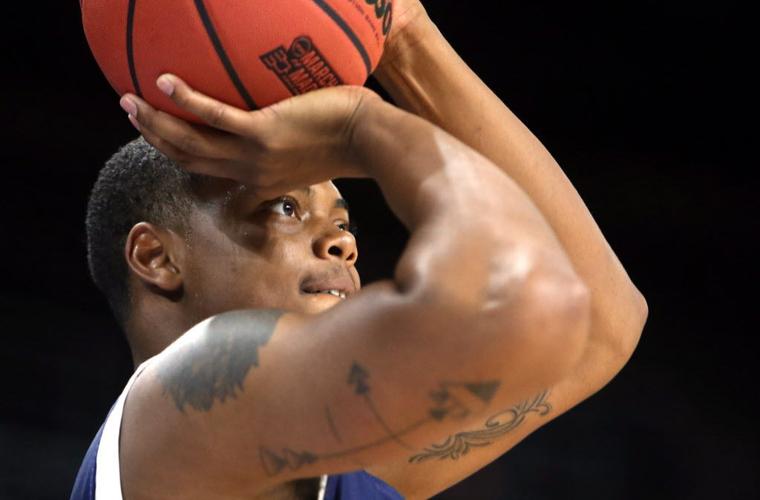
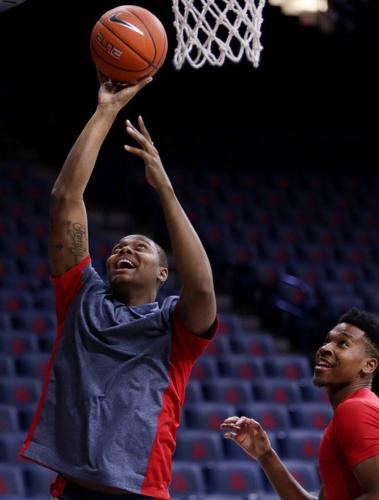
If the odds were stacked against Ray Smith this season, medical history had no way of telling him exactly how much.
The Arizona Wildcats redshirt freshman, who announced Thursday he is leaving basketball after suffering his third ACL tear, is something of an anomaly in the still-developing world of knee-injury science.
Smith entered the season already having torn both his ACLs, then ripped up the right one for a second time Tuesday in the Wildcats’ exhibition game with the College of Idaho.
That’s three ACL tears in 28 months. Two on the right knee, one on the left.
There just aren’t many folks in that data set.
The ballpark estimate for an elite athlete to return to previous form after an ACL tear is around 75 percent — a number that Canadian Olympic team doctor Robert McCormack finds too high — but the chances of returning after two are largely unknown, in part because many athletes stop playing at that point.
People are also reading…
Five NFL players suffered a third ACL tear between 2010 and 2013, according to a 2016 article in the Orthopaedic Journal of Sports Medicine. Carolina Panthers linebacker Thomas Davis became the first NFL player to come back from three ACL tears in 2012.
But all of Davis’ tears were to the right knee. Smith went left-right-right.
“His case seems unique,” said Steve Jordan, an orthopedic surgeon and partner at the Andrews Institute of Orthopaedics and Sports Medicine in Florida. “The bottom line is the (success-rate) numbers waffle back and forth, and it sounds like this young man has had bad luck.”
After studying 1,200 patients who had ACL reconstruction, McCormack suggested the success-rate figures should be permanently lowered. In the British Journal of Sports Medicine, he wrote an editorial titled: “Time to be honest regarding outcomes of ACL reconstructions: Should we be quoting success rates of 55-60 percent in high-level athletes?”
And that referred to just one ACL tear.
“It is more challenging after a second revision,” McCormack said. “There’s not much evidence. … It’s pretty commonly accepted that we think 70-80 percent will get back to the same level (after one ACL reconstruction), but I’d take 10 percent off of that, and after a second revision, I’d take off at least another 10 percent.”
Another complicating factor is that some statistics cite only the success rate of not re-injuring the same ACL. McCormack said recent UEFA (European Union of Football Association) rates around 70 percent might have been lower if they included injuries to the opposite knee, which can be related because of an imbalance or other issue that occurs after the first injury.
“We said if you take the other knee into consideration, maybe it’s not quite as rosy a picture,” McCormack said.
Since Smith injured both ACLs, all of that suggests he probably had somewhere around a 50-50 chance of playing for the Wildcats at a high level again.
Or, if his body mechanics or genetics were known to be working against him, maybe that stat might have been even lower. While UA declined requests for comment from staffers and doctors who worked with Smith, several experts say multiple ACL tears are often a result of factors an athlete was simply born with.
Among the potential complications, McCormack said, are small ACLs, knee bones in disadvantageous locations, or even cerebellar issues in the brain that affect movement.
In addition, heredity plays a role: McCormack said the normal occurrence of ACL tears is three per 10,000 people but first-degree relatives of an ACL reconstruction patient have a 24 percent higher chance of tearing their own ACLs.
It also doesn’t help if you have the first ACL tear before your early 20s, according to a 2014 University of North Carolina study that measured the ACL histories of Tar Heel athletes in all sports from 2000 to 2009.
“The thought process is this: The younger you are when you have an ACL tear, the more likely it is to happen again, and there’s a 3-4 percent chance it will be to the other ACL,” said Ganesh Kamath, a UNC associate professor of orthopedics who co-authored the study.
“But there is a small subset of patients who keep having this same problem. That’s probably a combination of biomechanics — the way you move — and genetics. They’ll continue to tear the ACL.
“But despite tearing the ACL, there’s something about the way the elite athlete is wired that they come back more than the rest of us. Certainly the chances of coming back are higher.”
McCormack knows the feeling. He works with not only Canadian Olympians but also the CFL’s B.C. Lions and the MLS’ Vancouver Whitecaps. He repairs about 200 ACLs per year.
Sometimes he offers advice other than reconstruction and rehab, telling athletes they have to think about the effects on their knees later in life.
“Those are hard discussions to have because the average elite athlete has a gladiator attitude,” McCormack said. “But as surgeons we talk about the cost or implications of recurring injuries. Sometimes I tell people, ‘You’ve had a good run at basketball, but the NBA doesn’t look in the cards.’
“Once I said to a national team wrestler, a national champion in Canada who had both ACLs done, ‘I’m not going to redo your ACL if you’re going back to wrestling.’ He said, ‘But if you don’t redo it, I can’t go back.’ It’s rare that I have to take that kind of paternal approach, but as surgeons we do have an obligation. Whether it’s two or three (reconstructions), it’s part of the equation.”
It’s unknown whether UA had any of those conversations with Smith after his third ACL tear on Tuesday, but Smith’s retirement announcement suggested they probably weren’t necessary.
“Sometimes in life all you can do is the best that you can do,” Smith posted on Twitter.
Jordan said he’s had conversations about multiple-ACL-tear cases with James Andrews, the well-known sports injury surgeon he partners with in Florida, and the two concluded that even with ideal reconstructions and rehabs sometimes “lightning strikes,” and it all happens again.
So sometimes, maybe you just have to throw up your hands and move on.
“While fitness is an incredible part of your health, elite sports are hard on your body — there’s no doubt about it,” McCormack said. “More and more in orthopedics, you say, ‘At what cost is too much?’ At some point you have to say enough is enough for your knee. And that’s a very individual decision.”