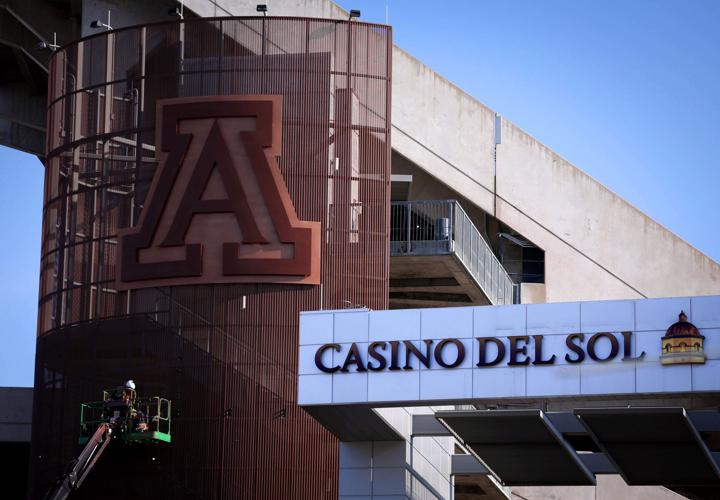
When Arizona's athletic department announced it would pull in a total of $87.7 million via major naming rights deals during the past school year, details were scarce.
Were the financial terms backloaded in the 20-year, $60 million deal that put Casino Del Sol’s name on UA's football stadium, and in the 15-year, $27.7 million deal that gave insurance broker Alkeme secondary McKale Center naming rights?
What were the opt-out terms, if any? What were the NIL components? What sort of signage and other exposure, exactly, was included?
Those details are largely being kept private. Even though the contracts greatly involve a public institution, Arizona is not releasing them because they are routed through Arizona Sports Enterprises, a nonprofit arm that handles sponsorship agreements benefiting the UA athletic department and, through NIL components, Arizona athletes.
People are also reading…

A new sign is added to Casino Del Sol Stadium in Tucson on Aug. 11, 2026.
The arrangement is likely why, a month after the Star submitted a public-records request to Arizona for the Alkeme contract, the university replied by saying it “does not possess any records responsive to your request” without mentioning ASE.
It’s likely also why it took a while before Arizona athletic director Desireé Reed-Francois came through on her promise to release at least the “first year number” of the Alkeme deal to the Star during her February news conference announcing the deal. After several follow-up inquiries by the Star over the last month, Reed-Francois said she would have to check with Alkeme officials to see if they would be willing to share the information. (Alkeme did not directly respond to the Star’s request for details of the agreement).
“Commercial agreements contain confidential and competitively sensitive terms,” Reed-Francois said. “So like any business, ASE is not going to want commercially sensitive items out there.”

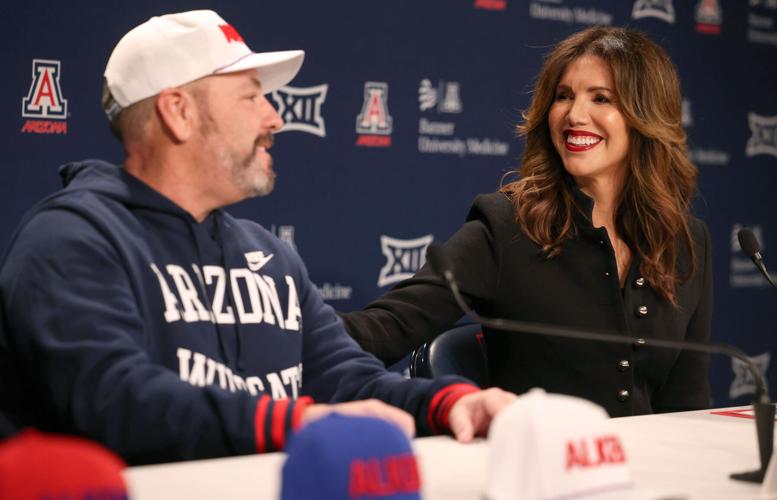
Alkeme chief executive officer Curtis Barton, left, and UA athletic director Desireé Reed-Francois hold a press conference for the renaming of McKale Center, Feb. 13, 2026. McKale Center is now McKale Center at Alkeme Arena.
Finally, on Tuesday afternoon, UA officials told the Star that Alkeme paid UA $1 million for the partial 2025-26 year — from February through June. UA also sent a graphic saying that the deal, which averages $1.85 million per year, includes payments that will increase by 4% every year, indicating the deal is, in fact, somewhat backloaded.
In addition, UA released limited terms of the Casino Del Sol deal, saying it has a three percent annual escalator for annual payments that average $3 million.
A national trend
Protecting terms of an agreement is a side benefit to entities such as ASE, according to Sportico investigative reporter Daniel Libit, on top of their ability to move with private-sector-like efficiency in the fast-moving era of college sports.
The entities are popping up all over college sports, generally replacing third-party sponsorship entities such as Learfield, which UA contracted with until the creation of ASE in 2024 after Reed-Francois was hired.
UA officials said they modeled ASE largely after one at Clemson, with the help of South Carolina-based attorney Clay Grayson, while Kentucky and Louisville have established similar entities.
Whether established as a nonprofit or for-profit, the entities can operate privately. Libit said he's even had to sue the universities of Colorado and New Mexico to obtain the sponsorship contracts he's sought.
“There are now these creatures, similar to what Arizona has created, that are now consuming more and more of the business of the athletics department, and the athletics departments are trying to exploit this from an obscurism standpoint and not turning over records,” Libit said. “It does not surprise me that with more and more deals that would have been disclosed they’re now claiming are exempt.”
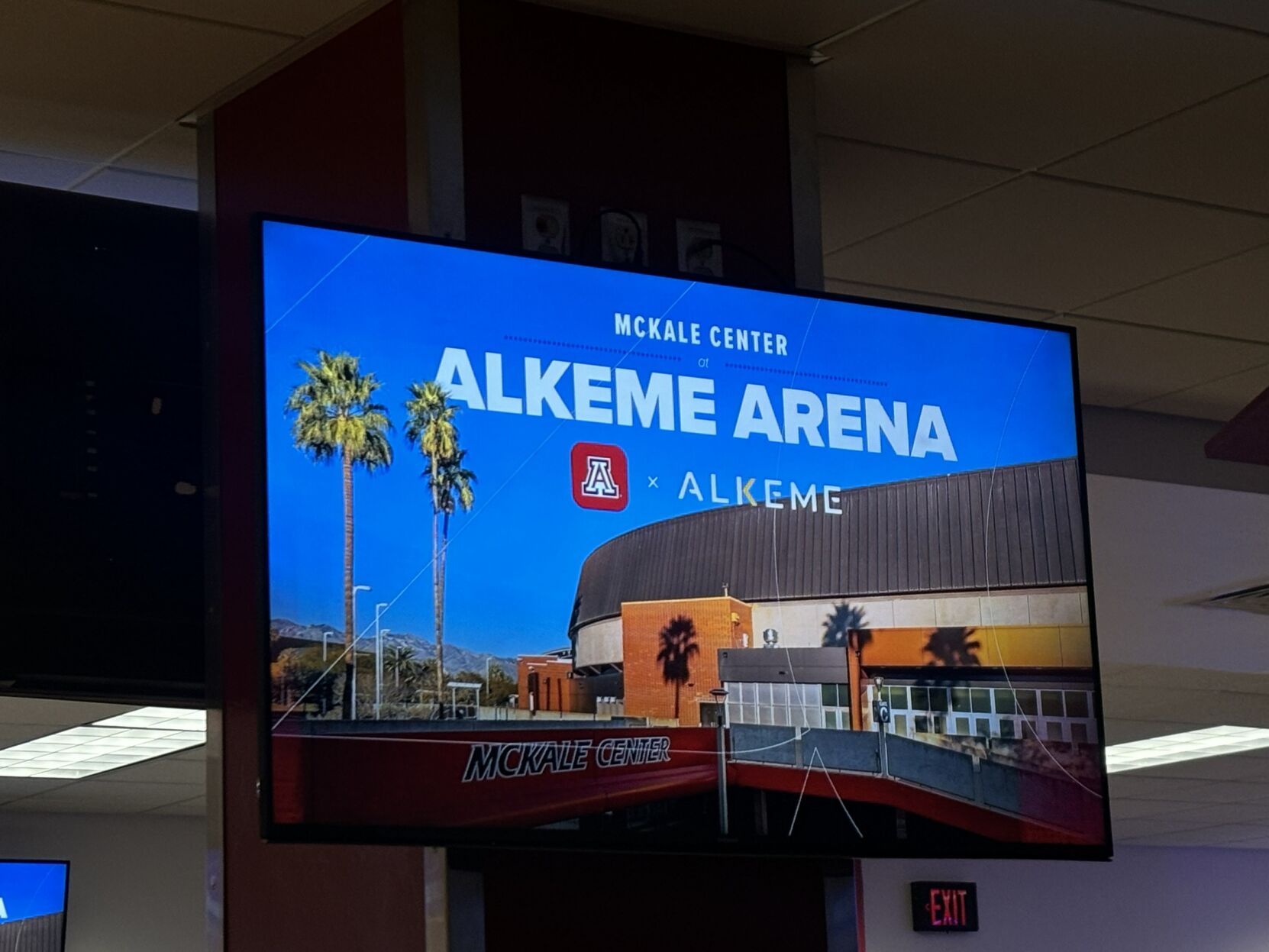
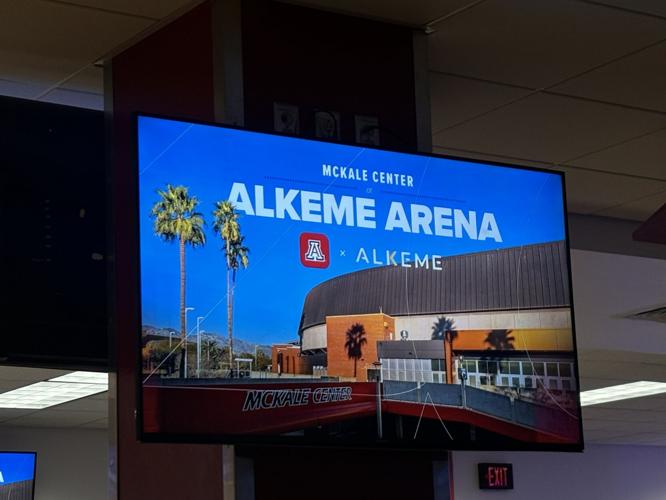
A screen at McKale Center displays the new partnership between the University of Arizona and Alkeme that will rebrand the campus' iconic athletic venue as McKale Center at Alkeme Arena, Feb. 13, 2026.
Sometimes, schools won’t even disclose the total revenue from sponsorship deals. Utah did not when it announced a deal with Alkeme to place the company's logo on its football helmet bumpers earlier this month, and Utah has not yet responded to the Star’s public records request for that contract.
Similarly, Ohio State and Kansas also did not disclose the expected revenue from football-jersey patch deals, which were routed through multimedia rights (MMR) partners of those schools, according to Front Office Sports.
Sam Ehrlich, a Boise State law professor who frequently writes about college sports law, said he felt “diverting deals though MMRs really does violate the spirit of public records laws,” though he added that differing laws and precedents make it difficult to tell if doing so actually violates the letter of the law.
“I would definitely be interested to see further litigation on this subject,” Ehrlich said in an email to the Star. “It would very much depend one the individual state law and the judge’s reading of it, but it does feel like an intentional subversion of public records laws, and the more it’s accepted, the more it’s going to happen.”
Messages to UA president Suresh Garimella and Arizona Board of Regents chair Doug Goodyear for comment on ASE's structure were not returned, though a spokesperson for the Regents issued a statement related to Regent policy 1-125, which says “component unit affiliates” are not public bodies.
“Universities commonly work with affiliated nonprofit organizations to support specific activities, such as fundraising, research, athletics, and other institutional priorities,” the Regents’ statement said. “The Board does not govern independent affiliate organizations, but provides oversight of the university's relationship with those entities through board policy.”
Grayson, the attorney who helped create the ASE structure, said public records or “Freedom of Information Act (FOIA)” laws vary from state to state but that he believes a nonprofit that does not take any funds from the state should not be subject to public records requests.
“FOIA is all about expenditure of funds and making sure you can track where money's going, that nobody's stealing it, that you're getting the value, the quid pro quo for that you paid for,” Grayson said. “It’s a watchdog to guard against fraud and abuse and waste, that kind of thing.
“If a nonprofit ever gets any support financially, any grant, any free ride, any free use of space, anything like that, then they are subject to FOIA forever. However, I believe the corollary is also true — that if they've paid for everything and they have been meticulous from day one, I don't think it's subject to FOIA.”
Basically, Grayson said, entities such as ASE are one-way deals: Designed only to make money, then give it to athletics and the athletes, all in a protected environment. He said the sophisticated sponsorship deals they create could be harmed if other schools gained competitively by learning of their structures.
So far, according to ASE general manager Brian Rooney, ASE booked $9.3 million in revenue during 2024-25, $10.5 million in 2025-26 and is projecting about $18 million in 2026-27 — when the Casino Del Sol and Alkeme deals will be fully kicked in.

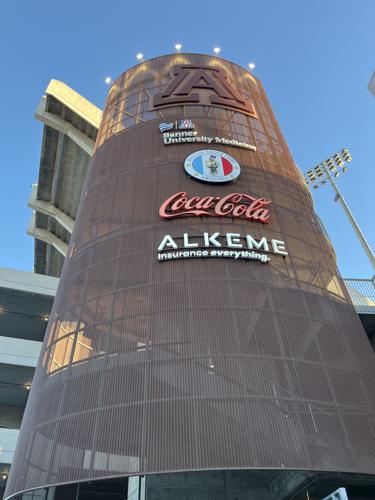
The logos of what UA calls its "pillar sponsors" are showcased on the outside of Casino Del Sol Stadium's northeast entrances.
That's more potential revenue than Arizona may have realized with a third-party sponsorship entity, even considering the expenses and risk it must shoulder. Typically, third-party providers pay schools a set amount for all sponsorship agreements while managing expenses and revenues of those deals themselves.
“There's a lot of disruption, a lot of change in the ad space surrounding collegiate sports now,” said Kyle Sherman, an ASE board member who once worked with Fox College Sports Properties. “It may not work for every university or every situation, but there's opportunities for universities to now look and say, ‘Why don't we take on the risk and then get the reward,’ especially with the extensions of name, image, and likeness and other aspects of the business that then you can now control yourself?”
Though Arizona athletes’ individual NIL contracts are also not subject to public records because of a 2025 state law, ASE additionally funnels NIL components via its underlying LLCs to athletes as part of overall sponsorship agreements — or as separate side deals.
Those help explain why schools such as Arizona are limited to paying only $21.6 million in revenue-sharing funds to players across all sports, and yet have combined revenue-share and NIL-backed payrolls for both football and men's basketball alone that are beyond that total.
Arizona’s men’s basketball roster budget was believed to be about $10 million last season while, according to The Athletic, UA’s football budget is between $12-18 million this season.

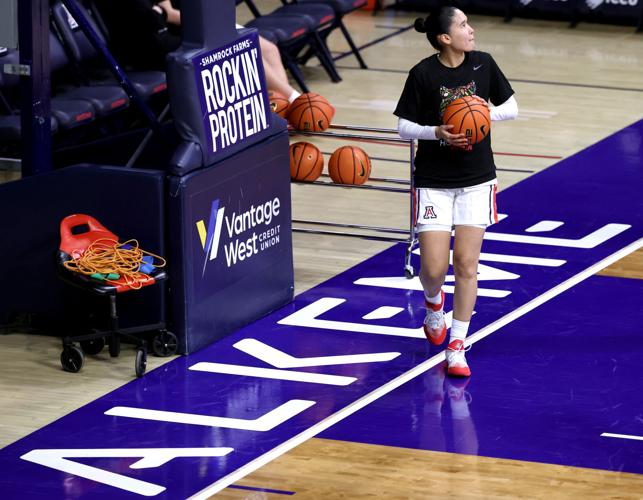
Arizona guard Mireia Jurado (8) heads onto the court over the new corporate sponsor logo, Alkeme, for the Wildcats’ game against Colorado, Feb. 17, 2026, in Tucson.
“ASE allows us to really aggressively pursue new revenue, and it unlocks the potential of our national brand and our strong local partnerships,” Reed-Francois said. “It also gives us the flexibility to create bespoke corporate opportunities that really advance what our partners' goals and benefits our student-athletes.
“NIL is one part of the broader platform that encompasses multimedia rights, sponsorships, naming rights, and events. And as college athletics evolves, ASE positions us to think more broadly as a sports and entertainment enterprise, allowing us to create new content, events, experiences that really extend beyond the game day.”
Reed-Francois serves along with Sherman, UA chief financial officer John Arnold and others on ASE’s Board of Directors, according to the 990 tax filing ASE filed for 2024, as posted on the ProPublica website. A veteran of pro sports sponsorships who last worked as the Arizona Cardinals director of corporate partnerships, Rooney was hired to become ASE’s general manager.
Together, UA officials say, ASE and its board members can move quickly and efficiently to secure deals and maximize their brand, as opposed to running it directly through the university and its athletic department.
For example, Grayson said, they can quickly add an NIL extension to a sponsorship deal if the opportunity arises.
“If I own a bank and I'm opening a new bank in Tucson, I may want a handful of basketball players to show up at my grand opening, or to be on my poster that's going to go in the arena,” Grayson said. “Now, because of this structure and because it's external from the university, ASE has the ability to go back to the student-athlete and say, ‘Hey, I’ve got a sponsor out here that's got this whole thing. Do you want to participate in it? If so, then let's kind of sign it all up, and we'll get the sponsor to approve it and engage.’
“That’s where I think an ASE is an extraordinarily brilliant and competitive advantage in the landscape because they followed all of the structure so carefully.”
Still, Libit says there’s also a benefit to sponsorship entities moving slower.
“The government is supposed to be a little bit less efficient because you want the guardrails of public awareness,” Libit said. “I mean, if efficiency was the lock, stock and trade of everything, and that's what you want, then get into the private sector, where there's more of that.
“Efficiency should not just rule the day. How many episodes at this point, especially in college sports, have we seen of people without proper oversight misbehaving with access to public money and public resources? I mean, it's a story as old as time.”
While the ASE Board is structured to provide oversight internally, NIL Go also does so externally, Grayson noted. All NIL deals over $600 must be run through the College Sports Commission’s NIL Go program within five days to determine if they are at fair market value.
ASE has “squeaky clean compliance, and yet they’ve got a mechanism to reduce the cost of the athletic department, increase the revenues, and even find a way to engage athletes into that university narrative under a unified brand that's a lot more adult-like and managed and professional,” Grayson said. “So I love it. To me, it's really a thoughtful way to approach chaos in this world of college athletics.
“I can't control the conferences, I can't control the NCAA, I can't control rulemaking. But what I can do is help universities better organize themselves, follow the rules compliantly, follow procurement accountability, and figure ways to engage athletes legally and in a compliant manner. To me, that's what competition's like now in the 21st century.”
Contact sports reporter Bruce Pascoe at bpascoe@tucson.com. On X(Twitter): @brucepascoe
Bruce Pascoe
Reporter