Ray Scott was in a dilemma.
The Arizona radio play-by-play broadcaster wanted to spend the holiday season with his family, but the Arizona football team accepted an invitation to the 1986 Aloha Bowl in Honolulu, which meant Scott was faced with the decision: spend six days, including Christmas, in Hawaii or stay home in Tucson.
“Ray said, in so many words, ‘I don’t want to spend six days and Christmas in Hawaii,’” recalled Brian Jeffries, who was a sideline reporter for the UA football broadcasts at the time.
Jeffries, an aspiring sports radio broadcaster from the Seattle area, raised his hand and opted to fill in for Scott.
Jeffries substituted for Scott, who was a longtime broadcaster for multiple colleges and the Green Bay Packers. Scott was the play-by-play broadcaster for the first two Super Bowls on CBS.
People are also reading…
“As you could imagine, my head was spinning,” Jeffries said. “Because it was going to be my first time doing a Division I college football game, those first five days, I don’t want to say I was in a panic, but I was nervous — extremely nervous. I didn’t get to vacation very much.
“I don’t even know if my toes touched the sand, because I was so concerned about trying to get it right. I haven’t listened to that tape in a long time. It’s probably not the greatest by any means. But it was my start. A month or so later, Ray announced he was going to retire and that gave me an opportunity to step in full time.”
Arizona beat North Carolina, 30-21, and won the Aloha Bowl, which was the Wildcats’ first-ever bowl win.
Since then, Jeffries has been the play-by-play radio voice of the Wildcats and is entering his 40th football season. Jeffries’ first full season was in 1987, which was head coach Dick Tomey’s first season.

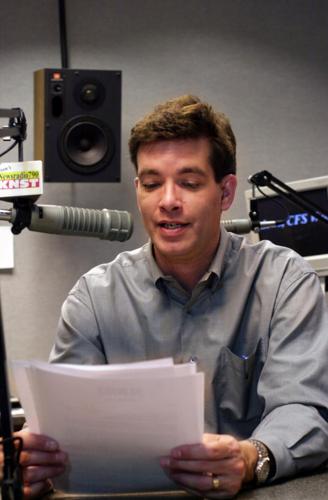
Brian Jeffries reads the sports news on his morning radio sports show on Thursday, March 29, 2001 that airs on KNST radio.
In the 451 UA football games Jeffries has broadcast in nearly four decades, the Wildcats are 231-229-4 — 95 of those wins are from Tomey. Including the Aloha Bowl in 1986, which was head coach Larry Smith’s last game, Jeffries was the play-by-play broadcaster for all 10 of Arizona’s bowl wins.
Leading up to his 40th football season as the voice of the Wildcats, Jeffries joined ESPN Tucson’s “Spears & Ali” to reflect on his career in Tucson.
Do you ever think about the butterfly effect of you opting to fill in for Scott and how that changed the trajectory of your career?
A: “It was never part of the plan, but it was my desire. That’s what I wanted to do, and that’s why I came to Tucson to work at the U of A, because I wanted to get there. I had been turned down for the job several times. I was doing the pregame and postgame show and moved into sideline reporting and did color analyst for basketball. The hope was that I wanted the play-by-play job.
“I got turned down a couple of times and I don’t want to say I was discouraged, but I said, ‘Boy, I gotta keep with it and be patient and persistent.’ And I was. … If that opportunity for the Aloha Bowl hadn’t come up, could that have changed things? You never know the direction our lives take, but that was one that certainly helped me. There’s a lot of people to be thankful for. It wasn’t just me, it was a lot of people who helped me in that direction and Ray was at the forefront of that.”
Those nerves you felt before your first broadcast, have you had that same feeling again?
A: “If you’re not nervous before you go on the air for every single game, you’re probably not going to have a very good broadcast. You have to have that edge. If you get overconfident and think, ‘Hey, I got this made and I’m fully prepared’ or ‘Whatever happens, I’m going to be able to handle it,’ I just don’t think you do a good job.

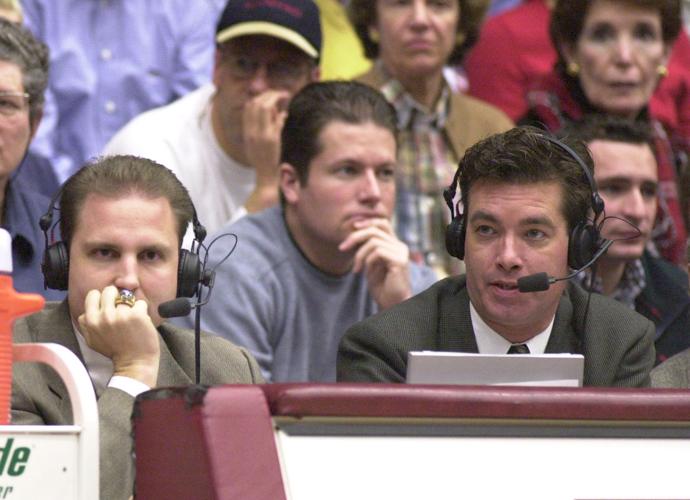
Ryan Hansen, left, coordinator of basketball operations for the UA, and Brian Jeffries commentate on the Arizona vs. Stanford basketball game in Palo Alto, Calif., Saturday, Feb. 2, 2002. Photo by Renee Sauer / Arizona Daily Star
“I’ll admit, there were some games over the years where I’m in a rush and don’t get done everything I need to get done. I pay for it and think I missed something during a broadcast. You can’t be perfect. There’s no such thing as a perfect broadcast. Everyone is going to make mistakes, but if you’re fully prepared, anything that comes along, you’re able to cover for it and handle those situations.
“I’ll be nervous on Saturday before the game. It’s the first game of the season, there’s a lot of new players — learning their numbers, names and positions. Learning NAU, thank goodness they’ve already played a game this season, so I had a chance to learn them. I’m going to have some butterflies on Saturday and if I didn’t, I’d be disappointed.”
What is the craziest sequence of games you had to broadcast?
A: “It was probably the two games in the same day. We’ve done that with the (2012) New Mexico Bowl in Albuquerue and then playing a basketball game at home that same night. That’s tough. … You go back to preparation. If you’re ready to go, even if you’re running on fumes at the time, you feel confident enough that you’ll do a good job. You want to make sure you get the basics right and if you walk away from it and feel like you were able to deliver the product, that’s what it’s all about.”
Is there one football broadcast that stands above the others?
A: “There’s too many to narrow it down to one. I think beating Washington when they were No. 1 (in 1992). That one is what I’ll always remember. When they beat Oklahoma, 6-3, at home (in 1989). People ask me, ‘Well, how can that be an exciting game?’ It was, because of the matchup and how the game unfolded.

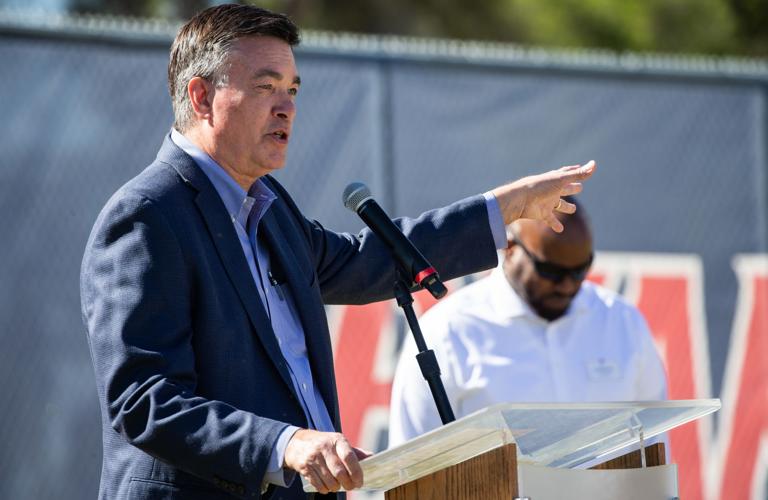
Arizona play-by-play broadcaster Brian Jeffries has been the voice of the Wildcats since 1987.
“There’s too many to narrow it down, because over all these years I’ve been blessed to see some great performances by the football team. You go back to 1998, arguably the greatest season in Arizona football history, the excitement of that year, those are the type of things I’ll always remember.”
What does it mean to be the play-by-play voice of the Wildcats for the last 40 seasons?
A: “I take it as a great responsibility, because there are so many people who can’t be at the game or see the game. They depend on the radio broadcast to be a Wildcat fan, and that’s something that means the most to me and something I take seriously, especially when I hear from people who might be sight-impaired or military members who are on the other side of the world.
“I’ve gotten notes over the years. I got one from a guy in Afghanistan who said he was hunkered down in a tent and listening on satellite radio. That’s what means the most to me, the people you touch who aren’t at the games or can’t be at the games or can’t see the games for any reason. That warms my heart that we have the ability to reach them. I think about that every time.
“The radio is their link to the Wildcats. When I talk to those people, it touches me. That means the most to me, those people in particular — all the fans do, but the people you reach that normally wouldn’t have that contact, that’s what I’ll always carry with me.”
Contact Justin Spears, the Star's Arizona football beat reporter, at jspears@tucson.com. On X(Twitter): @JustinESports

Justin Spears
Sports Reporter


 Arizona football: 10 post-camp observations — and bold predictions | Michael Lev