

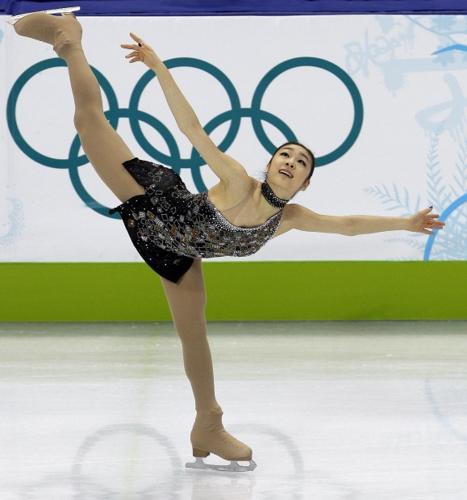
VANCOUVER - After nearly a year of breathless anticipation, the skating world finally got a chance to see whether its newest star, Kim Yu-na of South Korea, could withstand the pressure and perform at the level that had made her a heavy Olympic favorite.
"We don't guard them against the pressure at all," her coach, former Canadian silver medalist Brian Orser, said. "You have to face it head on. You certainly don't say this is not just another competition, because, you know that it isn't."
Kim handled the pressure in Tuesday night's short program, even when more pressure was added with an in-your-face skate by Japan's Mao Asada.
"My confidence is very good at these Olympics," Kim said.
As Kim took the ice with the crowd roaring for Asada's stunning performance, including a rock-solid triple-axel, double-toe loop combination, she went her Japanese rival one better.
People are also reading…
The two had just skated the two greatest short programs in Olympic history.
Kim, who countered with a triple lutz, triple-toe combination in her sassy program to a James Bond medley, rolled up a world record 78.50 points, breaking the mark of 76.28 she set earlier this year.
Asada, who had struggled all season, had 73.78, nearly 15 points better than her previous season best.
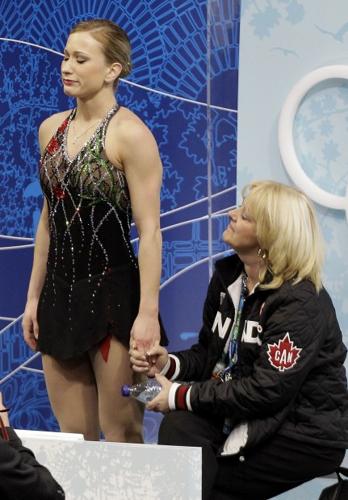
About a half-hour later, Canada's Joannie Rochette created a moment that few who witnessed it will ever forget.
Competing less than three days after her mother, Therese, 55, died of a heart attack early Sunday in Vancouver, Rochette skated as well as she ever has.
"I just applaud her for taking the ice," said U.S. skater Mirai Nagasu, 16, who finished sixth. "This is what the two of them worked so hard for. I think she will do her best because her mom will be with her."
Skating to music of a famous tango, Rochette managed to stay in character and hold her composure until finishing a program that put her third with 71.36 points. Then she bit her lip and began to cry.
Kim had a 3.2-point margin on the technical elements and 1.52 on components.
"Five points is not a lot," Asada insisted.
The free skate final is Thursday.
Asada's successful triple axel was only the second by a woman in Olympic skating history. Her countrywoman, Midori Ito, landed one while finishing second at the 1992 Olympics.
"I am very relieved," Asada said.
"I practiced my short program a lot and trusted myself to pull off the triple axel. I am feeling really good after that performance. I will try to stay calm and do my best in the free skating."
Despite a shaky landing on her triple lutz jump, U.S. champion Rachael Flatt delivered her expected solid performance - with a triple-triple combination. Flatt also got higher scores than expected and stood fifth, only .12 behind Miki Ando.
"Aside from the landing, it was a great program for me," Flatt said.
Nagasu of Arcadia, Calif., first of the high-rated competitors to take the ice in the Olympic short program Thursday, was planning to gamble on a tougher jump combination than she had done this season.
Nagasu, in her first Olympics, was in a perfect position to take the gamble, with no pressure on her.
But Nagasu decided to do triple-double after over-rotating the triple lutz. She wound up with a season-best score of 63.76 but was disappointed.
"In the Olympics, a medal is a big goal," she said. "From today's performance, I don't think I can reach the podium."
UP NEXT
• What: Figure skating, women's free program
• TV: 7 p.m. Thursday


