

Jay Bilas, fellow ESPN commentator Steve Lavin and recruiting analyst Jerry Meyer of Rivals.com compare the UA basketball team's challenges ahead to that of Indiana, where Tom Crean was lured away from Marquette last spring to rebuild a once-proud program devastated by a series of NCAA sanctions and other issues.
"You know going in it's a rebuilding process," says Scout.com analyst Dave Telep. "But the value in this job is always strong, and Russ Pennell's contribution has helped increase that. What happened at Arizona sends a great message that when you have fans and get players to band together, you can get it going."
The next five games, including tonight's outing at ASU, will help shape this season as well as the next. Here are four things that may be affected by how the Wildcats do over the final month:
1. Donations
People are also reading…
Men's basketball remains by far the most profitable aspect of the UA's athletic department, bringing in a net profit of about $12 million, according to public records filed for the 2007-08 fiscal year. Football is the only other profitable sport, netting $8.2 million for a department with $44 million of total expenses.
"It's critical," said John Perrin, the UA's senior associate athletic director. "Basketball and football are critical to the success of all our programs. We expect we'll do as well in basketball as we have every season."
But this is a tricky area in which to quantify short-term impact. Most of UA basketball's revenues are maxed out and/or locked in for the long term, including tickets, television deals and corporate sponsorships.
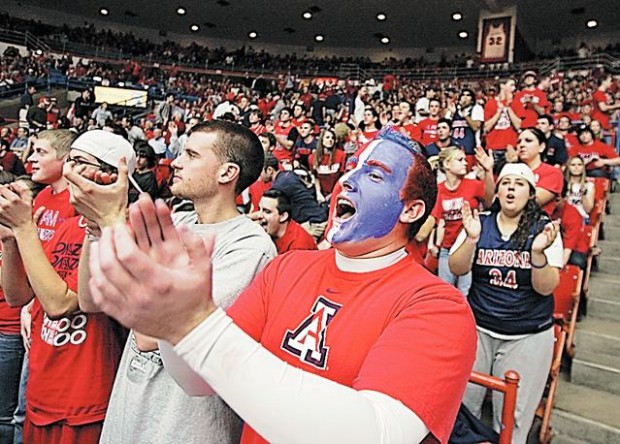
The Wildcats have managed to attract capacity crowds to McKale Center three times during the Pac-10 season. But ironically, a full house at McKale Center may not even make the athletic department more money than an under-capacity crowd — if the 2,300-student section is full of students instead of partially re-sold to the general public at higher prices.
Even a long NCAA tournament run only has a negligible impact — because the Pac-10 lumps all appearance fees from each team, divides by 10 teams, and issues a check (worth $1.2 million last year) to each school based on a rolling six-year average of those cumulative appearance fees.
Sponsorships, meanwhile, are no longer public information because the UA runs them through the separate IMG World entity, and, besides, local IMG general manager Brent Seebohm said about 80 percent of the UA's partnerships are multi-year deals that are immune to short-term impacts.
"On the corporate side, it has been and, we feel, will remain stable," Seebohm said. "A lot of it has become more sophisticated. It's a business decision, regardless of streaks or coaches."
That leaves fans, who have until May 1 to decide whether or not to renew their Wildcat Club memberships and premium seats. It is possible they could make an emotional decision now to renew, with the Wildcats riding high, or they may wait until the new coach is hired in late March or early April.
But having a wave of excitement from now until that new hire, rather than a forgettable season, can't hurt.
2. RECRUITING
A common adage in college basketball is that recruiting is like shaving — miss a day and you look bad.
The Wildcats have essentially missed two years.
All but one of Arizona's initial 2008 signees, reserve guard Brendon Lavender, bailed out over the turbulence from Lute Olson's season-long leave of absence and subsequent retirement. So did all three of the 2009 players who had orally committed.
Now, the Wildcats have only one questionable prospect lined up for the spring 2009 period. Even though Pennell said the UA's recruiting is still "null" because a new coach is not yet here to determine whom he wants, assistant coach Reggie Geary offered a scholarship to former junior college forward Tremayne Johnson for next fall.
Johnson came off the bench as a freshman for Los Angeles Southwest College last year, averaging about four points and two rebounds, and is not playing at all this season. So the offer caught Southwest coach Reggie Morris by surprise.
"This is a shock to me," Morris said. "I thought maybe a Division II school would take a chance on him."
But then again, Morris said, Johnson is athletic and might be able to develop into a four-year player. Besides, Rivals.com's Meyer said, there isn't much left in the class of 2009 for a new coach to quickly gather this spring.
"No, there's not," Meyer said. "A guy like Kyle Fogg pops up (in the spring) but as far as a difference-maker, no, they don't. It's going to be tough. It's pretty much a lost cause for Arizona recruiting."
The best-case scenario, Meyer said, is if a new coach can bring with him some committed players or signees (if they can get out of their letters-of-intent) from his old school, or at least get some transfers to become eligible for 2010-11. Then, even though roughly one-third of the Top 150 players from the class of 2010 are already committed, a UA coach would attempt to bring in talent from that class and begin making a run in 2011-12.
That's a long-term plan. But in the short-term, if the UA can keep in front of recruits this season, that can only make it easier for a new coach.
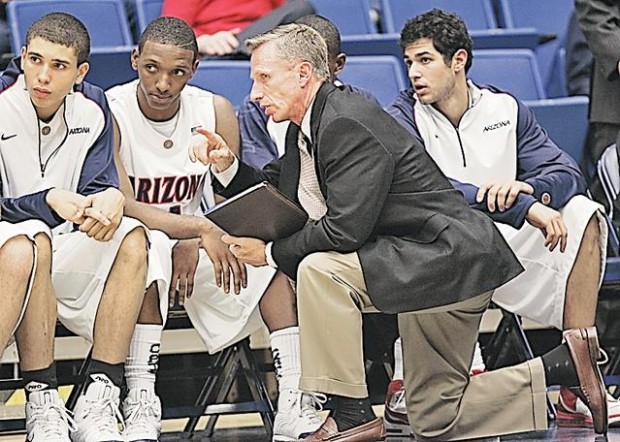
Pennell "is keeping the name alive by winning games," Scout.com's Telep said. "It's just not time now for recruiting at Arizona. But Russ Pennell is doing a service to the school."
3. RéSUMé building
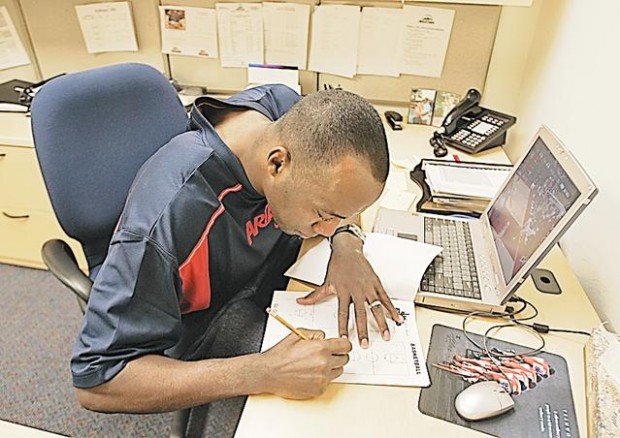
While Pennell and associate head coach Mike Dunlap have made it clear they expect to be elsewhere next season, Geary said he hopes to stay on the staff under a new regime if at all possible.
"Most definitely," said Geary, a standout Wildcat player in the 1990s. "That's why I will continue to recruit. I'm preparing for a transition and when the new person does come in, we'll have somebody on the current staff who has been thinking about this."
Lavin, who has known Dunlap for two decades, said he could see Dunlap taking a Division I head coaching job somewhere or returning to the NBA.
Either way, Pennell said, he'll be fine.
"There's no question Mike is outstanding in what he does and everyone in the basketball world knows that," Pennell said.
But whatever happens, the UA's current success could benefit Geary and Dunlap — and, of course, Pennell, a longtime Division I assistant who worked with a traveling-team program last season.
Even though Bilas suggested an interim coach is not often a good permanent solution, he said Pennell has elevated his profile considerably.
"There's no question it's helped him," Bilas said. "Everyone who follows college basketball now knows Russ. I knew him when I was teaching a skills camp in Phoenix ... . He had a beard, Birkenstocks and a flowered shirt. Now everybody knows him."
4. ATTRACTing a coach
The cynical view of evaluating a coaching vacancy is that you want to take over a program at its lowest point, where there's nowhere to go but up. So maybe some candidates might not want to see Pennell taking the Wildcats to the NCAA tournament when they might envision a struggle just to break .500 next season.
"I could see how someone could think that way," Rivals.com's Meyer said. "But most coaches have such strong beliefs in their abilities that that wouldn't scare them away."
Besides, Lavin said, a coaching candidate is going to view the program with an eye toward a six-year big picture.
"You look at programs regardless of what the current roster is and whether or not the previous season they had success," Lavin said. "You're looking at the larger key elements: the tradition, the conference affiliation, the recruiting base, the administration, and the admission standards."
Ultimately, Scout.com's Telep said, there are many ways to look at it. And having success now will probably help make the UA job appear more attractive to a prospective coach.
"The way that they're playing this year is a big benefit because it's sustained the value and brand of the program," Telep said. Next season, "everybody knows that there will be a lot of change going in and you brace yourself for it."


