

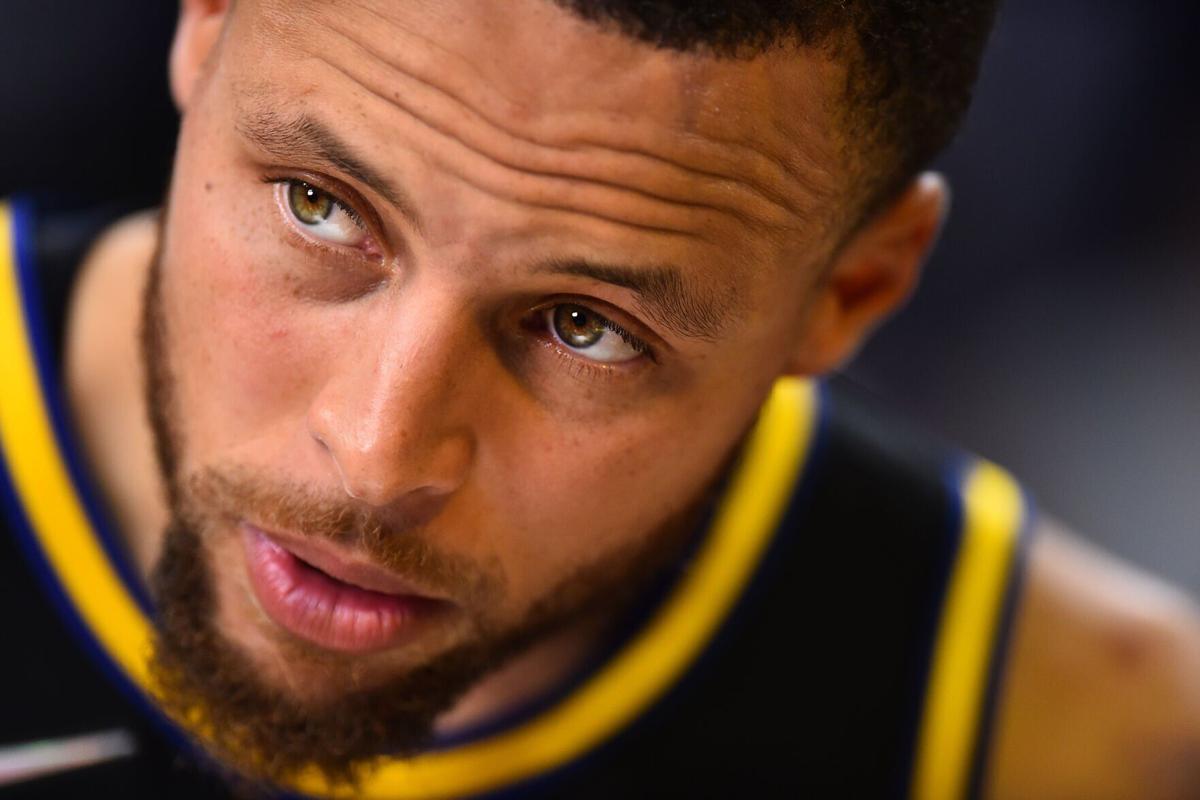
SAN FRANCISCO — Steph Curry has a mantle full of trophies earned through his Warriors career. He can add a college diploma to his collection.
Thirteen years after leaving Davidson College for the NBA, Curry will graduate with the class of 2022 with a bachelor’s degree in sociology.
Curry won’t be at his alma mater’s graduation ceremony this weekend to walk the stage and get his diploma — he has the Western Conference finals to prepare for — but the North Carolina college invited him to get his diploma in person when basketball duties are paused.
In a statement, Davidson said Curry re-enrolled this spring, needing to complete one semester to graduate. Curry, 34, did his classwork remotely with two members of the Davidson faculty working nearby Stanford University and University of California, Santa Cruz.
People are also reading…
The two-time MVP left Davidson and entered the NBA Draft in 2009, where the Warriors selected him seventh overall in the first round. Curry came to Golden State after a stunning March Madness run in his sophomore season in which he led the Wildcats under coach Bob McKillop to an Elite 8 appearance.
For his scoring second-half flurries that led to unlikely victories, Curry was named the Most Outstanding Player of the Midwest Region of the Tournament. His junior season, Curry averaged 28.3 points per game and was the NCAA scoring leader.
Curry hesitated to opt out of his senior year because he wanted to earn his degree. The NBA pulled him away, but a tenacious Curry finished what he started.


The 31 best MVP seasons in NBA history
Where does Stephen Curry’s historic campaign rank against his MVP-winning peers in the scope of NBA history? PointAfter finds out.

Golden State Warriors point guard Stephen Curry repeated as the NBA’s Most Valuable Player in 2016, becoming the first player ever to be voted MVP unanimously. But where did Curry’s historic campaign rank against his MVP-winning peers in the scope of NBA history?
Admittedly, that’s an incredibly difficult question to answer. Should eras be weighted differently? Should individual stats outweigh team wins, or vice versa?
In order to peg the best MVP seasons in league history, PointAfter, a sports data visualization site that’s part of the Graphiq network, aimed to include important parts of both individual and team successes. The former was measured by a player’s win shares per 48 minutes — which helped prevent penalizing players who played fewer minutes per game (we can't exactly dock Curry for sitting out a number of fourth quarters this season as the Dubs cruised to victory) or those who played during seasons shortened by lockouts. The latter was tied to team winning percentage. Since both figures are represented as decimals, we simply added win shares per 48 minutes and winning percentage to create a composite score for each player, then ranked the list accordingly.
This inherently puts a greater emphasis on winning as a team, but what's more important than that?
Additional Notes:
It’s worth noting that we only accounted for regular season exploits, because that’s all awards voters consider. MVPs who went on to win championships in that season were not given added points, just like players whose teams flamed out early in the playoffs were not penalized.
Additionally, respected advanced stats like player efficiency rating (PER) or box plus/minus (BPM) may be a preferred method of measuring individual prowess in the game today, but neither dates back far enough to provide much use. PER presents problems because today’s calculation includes three-point shooting, steals and blocks — all statistical categories that did not exist until the 1970s. Likewise, BPM does not exist before 1973-74, so it couldn’t provide added insights across eras.


