

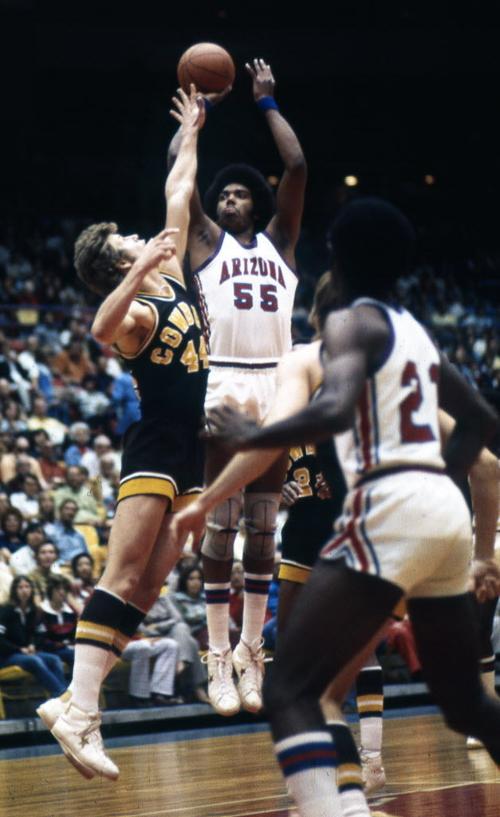
The year 1972 turned out to be an important one for the Arizona Wildcats.
It was the year the UA plucked Dave Strack from Michigan to be its athletic director, who proceeded to bring Fred Snowden — an assistant on Michigan’s coaching staff — to be Arizona’s new basketball coach.
This soon led to a commitment from center Bob Elliott, a prep star in Ann Arbor, Michigan.
That trifecta of new additions to the Wildcat family might have changed the course of UA basketball.
Elliott quickly established himself as a star — and one of Arizona’s all-time greats — and helped to put the UA basketball program on the map.
Eventually for Elliott, it led to an NBA career and one of the more interesting post-playing careers of any former Wildcat.
People are also reading…
Here’s a look back at his path to the NBA draft.
At Arizona: The 6-foot-10-inch Elliott, nicknamed “Big Bird,” had his pick of colleges coming out of high school.
“My father and I sat down and wrote a list of the criteria concerning a school’s past history both academically and athletically,” Elliott told a local paper, “and that eliminated a lot of schools right away.”
The list was eventually trimmed to two — Michigan and Arizona.
Elliott wanted something different, plus with a little convincing from Snowden, he became a Wildcat.
“I had lived in Ann Arbor all my life until I came to school, and to me it would have just been another transition of going through school if I had gone to Michigan, like junior high school to high school,” he said.
“I felt I needed, for my own personal maturity, to get out of Ann Arbor and see other parts of the country and meet other people.”
Elliott started as a freshman on a UA team that also featured six future NBA draft picks, including Eric Money, Coniel Norman and Al Fleming, Arizona’s all-time leading rebounder.
That year, Elliott averaged a double-double — 16.5 points, 10.5 rebounds per game — which is something that’s been done only five times since, including once more by Elliott. The team went 19-7, Arizona’s best mark in 24 years. In one game against Arizona State, Elliott tallied 38 points and 25 rebounds.
As a sophomore, with Money and Norman off to the NBA, Elliott began his ascent to stardom. He led Arizona with 23.3 points per game and 7.7 rebounds, guiding the Wildcats to a 22-7 record and a National Commissioners Invitational Tournament berth.
In his final two years, Elliott led the Wildcats to two NCAA tournaments and was an All-American. He finished his career as Arizona’s all-time leading scorer — he’s now second — and second-leading rebounder, and a three-time All-WAC selection.
A stellar career led to a near-certain selection in the 1977 NBA draft.
The draft: Elliott was viewed as one of the better prospects entering the draft.
In 2011, the Star compared Elliott to Arizona’s Derrick Williams, who was drafted that year No. 2 overall. Elliott could play anywhere from small forward to center, could beat players off the dribble and could shoot from all over the floor.
But, “being Big Bird had nothing to do with my leaping,” Elliott joked.
Regardless, an Associated Press article from 1977 listed Elliott as one of its top-30 prospects entering the draft.
Elliott fell to the second round before being selected at pick No. 42 by the Philadelphia 76ers. One pick later, the Sixers also selected Elliott’s Arizona teammate, guard Herman Harris.
“It’s the ultimate dream,” Elliot told the Star. “Back in the second grade, you say I’m Kareem, and you’re Walton. Now we have a chance to play in the big league.”
As a pro: Neither Elliott nor Harris would ever play a minute for the Sixers.
Harris, in fact, never played in the NBA, while Elliott spent the 1977-78 season in Italy after being cut by the Sixers before his rookie season. Elliott eventually signed with the New Jersey Nets.
Elliott played for the Nets for three seasons, and then one season with the Detroit Spirits of the Continental Basketball Assocation (CBA).
Elliott never quite became the NBA star that he was in college — his career averages were just 7.0 points and 3.6 rebounds per game — but he had a successful career in Tucson after his playing career ended.
He has been a broadcaster and a sports agent, and he now owns an accounting practice in the city.
He wrote a book, released in 2014, titled “Tucson: A Basketball Town” about the Fred Snowden era and the rise of popularity for the Wildcats in Tucson.


