Sean McDermott and Leslie Frazier were in agreement this week.
The Buffalo Bills’ head coach and defensive coordinator singled out the team’s four-man pass rush as an area that has not produced to the level needed thus far.
“One hundred percent. Yeah. Yes,” McDermott said when asked if he needed more from that group. “My answer is yes.”
The Bills enter Sunday’s game against the Carolina Panthers at Highmark Stadium ranked 28th in the NFL with 23 sacks. That is just one statistical measure of a defensive line’s performance, but it’s a number everyone in the organization recognizes needs to be better – especially considering 5.5 of those sacks have come from either a linebacker or member of the secondary.
In both dollars spent and draft capital used, the Bills have heavily invested in the defensive line. The return on that investment has not been satisfactory often enough through a 7-6 start.
People are also reading…
“We’re not hurrying or hitting the quarterback often with our four as we would like," Frazier said. "There have been some games on occasion where we’re really good at disrupting a quarterback with our four rushers, our four primary rushers, but not on a consistent basis, not as consistent as we would like. We’re still trying to get it to where it’s more consistent. We like being able to rush four. It helps our coverage, it helps everything we’re trying to do on defense. We just need to get a little bit more on a consistent basis than what we’ve been getting.”
Last week’s first half against the Tampa Bay Buccaneers was a good example. The Bills sacked Bucs quarterback Tom Brady just once, and hit him twice. On several other occasions, Brady had more than ample time in the pocket.

The Bills' special teams ace, who was recruited to Temple to play for Matt Rhule, now faces his former head coach on Sunday.
That forced Frazier to change his defensive game plan.
“In the second half, we brought a little more pressure,” Frazier said. “We didn’t feel like we were consistently making the quarterback speed up a little bit. So we had to bring a little bit more pressure in Matt Milano and some other blitzers. They ended up doing a good job of affecting him at times.”
While the second half against the Bucs was better defensively for the Bills, it’s not as simple as saying, “Just do that every week.”
As Frazier explains, “The problem it presents, depending on what type of pressure you’re bringing, it can leave your secondary in a lot of one on ones. You know, it’s more like risk/reward. So ideally, if you can rush four, I think every coordinator in the National Football League would say that would be the ideal way. But …if that’s not getting you the results you want, then you’ve got to find another way to do it. And that usually means bringing five or six. And the peril to that is, somebody’s in a one-on-one situation, and somebody has to win.”
According to advanced stats kept by Pro Football Reference, the Bills have blitzed 109 times this season, a total that ranks 24th in the NFL. By percentage of opposing quarterback dropbacks, the Bills blitz 23.5% of the time, which is 20th.
Not surprisingly, a lot of you have many grievances when it comes to NFL officiating.
What’s interesting is that the Bills have hurried the opposing quarterback 71 times, which ranks fourth in the league, and their hurry percentage of 14.7 actually leads the league, so the pass rush is getting close.
For defensive end Jerry Hughes, however, that’s not good enough.
“We honestly got to be better,” Hughes told The Buffalo News on Friday. “I live, and I'm pretty sure the rest of the guys in the D-line room will say this, too -- we live for sacks. We want to be able to tackle the quarterback and make it a physical and violent game for him -- make it a long day whenever they're playing the Buffalo Bills. We've got to be better in that area as far as getting to the quarterback, and then once we do that, either get him down or get the ball out of his hands. That's something we know we've got to be better at. We just haven't been good this year.”
According to Pro Football Reference, the Bills have 41 quarterback knockdowns, tied for 14th, and 132 total pressures, which combines sacks, knockdowns and hurries. That’s tied for eighth.
“I just look at our pressure rate,” defensive line coach Eric Washington said. “First of all, I look at whether or not we actually affected a play in a passing situation or on third down for the benefit of our defense. Are we getting off the field, and is that a function of what we're able to do in terms of forcing the quarterback to throw the ball out of bounds? … Are we winning our one on ones consistently? Is the completion percentage of the quarterback or the quarterback rating, again, a function of our prowess, what we're doing as a group and what we're able to do as individual rushers? Those are the things I look at in evaluating how we're working and whether or not we're headed in the right direction.”

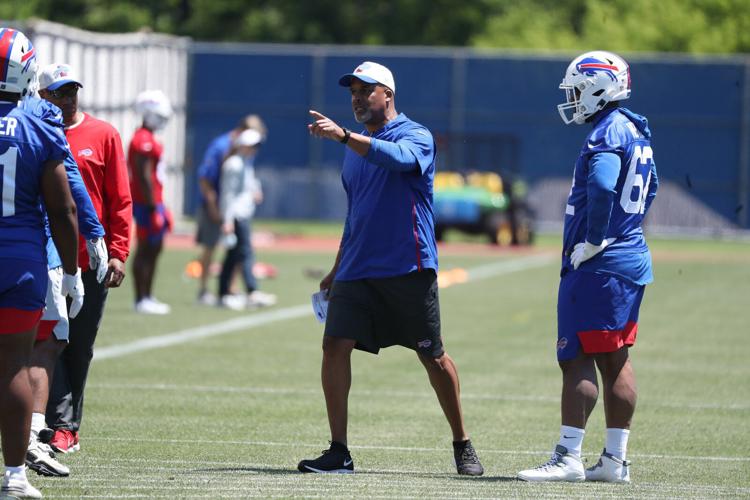
Bills defensive line coach Eric Washington directs his linemen at ADPRO Sports Training Center in Orchard Park in June 2021.
Opposing quarterbacks have a rating of 67.7 against the Bills this season, which is the lowest in the NFL.
“We understand that we've got to figure out ways to get to the quarterback, so we can cause some kind of disturbance in their passing rhythm so they're not just catching and throwing the ball,” Hughes said. “We're trying to take pressure off the secondary as well as just being an active member of the team, so we can help cause turnovers, create the short fields to help our offense score points. We understand those are the things we've got to do. It's just a matter of doing them on Sunday.”
There was an unmistakable sense of frustration in Hughes’ voice as he spoke Friday, which is understandable. The 33-year-old has just 1.5 sacks and six quarterback hits in the final year of his contract.
PlayAction is new to The Buffalo News' extensive NFL coverage. Each week, Mark Gaughan, who has covered the league throughout his 38 years at The News, distills X's and O's and strategy relating to how the Bills match up with their next opponent. All in about two minutes.
"Yeah, absolutely. Like I say, we want to help our team, and we understand that in doing so, we've got to make it a long day for the quarterback,” he said. “For us to have a successful game, that's what we've got to do as a front and we've just got to do it better and we've got to do it faster.”
It begs the question – why has that happened more often? It’s not for a lack of investment. According to contracts website spotrac.com, the Bills have $43.5 million invested in their defensive line this season. That’s the most in the NFL. General Manager Brandon Beane has used first- or second-round draft picks on Ed Oliver, A.J. Epenesa, Greg Rousseau and Boogie Basham. Additionally, Star Lotulelei and Mario Addison were big-money free-agent additions.
Addison leads the team in sacks with four, followed by Rousseau (3), Lotulelei (2), Basham (1.5), Hughes (1.5), Efe Obada (1.5), Justin Zimmer (1), Eli Ankou (1), Oliver (0.5) and Epenesa (0.5) among defensive linemen.
“I also want to keep some level of patience because quite a few of those players are young,” McDermott cautioned. “When you look at Greg Rousseau, who’s starting for us at left defensive end; you look at A.J. Epenesa as a second-year player; Boogie Basham a first-year player and Ed is still considered young overall in this league. So, there’s some youth there and yet at the same time, it’s such a critical part of a good defense, to be able to affect the quarterback with four - stop the run and affect the quarterback with four.
"We’ve got to continue to emphasize that. It’s been emphasized, I should say, but it’s got to show up, in particular more than it did this past week.”
A potential fix
A couple of key members of the defensive line pointed to one thing when asked what has led to such inconsistency.
“We've got to be a lot more unified as a rush unit,” Hughes said. “We've got to hunt together. That starts with us up front. If we're not hunting together, then we don't really help out our defense. It's just little things -- better hand placement, violent hands. We have to get there quicker, because we know how important it is to disrupt the quarterback, especially around this time of year.”
Defensive tackle Harrison Phillips echoed a similar sentiment.

Phillips was named the team’s nominee for the Walter Payton Man of the Year Award, which honors both service off the field and excellence on it, for the second year in a row.
“You have to work together to create a solid pass rush,” he said. “You’ll see countless times, a guy will win clean but if another guy is in his rush lane or in his quadrant of the rush, guys can escape or at least step up and get the ball out quick. That’s definitely an area we want to improve upon. We’ve had the same mindset all year. I think we’re just gonna continue to work our system and our games, and have whoever is out there gel together really well and have good rush redundancy and rush overlap.”
Washington is the one in charge of getting the Bills on the same page when it comes to the rush.
“I absolutely love the effort that we get from our guys. You've got to look at this season in totality,” he said. “I look at all of the circumstances that we've been faced with, and some of the decisions that are made offensively because of the threat of our rush and some of the things that we're able to do. ... I love what we've been able to do.
"When you look at the game the other night, we had a lot of passing attempts from the quarterback and we didn't have as many hits as we would like to have. That's one circumstance. When I look at the balance of the season and some of the opportunities that we've gotten and what we've done with those opportunities, I feel pretty good about that.”
The Bills have the No. 3 third-down defense in the NFL, allowing conversions 33.7% of the time. On third-and-long situations, defined as 7 yards or more, the Bills lead the league in allowing conversions just 14.8% (12 of 81) of the time.
“Certainly I'm not going to let one game color or create the false perception that the guys up front have not, first of all, given maximum effort, or they haven't affected the game as one-on-one pass rushers or as a group of rushers on third down or in obvious passing situations,” Washington said. “We want more from everything. We want more consistency in every aspect of our defense. Point of attack, run defense, etc. The guys are focused on that. They're aware of that, and they're working as hard as ever to continue to improve that as we move forward.”
Stopping the run, too
Peaks and valleys are to expected in any season. Right now, when it comes to rushing the passer, the Bills are in one of those valleys. The team has just four sacks and 12 quarterback hits over the last four games -- a stretch in which the Bills have gone 1-3.
“One of the things we don't control is an offense throwing a screen pass or offenses that are choosing to utilize six or seven guys in protection and chip us. Those aren't excuses. Those are factors,” Washington said. “So we've had some outstanding circumstances and I think we've got some circumstances just like you have with any aspect of your football team that we want to continue to grow and develop the individual people who are part of that and then obviously how we're able to meld that into a formidable group that we can really depend on in obvious passing situations.”
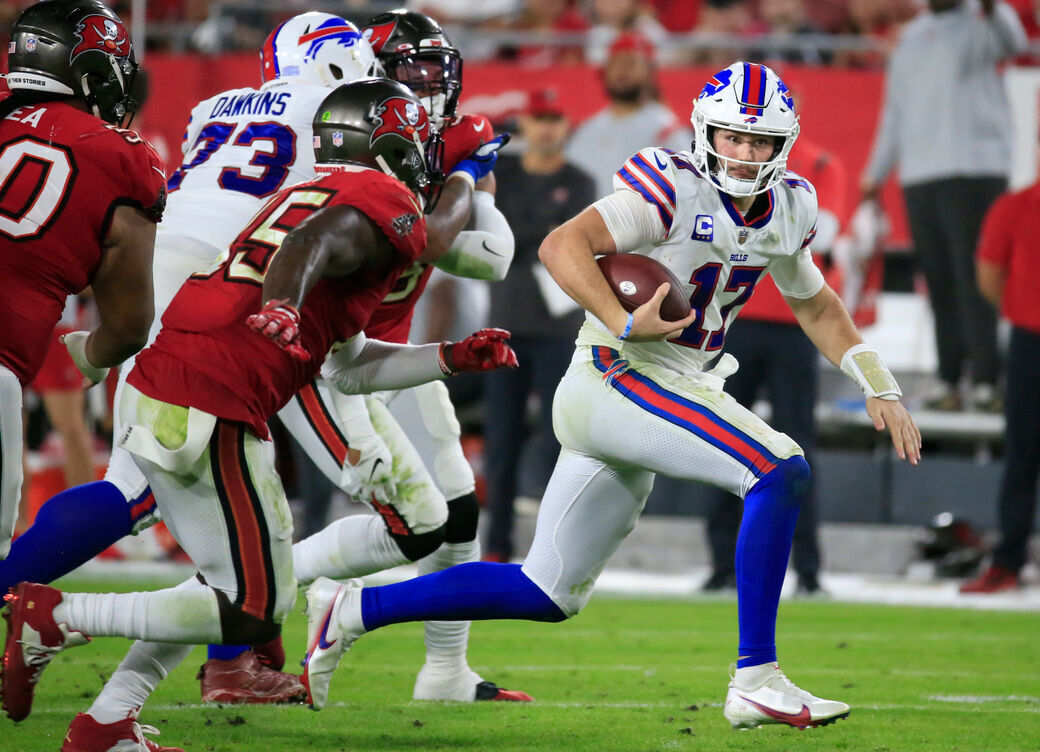
The question of how much Allen will be able to do on the ground despite a sprained foot looms over this game.
Of course, the pass rush is just one part of the defensive line’s job. The big guys up front are also responsible for setting the tone in run defense. Again, that’s an area the Bills have had a good deal of success, ranking tied for 12th in the league in yards allowed per game.
Washington pointed to the fourth-and-1 tackle for loss made by Addison against the New Orleans Saints of an example of things going exactly according to plan. Oliver burst through the line of scrimmages as the three-technique defensive tackle, while Addison set the edge and finished off the play.
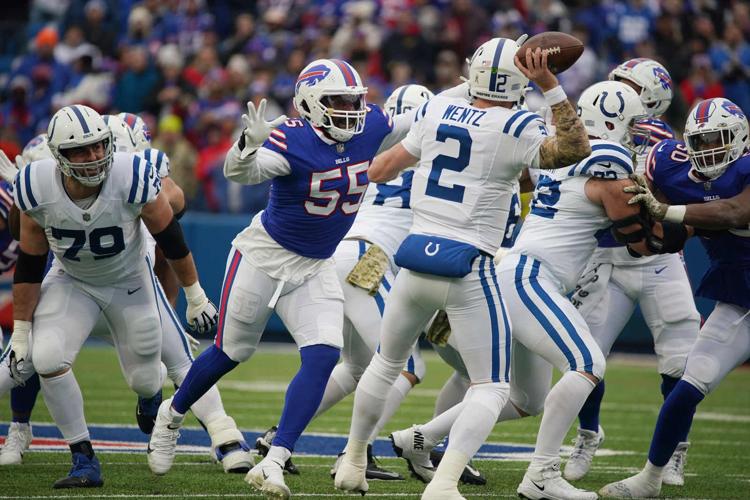
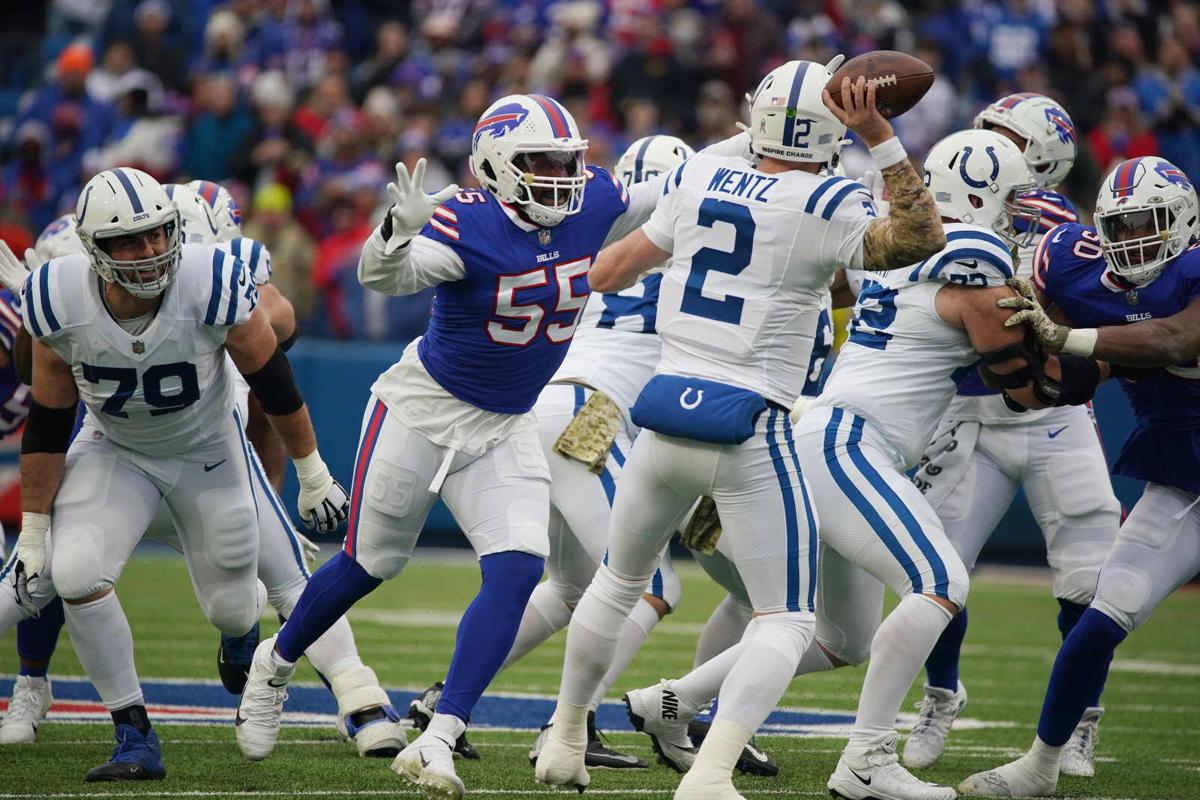
However, the team’s breakdowns in run defense have been impossible to ignore, notably Jonathan Taylor's 185 yards and four rushing touchdowns for the Indianapolis Colts and the New England Patriots' 222 yards on 46 carries in a game in which they attempted only three passes.
The Bills' 42 runs of 10 or more yards allowed represent 13% of the opposition's total running plays, according to Sharp Football. The percentage ranks seventh worst in the league.
“We were able to effectively take that away in that situation (against New Orleans). You have that piece, and then you have the explosive runs that obviously we're trying to eliminate as an entire defense,” Washington said.
“I can't say enough about what we've done in terms of penetrating and setting edges and creating negative plays in the run game. We just have to make sure that we stay out of wrong types of extremes. We can't be extremely good, and then turn around and be extremely in the other way. We're working to address that. That's been minimal in terms of when that’s happened, but it's been highly visible.”