PHOENIX — Sasha Seymore was a walk-on basketball player at North Carolina in 2014, tasked with something almost every college athlete has experienced.
The coaching staff handed Seymore a giant three-ring notebook and told him to study and memorize everything in it. He took the daunting playbook back to his dorm room, and that’s when Andrew Powell, UNC’s student body president who also happened to be Seymore’s roommate, began to question the tedious learning methods with which Seymore was forced to comply.
What started as a college athlete struggling to study a playbook in a University of North Carolina dorm room has turned into a Series A company that has raised about $34 million in Silicon Valley venture capital.
Ethos Systems, an artificial intelligence-powered “human readiness platform,” aims to change how people learn and perform in high-pressure environments — whether on the field or in combat.
People are also reading…
“We aim to be the best possible tech platform to help prepare people for the knowledge they need in the moment they need it,” Seymore said.
Since the company’s official launch in 2019, it has acquired partnerships ranging from the University of Michigan athletic department to the NFL’s Seattle Seahawks and the US armed forces.

Michigan guard Roddy Gayle Jr. (11) gestures to a teammate after slotting home a three from the corner against Arizona men's basketball in the first half of their Final Four game in Indianapolis, Ind., April 4, 2026.
Its latest partnership is taking shape in Tempe with Arizona State University.
From dorm room idea to growing company
Seymore vividly remembers that dorm-room brainstorming session with Powell 12 years ago.
Instead of relying on static materials, Seymore and Powell started experimenting with more interactive, technology-driven methods. The goal was simple: make learning faster, more effective and easier to apply under pressure.
The initial thought was a program similar to that of Duolingo, an interactive language learning app that personalizes the program to the student’s needs. The two Tar Heels springboarded off this idea and began using UNC basketball and football as their guinea pigs.
From there, Learn to Win, the precursor to Ethos — was launched.
That early work expanded quickly.
Changing how athletes prepare and perform
Ethos’ earliest success came in sports, where the platform was built to solve a familiar problem: how athletes learn and retain complex playbooks.
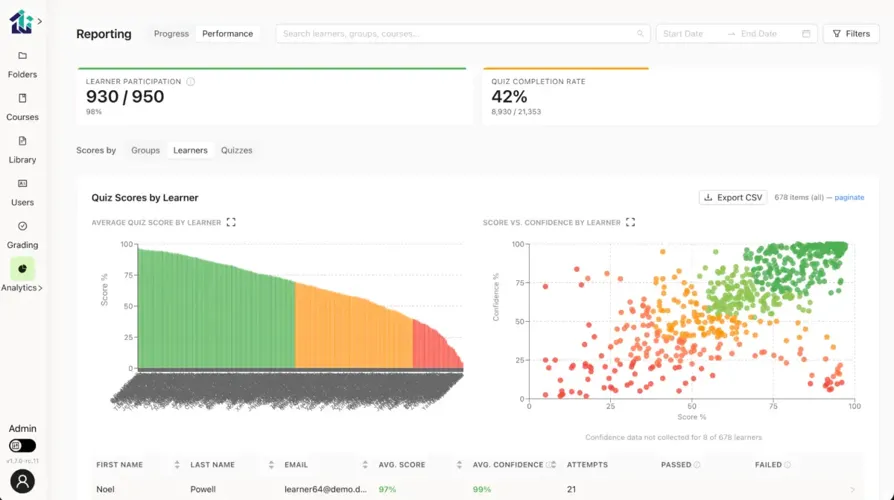
Instead of relying on binders or hours of film study, teams upload their playbooks into Ethos Systems, where artificial intelligence breaks the material into interactive learning modules. The system then maps out everything a player needs to know for their specific role, creating a structured framework that tracks how well each concept is understood.
“What if every player had the best study practices and the best film analysis?” Powell told The Athletic in a 2020 article. “You might have an elite player like Peyton Manning or Kobe Bryant, but what if every player at every level could study and learn the game like that?”
From there, coaches gain real-time insight into their team’s readiness.
If a player struggles with a specific assignment or concept, the platform flags it immediately. Rather than waiting until a mistake shows up in a game, coaches can address gaps during the week and adjust practices accordingly.
“It can map and measure your team on where their knowledge currently sits and then really quickly help fill those gaps,” Seymore said.

Ethos offers in-depth statistics on a human’s abilities within specific areas and helps fill gaps where needed.
The platform also changes how teams approach weekly preparation. Instead of spending hours reviewing film, coaches can focus on specific tendencies and situations players need to master before game day, making preparation more targeted and efficient.
That approach has attracted high-level programs, including the Seahawks, the Los Angeles Rams and Michigan football, all programs that have been crowned champions in recent years.
Coincidence? Seymore thinks not.
From the field to the front lines
As the platform continued to grow, its impact extended beyond sports.
“What we realized was we weren’t just solving an athletic problem,” Seymore said. “We were solving a human learning problem.”
That realization became more concrete when Seymore received a direct commission to do intelligence work for the U.S. Navy, where he saw firsthand how similar the challenges were.
“There were lots of other places we could take this similar thought process, similar methodology, similar idea for how you train someone to perform in the moment that they need it, especially in high-stakes situations,” he said.
Around the same time, Seymore and his team brought the platform into a Stanford course that partners with the Department of Defense to solve real-world military problems. Using their existing system, they adapted the technology to support Air Force pilot training, applying the same principles used in athletics to a completely different environment.
The result was immediate interest. Shortly after the project, Ethos secured its first contract with the Air Force, marking the company’s formal entry into the defense sector.
The transition, Seymore said, was more seamless than expected.
“It was actually a remarkably easy transition because of how similar the two communities are,” he said.
Like athletes, military personnel must absorb large amounts of information, make split-second decisions and perform under pressure. Ethos’ platform, originally built to improve playbook comprehension and on-field execution, proved equally effective in preparing service members for mission-critical tasks.
Today, the platform is used across multiple branches of the military, including the Air Force, Navy and Army.
An Arizona partnership takes place
Known for its focus on innovation, ASU has increasingly positioned itself at the center of efforts to modernize how large organizations train and educate.
That reputation has extended into the military. The university recently partnered with the U.S. Army to help redesign how soldiers learn, using digital platforms, immersive tools and data-driven insights.
“ASU has demonstrated proficiency in redesigning itself as an efficient, tech-enabled and adaptable leader in learning and innovation,” ASU President Michael Crow told ASU News. “We are proud of the opportunity to partner with the U.S. Army and excited to share our valuable lessons, expertise and tools to help inspire and prepare our nation’s military forces in an increasingly complex world.”
The effort reflects a broader push to rethink how service members are trained in a rapidly evolving technological landscape.
“There is a need to take soldiers and ensure they’re getting the best, most cutting-edge learning that they can to be effective,” said Chris Howard, Air Force veteran and ASU executive vice president and chief operating officer. “We want to help every single soldier to be a master learner, a lifelong learner.”
For companies like Ethos, the partnership presents a natural opportunity for collaboration.
“ASU is one of the more modern and forward-thinking, tech-leading universities that I’ve seen,” Seymore said.
ASU’s relationship with Ethos started in January 2026 after an initial meeting and demonstration, then deepened around a shared interest in the Army’s learning transformation.
Ethos had already been working closely with the Army using its AI-driven training platform, while ASU is simultaneously helping modernize military education systems. Now, the two are exploring how their efforts can align, combining Ethos’ real-time, personalized learning tools with ASU’s large-scale curriculum and training initiatives.
“Ethos's journey from sports performance to military readiness isn't a pivot. It's the same core insight applied in a higher-stakes domain,” Ethos Vice President of US Army & SOCOM Programs Brett Funck said. “Knowing what someone scored is far less valuable than knowing where, why and how proficiency gaps connect. ASU's role as a partner in the Army's learning transformation creates a natural bridge between those worlds."
The collaboration is already taking shape. Ethos is expected to participate in an upcoming ASU-led workshop this summer focused on drone technology, a rapidly evolving area of military training.
As the Army and institutions such as ASU work to close the gap between growing technology and traditional training models, Ethos is designed to do exactly that: deliver more adaptive, real-time learning in high-stakes environments.