GREENVILLE, S.C. — Illinois' Brad Underwood knows all about the traps awaiting a favored team in March Madness. He remembers springing two himself as a double-digit seed while coaching Stephen F. Austin.
"It's what we talk about all year," Underwood said before the third-seeded Illini faced 14th-seeded Penn in the first round of the NCAA Tournament. "It's not just getting in the tournament, but the margins are very small. Every team here is great."

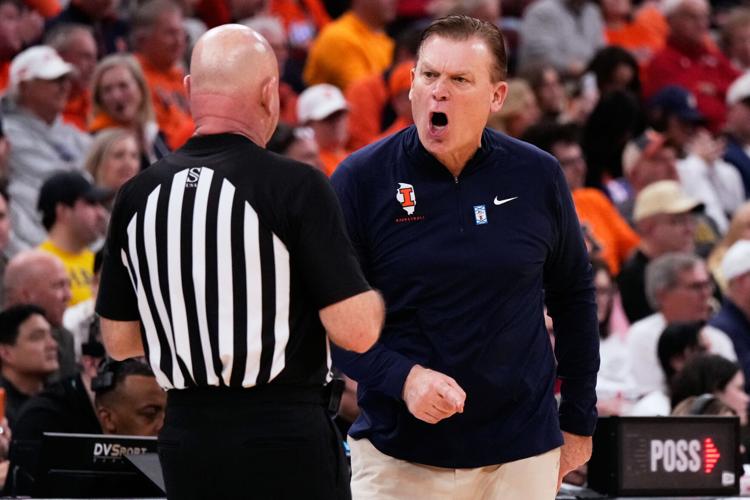
Illinois head coach Brad Underwood, right, reacts to a call during a game against Wisconsin in the quarterfinals of the Big 10 Conference tournament on March 13 in Chicago.
Lower-seeded teams have long filled March with shocking upsets to earn the almost honorary title of Cinderella. And years of tournament reels have proven anything can happen, particularly with top teams often leaning on younger high-end NBA prospects against older and more experienced teams.
But this year, fans looking to identify the most likely upsets won't have an easy time picking them in the first round of the NCAA bracket, not with big point spreads for the first-round favorites Thursday and Friday.
People are also reading…
And that comes after a chalky year in which all four No. 1 seeds reached the Final Four for just the second time since seeding began in 1979.
Big gaps
For example, two of the No. 5 region seeds — Wisconsin in the West, Vanderbilt in the South — were favored by at least 10 1/2 points on BetMGM Sportsbook as of early Thursday, coming in the 5-versus-12 matchups considered prime territory for first-round upsets.
Region 4-seeds Nebraska (versus Troy), Kansas (Cal Baptist) and Arkansas (Hawaii) were all picked by at least 13 1/2.
Midwest No. 6 seed Tennessee was set as an 11 1/2-point favorite on Miami (Ohio) after the RedHawks' First Four win against SMU on Wednesday.
And that's before getting to the massive spreads for No. 1 seeds like reigning national champion Florida (35 1/2 against Prairie View A&M) and Michigan (30 1/2 against Howard), or 2-seeds like Purdue (25 1/2 against Queens) and Iowa State (24 1/2 against Tennessee Tech).

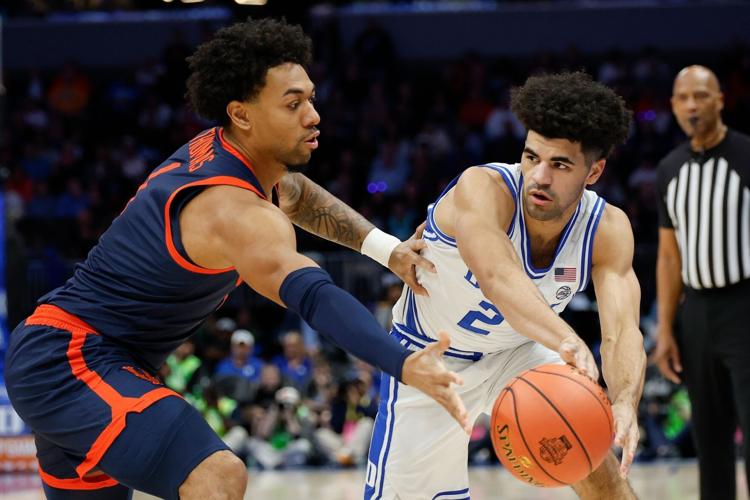
Duke guard Cayden Boozer, right, passes the ball around Virginia guard Malik Thomas, left, during a game in the championship of the Atlantic Coast Conference tournament in Charlotte, N.C., on March 14.
For those top teams, the mission is to handle these games as efficiently as they have just about everything else all year.
"Every team is good here, so we are not thinking about the favorites to win the game," big man Aday Mara said from top-seeded Michigan. "We are just thinking about if you lose the game, you go home."
Getting ready
The 2025 tournament that saw Florida, Houston, Auburn and Duke reach the Final Four joined the 2008 finale as the only years with every 1-seed reaching the season's final weekend.
Yet only two years earlier, UConn won its first of two straight national titles in an unusual Final Four that was part of what had been a more volatile first four tournaments since the COVID-19 pandemic. In 2023, no 1-, 2- or 3-seed in the national semifinals for the first time since the tournament expanded to 64 teams in 1985
Player movement through the transfer portal had seemingly scattered experienced talent across the country to create the potential for more of those March moments. Yet the arrival of the revenue-sharing era allowing schools to pay athletes directly beyond what they could earn for use of their name, image and likeness (NIL). And that's driving more talent to top programs that can pay for it, whether in poaching the mid-major ranks or snagging a player from a peer league.

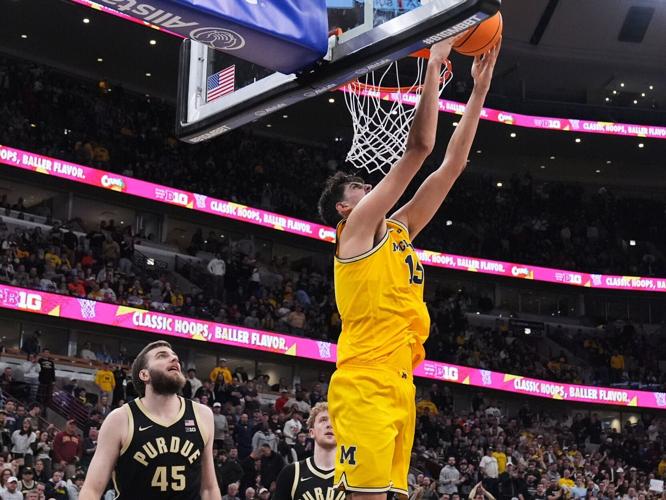
Michigan center Aday Mara, right, does a reverse dunk as Purdue center Oscar Cluff looks on during a game in the championship of the Big 10 Conference tournament on Sunday in Chicago.
Where does that leave the upstarts?
"So much of this is a mindset and a look and an approach, the rest follows suit," Hawaii coach Eran Ganot said. "If you don't have that mindset, you're cooked. It's with great humility and great respect.
"Whatever name popped up, we were going to play a championship-caliber program that's won a lot of games. We don't try to outsmart ourselves. We don't scoreboard watch, who do we want to play, who we don't want to play. It's a bring-it-on mentality, understanding it's going to be difficult. That's kind of been our deal all year."
Upset triggers?
Still, there are variables that can create opportunities for surprises.
Injuries have already played a big role in limiting the upside of some teams, such as South 6-seed North Carolina having lost Associated Press second-team All-American Caleb Wilson to a late-season thumb injury. Or West 6-seed BYU losing No. 3 scorer Richie Saunders to a season-ending knee injury in February, increase the load on star freshman and AP first-team all-American AJ Dybantsa.
And there are other variables, such as Midwest 4-seed Alabama seeing No. 2 scorer Aden Holloway being indefinitely suspended after his Monday arrest on a felony drug charge.
Or there's simply the challenge for favorites like No. 1 overall tournament seed Duke and fellow 1-seed Arizona playing in the sport's brightest spotlight while leaning on young talent.
The oddsmakers like their chances.
But March Madness has earned that moniker for a reason, too.
"I think the biggest thing is just understanding that these games have a higher stake," Blue Devils freshman point guard Cayden Boozer said.
"If we don't show up the right way, we're going to lose, we're going to go home and we're not going to achieve what we want to do."
Iconic moments in sports that defined the '60s
Iconic moments in sports that defined the '60s

The 1960s were one of the most tumultuous decades in American history. The Vietnam War became a polarizing issue as many citizens watched brothers, neighbors, and boyfriends drafted into the military. The counterculture that sprung up created new attitudes toward physical and emotional expression, defining the 1960s as a period of independence. All of this took place alongside events such as Neil Armstrong walking on the moon, the assassinations of President John F. Kennedy and Dr. Martin Luther King Jr., as well as the Stonewall riots.
In the realm of sports, several events paralleled the momentous events occurring around the world. Athletes like sprinter Wilma Rudolph inspired fights for gender equality with her record-breaking Olympic performances in 1960, while Muhammad Ali became a voice for both the conscientious objector and African-Americans still facing inequality in their daily lives. Other athletes like Joe Namath represented the more carefree spirit that many began to embody in the 1960s, and his brash demeanor changed the face of professional football. Outside of the U.S., Japan reintroduced itself to the world as a growing economic force. In 1964, Tokyo hosted the Summer Olympics, less than 20 years after World War II wrought devastation on the island nation.
Stacker looks back at 30 iconic moments in sports that defined the 1960s. These include college basketball dynasties from the state of California, historic home runs that set records and won the World Series, and ingenious high jumpers who changed the way track-and-field sports were performed. These athletes rocked and delighted crowds just as much as the acts at Woodstock.
You may also like: Best movies of the 60s

Wilma Rudolph’s historic Olympic run

At the 1960 Summer Olympics in Rome, Italy, Wilma Rudolph won three golds and set three world records. Rudolph’s winning performances in the 100 meters, 200 meters, and 4x100-meter relay made her the first American woman to capture three events in a single Olympiad. Early in her childhood, Rudolph overcame polio and became a college track star at Tennessee State University.
Cassius Clay introduces himself to the world
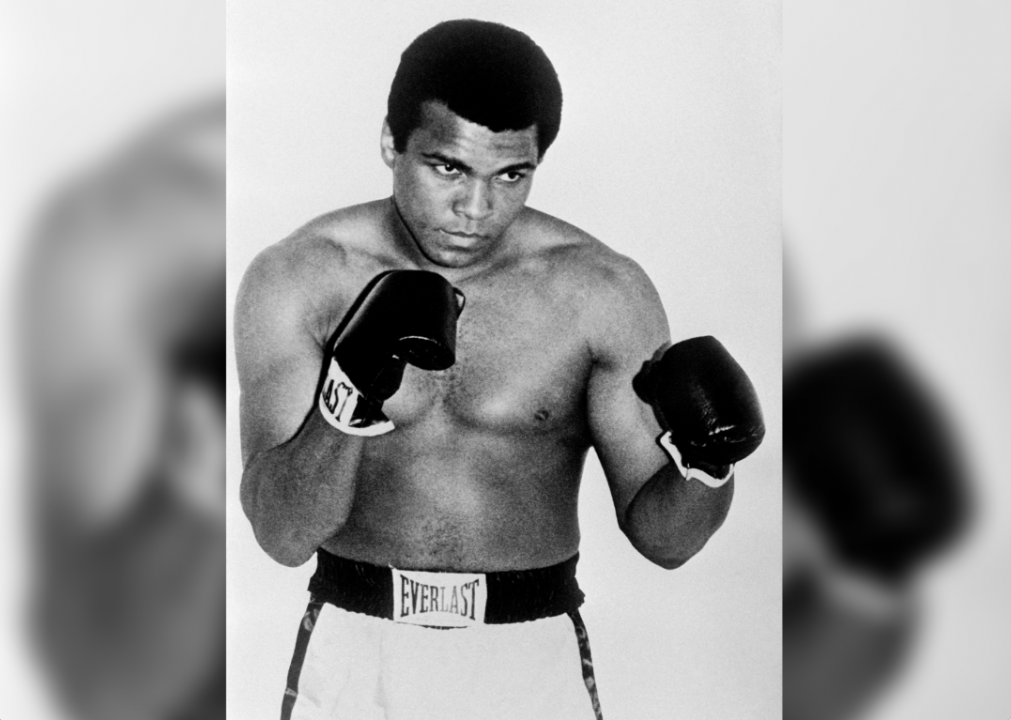
Cassius Clay captured gold in the light heavyweight division at the 1960 Rome Games, and with the likes of Wilma Rudolph, emerged as a rising star in American sports. The 18-year-old Clay was afraid to fly to Italy but had no fear inside the ring, easily outpointing Poland’s Zbigniew Pietrzykowski in the final. Clay’s fighting style won over locals and 36 years later, Clay, now known as Muhammad Ali, again provided a memorable Olympic moment when he lit the cauldron at the 1996 Summer Games in Atlanta.
Bill Mazeroski walks it off

The final two innings of Game 7 of the 1960 World Series were among the most tense in baseball history. After blowing a 4-0 lead, the Pittsburgh Pirates trailed 7-4 entering the bottom of the eighth. They scored five runs, only to watch the New York Yankees tie the game in the top of the ninth. That allowed Bill Mazeroski to step in to face Ralph Terry in the bottom of the ninth, and the Pirates second baseman became the first and only player to hit a walk-off home run in a Game 7 of the World Series, sending the ball over the left-field wall at Pittsburgh’s Forbes Field.
61 in ‘61

Few things stir up baseball fans like a good home run chase, and in 1961 the predominant sports question throughout the summer was whether someone could finally top Babe Ruth’s single-season home run record of 60. On Oct. 1, Yankees slugger Roger Maris finally topped the Great Bambino, hitting his 61st homer off Boston Red Sox pitcher Tracy Stallard. Maris was actually criticized by some hometown fans at first, given Ruth’s reverence in the Bronx, but over the 37 years the record stood, it grew in esteem.
The Big O’s rare feat

After Oscar Robertson won the National Basketball Association’s Rookie of the Year award in 1961, his encore proved even more impressive. During the 1961–62 season, Robertson became the first player to average a triple-double (10 or more points, rebounds, and assists per game). Later in life, Robertson won a Most Valuable Player award, an NBA title, was elected to the Hall of Fame, and inspired a generation of multi-talented guards like Magic Johnson, Jason Kidd, and Russell Westbrook—players whose all-around skill sets have revolutionized pro basketball.
Meet the Mets

The New York Mets were born in 1962. In their first season, the Mets drew large crowds but played awful baseball, posting a 40-120 record—the most losses by a major league team in the modern era. The 1962 Mets have since become a reference point for sports futility.
To play or not to play?

When U.S. President John F. Kennedy was assassinated on Nov. 22, 1963, his death resonated throughout all aspects of American life. The NFL decided to play games that Sunday, a choice commissioner Pete Rozelle would later call the biggest mistake of his career, according to The Atlanta Journal-Constitution’s Mike Luck. Players remember the eerie feeling of taking the field, some even crying. A few weeks later, the annual Army-Navy college football game was played in Kennedy’s honor.
UCLA starts a dynasty

The University of California, Los Angeles made tons of history during the 1972-73 season. First, the Bruins went undefeated and captured their eighth national title. But that was just the beginning of a prolonged run of dominance. Under the tutelage of John Wooden, the team would win 10 NCAA tournament championships from 1964 to 1975 and produce some of college basketball’s all-time greats like Lew Alcindor and Bill Walton.
Japan shows its recovery

Nineteen years after Hiroshima, the nation hosted the 1964 Summer Olympics. The city of Tokyo introduced a modern infrastructure, and the successful staging of the Games helped Japan’s economy recover from the war. Among the long-lasting creations to come out of the event were bullet trains, which remain the pinnacle of rail travel around the world.
The Golden Bear wears green with a record performance

With a record score of 17 under par, Jack Nicklaus captured the 1965 Masters. “The Golden Bear” earned his second green jacket for winning the tournament, and Nicklaus would win seven majors during the 1960s. His 1965 Masters score remained the best ever until Tiger Woods surpassed it in 1997.
Cutting down nets and breaking down barriers

Coached by Don Haskins, Texas Western won the 1966 NCAA men’s basketball tournament. But this was not any regular championship. In the final, Texas Western’s all-back starting five, faced off against Kentucky’s all-white starting five. Texas Western’s victory broke down racial barriers and was dramatized in the 2006 film, “Glory Road.”
AFL-NFL merger

On June 8, 1966, NFL commissioner Pete Rozelle announced his league would merge with the American Football League. The new NFL would eventually expand to 28 teams, finally accepting AFL teams among their ranks. Though the AFL and NFL were bitter rivals for much of the 1960s, they began negotiations with a series of secret meetings.
England wins on home soil

England, hosts of the 1966 World Cup, captured their first tournament championship. England topped West Germany in the final, 4-2, in Wembley Stadium, and was paced by Geoff Hurst, who scored a hat-trick. The victory is sometimes noted as ushering in a cultural shift in England.
The Game of the Century

Notre Dame met Michigan State in East Lansing, Mich., in what was billed as the football “Game of the Century.” Both teams were undefeated, and the evenly matched rivals played to a fitting 10-10 tie. Instead of going for a game-winning drive, Notre Dame coach Ara Parseghian decided to run out the clock.
Super Bowl I

The AFL-NFL merger led to the creation of a World Championship game, which eventually became known as the Super Bowl. The AFL champion Kansas City Chiefs took on the NFL champion Green Bay Packers at Los Angeles Memorial Coliseum on Jan. 15, 1967. The Packers won, 35-10, and would also take Super Bowl II under the direction of Vince Lombardi.
Muhammad Ali conscientiously objects

In 1967, Muhammad Ali refused to enter the military and fight in the Vietnam War. Stating that as a Muslim he was a conscientious objector to service, Ali was stripped of his heavyweight title. Ali was originally found guilty for refusing to serve, which the Supreme Court overturned in 1971. Throughout his exile from boxing, Ali fortified his beliefs with public speaking engagements and continued to be one of America’s most outspoken voices.
An NBA rarity

The 1967 NBA Finals were the only championship round this decade to not see the Boston Celtics celebrate after all was said and done. The Philadelphia 76ers, who defeated the Celtics earlier in the playoffs, topped the San Francisco Warriors in six games. During the regular season, the 76ers went 68-13 on the strength of Wilt Chamberlain’s dominance.
The American Basketball Association opens for business

On Oct. 13, 1967, the ABA played its first game. The Pittsburgh Pipers posted the best record during the regular season and narrowly defeated the New Orleans Buccaneers in seven games in the finals. Over a decade, the ABA introduced many new facets to professional basketball from a red, white, and blue ball to the three-point shot.
The NHL expands

The National Hockey League did not expand until 1967, when six new teams entered the league. Two teams were assigned to California, two to Pennsylvania, and two to the Midwest. This would lead to a wave of expansion over the next decade, and by 2017, the NHL had 31 teams.
Peggy Fleming reinvigorates American figure skating

Peggy Fleming captured the only Olympic gold medal for the U.S. at the 1968 Winter Olympics in Grenoble, France, but her legacy goes far beyond that. Fleming, only 19 at the time, rejuvenated interest in American figure skating and became an icon to future champions like Kristi Yamaguchi.
Stan Mikita’s run for the ages

Stan Mikita, a dynamic center for the Chicago Blackhawks, won his fourth Art Ross trophy in five years in 1968. The trophy is awarded to the player who leads the NHL in points (Mikita also was a two-time winner of the league’s MVP and sportsmanship awards). Mikita, a future Hall of Famer, won one Stanley Cup during the decade and later was popularized as a fictional donut shop owner in the film “Wayne’s World.”
The Fosbury Flop

Today, we associate flopping in sports with acts of mischief—an NBA star pretending to be fouled or a soccer player writhing on the ground like a fish out of water. At the 1968 Summer Olympics in Mexico City, Dick Fosbury “flopped” his way to a gold medal. Fosbury revolutionized the high jump by approaching the bar and jumping with his back flying over the bar.
A masterful mistake

On the 17th hole of the final round of the 1968 Masters, Roberto De Vicenzo signed off on an incorrectly recorded scorecard. That fateful error canceled out a potential playoff against Bob Goalby, who was awarded the win. The Argentine native later called himself “stupid.”
Tommie Smith and John Carlos take a stand

After Tommie Smith and John Carlos medaled in the 200 meters at the 1968 Summer Olympics, both men took the medal stand and raised a fist covered by a black glove. The symbolic moment was intended to protest inequalities in America; both athletes were largely criticizedat the time, but the image of Smith and Carlos with their fists in the air has become an iconic marker in American civil rights history.
Bob Gibson dominates like no other

In 1968, St. Louis Cardinals pitcher Bob Gibson recorded a season for the ages. Gibson posted a 1.12 earned run average, the lowest in modern baseball history. With a 22-9 record, Gibson threw 13 shutouts and also led the National League with 268 strikeouts. His performance earned him the Cy Young and MVP awards.
Harvard Beats Yale, 29-29

The 1968 rivalry football game between Harvard and Yale is one of the most memorable in the 135 meetings between the two schools. Harvard scored 16 points in the last minute to tie the game, 29-29. And although the contest finished with the same score, the following day the Harvard Crimson student newspaper proclaimed in a shot at their rivals, “Harvard Beats Yale, 29-29.”
Joe Namath’s guarantee

Before Super Bowl III, New York Jets quarterback Joe Namath was cornered by reporters at his hotel pool and, tired of hearing about the greatness of his upcoming opponent, the Baltimore Colts, Namath made a proclamation. The cocky quarterback guaranteed victory and fulfilled his boast, as the Jets upset the Colts, 16-7. The win certified teams from the AFL as equals to their NFL counterparts.
Canadian dominance

With their Stanley Cup win in 1969, the Montreal Canadiens won their fifth championship of the decade. Combined with the Toronto Maple Leafs’ four Cups from the 1960s, teams from Canada combined for nine championships.
The Miracle Mets

Seven years after going 40-120 and posting one of the worst records in major league history, the New York Mets won their first World Series. Christened the “Miracle Mets,” the former ragtag team was propelled by stud pitchers Tom Seaver and Jerry Koosman. Cleon Jones caught the final out, dropping to one knee, and scores of New Yorkers rushed the field to celebrate their chumps turned champs.
Rod Laver’s Grand Slam

In 1969, Australian tennis star Rod Laver achieved his second Grand Slam—winning all four major tennis tournaments in the same year. Laver previously accomplished the feat in 1962 and remains the only men’s singles player to complete a Grand Slam twice. Many people today may recognize Laver as the namesake for a popular Adidas tennis shoe.