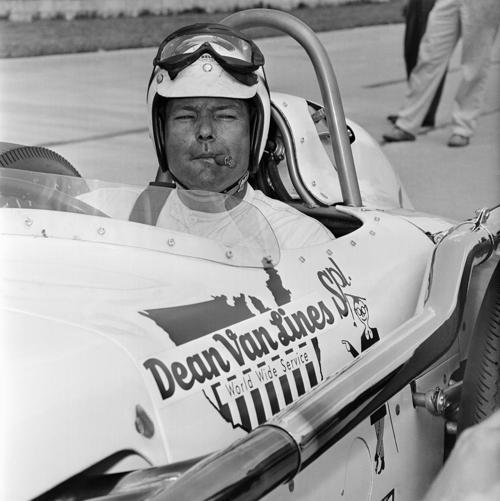
MAY 30, 1958: BILL CHEESBOURG FINISHES 10TH AT INDY 500
The American sports culture of the 1950s and 1960s was such that the four leading events of the year were (1) World Series; (2) Rose Bowl; (3) MLB All-Star Game; (4) Indy 500.
It was during that period that Bill Cheesbourg, a self-taught driver from Tucson’s dirt tracks, qualified for and raced in seven Indy 500s on a shoestring budget without a sustaining sponsor.
“He could have won Indy if he had had a good car,” said Bob Huff, who promoted auto racing for many years, mostly at the old Tucson Speedway on Orange Grove Road. “He never had the right connection to get into a car that had the ability to do what he had the ability to do.”
But that didn’t mean Cheesbourg, a Tucson High grad, didn’t get close.
People are also reading…
After finishing 26th as a rookie Indy driver in 1957, Cheesbourg felt he was one of the favorites in the 1958 Indy 500.
The lead story in the Arizona Daily Star sports section on race day, May 30, 1958, included the headline: ‘I’M GONNA WIN ’ER’
“If the chassis holds together, I think we’ll go all the way,” he said.
It was about time the racing gods smiled on Cheesbourg.
The first time he went to Indy, in 1956, he didn’t get to qualify when powerful rainstorms cut the qualifying rounds short. In 1957, he qualified for his first Indy 500 but a day later was told that his 2-year-old son, Billy Jr., died from a sudden illness at St. Mary’s Hospital.
Cheesbourg flew to Tucson to arrange funeral services and mourn with his family. When he returned to Indianapolis, he finished 26th. He was near the lead in that 1957 race when his car developed a fuel leak.
So in 1958, the man who won his first race, the Soap Box Derby, as a 13-year-old Tucsonan, felt his time had come.
It took one lap for him to encounter more misfortune.
In a 15-car pileup on Lap 1, a crash that killed driver Pat O’Connor, the rear sway bar on Cheesbourg’s Novi Special broke.
“There wasn’t a car I couldn’t pass on the straightaway,” he told the Star. “But those turns hurt me. The guys I passed on the straightaways ran off and left me in the turns. I had to make almost four complete turns around the steering wheel to get around a curve.”
Somehow he finished 10th anyway.
Cheesbourg returned to the Indy 500 and qualified in 1959, 1961, 1964 and 1965, but the increased science of auto racing mechanics related more to finances than driving. An old dirt track driver like Cheesbourg couldn’t keep up with those more well-funded.
In ’59, he set an Indy 500 lap record by passing 17 cars on the first lap, but engine trouble ended his race after 127 laps.
Away from Indianapolis, Cheesbourg was a pillar of Arizona auto racing.
He built and raced jalopies during the 1950s at the long-since-gone Gilpin Speedway on Prince Road near where Interstate 10 passes. He also raced at the Tucson Rodeo Grounds and later at Tucson Speedway before reaching the top level of automobile racing.
In 1975, he won a NASCAR race in Phoenix but mostly stuck to stock cars at Tucson’s old Corona Speedway and Tucson Raceway Park, becoming something of a mentor for weekend racers.
Still, his Indy 500 appearances were enough to attract attention from Champion Spark Plug. The company hired Cheesbourg to tour the country and talk to high school students about highway safety.
“He was so personable, he could grab kids’ attention and hold it,” Huff said. “He was a great storyteller.”
Where are they now: Cheesbourg, a mechanic, died of cancer in Tucson in 1995. He was 68. He was survived by six children.
How he did it: After winning the Tucson Soap Box Derby as a teenager, Cheesbourg took his vehicle apart and studied the parts, learning the intricacies of what made it go faster (or slower).
A decade later he was racing at speeds of 150 mph against the world’s best.
“Back then, when you touched the wall, the thing came apart,” he said in a 1994 interview. “Car parts flew everywhere, including into the drivers compartment. I see guys jump out of crashes today that would have annihilated guys in my day.”