When Alison Meadow coached an elementary school cross-country team in Tucson, extreme heat and monsoon storms regularly interrupted the season, she said.
“So completely adorable, also extremely hot,” said Meadow, a University of Arizona research professor who coached with the Tucson Unified School District.
Team practices were canceled and meets were regularly rescheduled because of extreme heat and weather, she said.
Now, Meadow is studying how climate change could impact the future of youth sports in Southern Arizona with College of Education professor Xingxing Wu and other UA colleagues.
They are conducting a pilot study to examine how sports organizations in Pima County are responding to climate-related issues.
The researchers began by surveying people involved in youth, recreational and collegiate sports in Pima County about their biggest concerns regarding climate change and its potential effects on sports.
People are also reading…
Meadow said three major concerns emerged from the survey so far: overall rising temperatures, extreme heat events and increasingly severe monsoon storms.
These changing weather patterns create challenges for sports organizations, including canceled practices, rescheduled competitions and concerns regarding athlete safety.
“This part of the world, we are warming, when you look at the science behind this we are actually warming a little bit faster than the global average,” Meadow said.
For local youth sports coaches, unpredictable weather can present concerns about player safety, too.
Angel Fierro, coach of the Academy of Math and Science-Prince Centaurs girls’ flag football team, said heavy rainfall during monsoon can disrupt practices and games.

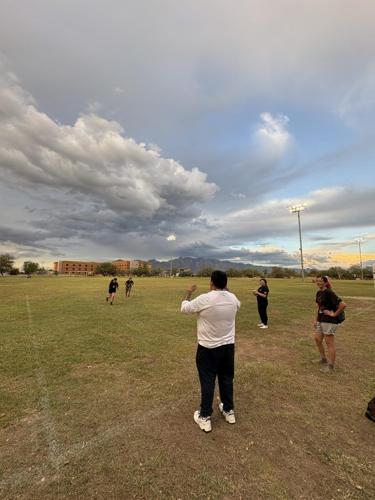
Girl’s flag football coach Angel Fierro instructs his players to run play “number two” after practice at the Nicolas P. Ochoa Soccer Complex, on Tuesday, Oct. 20, 2026.
“I don’t want my players to get hurt, because the fields can get really muddy and slippery,” Fierro said.
Gilbert Dominguez, whose 16-year-old daughter, Karley, plays softball for the Desert Thunder youth team, said she has participated in sports in Tucson for 10 to 12 years.
Although rain and lightning have occasionally caused games or practices to be canceled, he said those disruptions have not significantly affected his family’s schedule.
“A lot of people who aren’t from here have concerns about the heat that natives don’t,” he said.
He thinks many Tucsonans are already adapted to dealing with extreme heat, and said his daughter’s coaches emphasize hydration.
Still, Wu said the weather Arizonans are accustomed to is changing, and shifts in the climate may require sports organizations to rethink how they operate in the future.
“With sports and everything here, we kind of adapt to the climate because Pima County is hot, in general,” he said. “But also I feel like you know, it’s getting hotter.”
One challenge in Pima County is the limited access to indoor facilities where young athletes can practice during periods of extreme heat, Meadow added.
Some public schools in Southern Arizona lack consistent access to air-conditioned facilities, forcing teams to schedule practices earlier in the morning or cancel them due to excessive heat in the afternoon.
But changing practice times and schedules can create additional challenges for families.
“The challenge is it’s not going to get any better, and we have to start thinking longer term,” Meadow said.

The Desert Thunder youth softball team competes in a game at Ann Day Community Park on Tuesday, Oct. 20, 2026, as dark storm clouds gather over the field. Monsoon storms create challenges for youth sports teams across Southern Arizona, including safety concerns and game cancellations.
One potential solution is adjusting sports seasons in Southern Arizona to avoid the hottest months of the year.
Moving sports like soccer to the winter season could help athletes avoid excessive heat, but it could also create conflicts with teams in cooler states that follow different schedules.
That could make it more difficult for Southern Arizona teams to compete in tournaments across the country.
Beyond scheduling concerns, Meadow said increasing temperatures and poor air quality could also pose dangerous risks to young athletes.
“I worry we’re going to narrow these opportunities too far and kids won’t get the same chances we had to run around sports fields and be on teams,” Meadow said.
But she said she’s confident there are ways to make sports accessible to kids even as temperatures rise.
“I think there are answers out there, I just want to get people thinking about them now so we have plenty of runway for planning,” she said.
Wu said he and Meadow hope their study will help sports organizations begin planning for future climate conditions, particularly programs with fewer resources.
The pilot study is ongoing, but Wu and Meadow hope their findings will encourage sports organizations to consider long-term solutions, including alternative practice schedules and seasons, and greater access to indoor facilities.
“We’re still going to do sports. That’s my hope,” Wu said. “We’re still going to go outdoors, we just have to figure out how to do it.”
Arizona Sonoran News is a news service of the University of Arizona School of Journalism.


 Cienega’s Abby Chandler leads by example on and off the golf course