When Cassidy Bargell took the field for Team USA at the 2025 Women’s Rugby World Cup, she joined scores of elite athletes who fought to achieve their dream of competing on an international stage.
Evidence of Bargell’s biggest battle, however, was hidden under her jersey.
Bargell has played with an ostomy bag since 2021, when she was diagnosed with an inflammatory bowel disease called severe acute ulcerative colitis. The bag collects and stores waste from a point, or stoma, in Bargell's abdomen where her colon was surgically removed.
Bargell, a NCAA Division I college rugby player at the time, underwent four major abdominal surgeries in the span of a year while simultaneously recovering from an ACL tear.

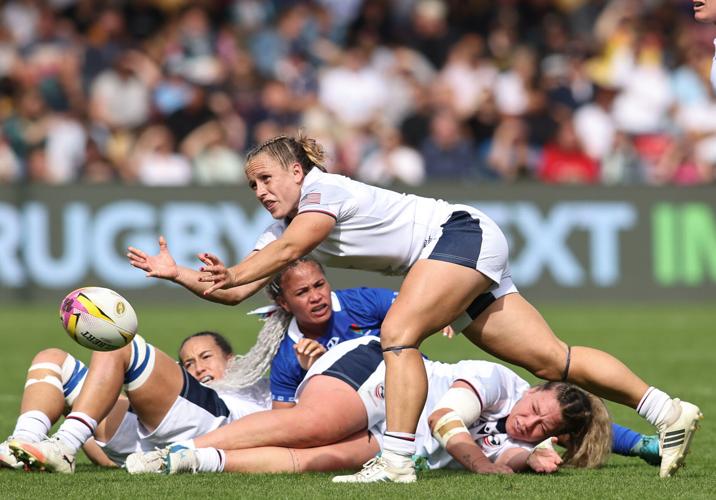
Cassidy Bargell of the United States passes the ball during a Women's Rugby World Cup match against Samoa on Sept. 6 at LNER Community Stadium in York, Britain.
That type of setback can derail an athletic career. But Bargell continues to ascend the U.S. rugby ranks, and she’s now intent on making her first Olympic roster for the 2028 Los Angeles Games.
People are also reading…
“Every time I get to train with these athletes and with my team and play, it’s a reminder of how much I love playing, how much I love training, and how grateful I am for my body and the ability to do it,” Bargell said.
'How sick could I be? I was still training for rugby'
While she was in college at Harvard, Bargell began to experience minor bowel disease flare-ups, but she never saw a doctor because the symptoms always seemed to go away — until they became too big to ignore.
Bargell suffered severe abdominal pain, lost weight and was unable to eat or sleep through the night without waking up drenched in sweat. She constantly needed to use the bathroom and passed a lot of blood when she did.
“I knew I was sick but how sick could I be?” Bargell recalled. “I was still training for rugby and you don’t ever think of yourself as being that sick until it became I couldn’t walk to class anymore.”
Finally, in November 2021, Bargell rushed to the hospital and had surgery to remove her colon and create a stoma.
A few months later, she was back on the rugby pitch for the Crimson. But Bargell needed another abdominal surgery in June 2022, then in October 2022 tore her ACL while playing rugby. In November 2022, she had two more emergency abdominal surgeries.
“I vividly remember the first tackle I ever made when I had a bag and how scary that was,” Bargell said. “I’m pretty sure my teammate just fell over for me, like didn’t actually make me tackle her. But yeah, there was a lot of fear and it took a lot of courage, but I don’t think I ever thought that I wouldn’t play again.”
From surgeries to making the national team
Bargell played for the junior national teams when she was younger and always wanted to compete for the senior national team, but after her various abdominal surgeries and knee injury, she no longer expected that to happen. So when USA Rugby gave her another shot at her dream, she jumped at the chance.
Bargell hadn’t played rugby for almost a year when she was invited to a domestic national team camp in January 2024. She performed so well that she was invited on a tour and debuted for the senior national team in March of that same year. Bargell credits former USA 15s head coach Sione Fukofuka, who now coaches the Scottish national team, for supporting her and her ostomy.
“He didn’t see it as something that took away from me, he saw it as something that added to who I was as a person,” Bargell said.

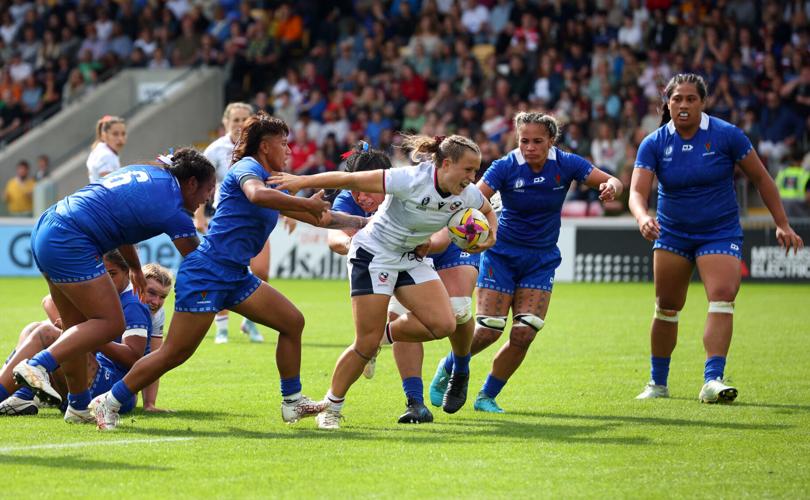
Cassidy Bargell of the U.S. competes against Samoa in the Women's World Cup on Sept. 6 in York, Britain.
Bargell started playing rugby when she was 13 in her hometown of Silverthorne, Colorado, a girls’ rugby hotbed. She went on to play four years at Harvard, where she won the national 15s championship as a sophomore and co-captained the team as a senior.
USA sevens head coach Emilie Bydwell, who has coached Bargell for more than a decade, said the defining traits of a great rugby player are a tremendous work ethic and a willingness to persevere through adversity. Bargell fits that mold, Bydwell said.
“She’s an absolute workhorse,” Bydwell said. “Her ability to contribute on both sides of the ball, maintain tempo and set intensity is what allows her to be successful in both sevens and 15s. She’s a powerful athlete with a highly developed skill set, and that combination makes her a dynamic ball carrier who connects really effectively with the players around her. She’s also a true student of the game — a smart, thoughtful player who is constantly looking to tactically evolve, not just to have an individual impact, but to play her role in a way that maximizes the performance of the team.”
Bargell plays scrum-half, one of multiple playmaking positions in rugby. The scrum-half acts as a link between the forwards and backs and is the team’s key decision-maker. The position comes naturally to a cerebral person like Bargell, who describes herself as “very Type A.”
“I love the thinking part of the game, the tactical part of the game, I love passing,” she said. “I love being a nine, I say it all the time.”
When it came to dealing with her diagnosis, though, Bargell wasn’t in control. Ulcerative colitis was never part of her life plan. But it forced her to adjust her expectations and accept that progress isn’t always linear.
“I think it gave me a lot of resilience, just knowing that everything is going to work out for me, even if it’s not exactly how I envisioned it the first time,” Bargell said. “It’s still something that can help me on the field. Something I’m really trying to bring to my game is just the anti-fragile mindset of any failure or setback is going to make me stronger and better and more prepared for the next time, or the next moment.”
Next goal: The 2028 Olympics
Bargell is one of a handful of U.S. athletes who compete for both the sevens and 15s teams, and she could have a busy summer ahead. The sevens team will next compete in two world championship series in Valladolid, Spain, from May 29-31 and in Bordeaux, France, from June 5-7. The 15s team will travel to South Africa for two games in July.
Those are just the first steps on the path to qualify for the 2028 Olympics, where the U.S. women’s sevens team will follow up its bronze medal-winning performance at the Paris Games. The last Olympics made U.S. women’s rugby star Ilona Maher a household name and increased American exposure to the sport, but Bargell said there’s now pressure to continue that momentum.
“We sort of have a responsibility now to continue to push American rugby forward and show what that means to the country and to the world,” Bargell said. “We all know how much rugby has given to us in our lives and how in a high-performance sport, performance matters. And that’s bringing rugby to America and rugby to other girls like us in our communities, and how much that can give back to other people.”
Bargell now embraces ulcerative colitis as part of her everyday life. She is pain-free, changes her bag when necessary, stays hydrated and has no dietary restrictions (aside from avoiding super fibrous foods right before training).
When she’s not playing rugby, the Harvard graduate works as a data analyst for the Crohn’s and Colitis Foundation, a job that feels deeply personal.
She’s also become more comfortable sharing her experience. Bargell is open with her teammates and friends about her condition and even gave a TEDx Talk titled, “No Colon: Still Rollin’.”
“If I can help be someone that shares about it and breaks the stigma, it’ll make it easier on other people,” Bargell said. “That’s something I’ve told my teammates when they ask about it, like you never know in your life who else is going to have a bag: someone in your family or one of your friends or someone related to you in some way. And so if you know even a little bit about it, that’s going to make them feel so much better.”