In Indianapolis, home to major automotive manufacturers like Duesenburg and Stutz over the years, the fascination with cars dates back to the demise of streetcars after World War II.
Without a doubt, the Circle City’s greatest contribution to car culture is the Indianapolis 500. The largest single-day sporting event in the world produced several noteworthy automotive innovations over the last century-plus, with drivers pioneering new technologies in pursuit of speed — and, ideally, staying alive in the process.
These are just a handful of everyday car features that owe their existence at least in part to the Brickyard.

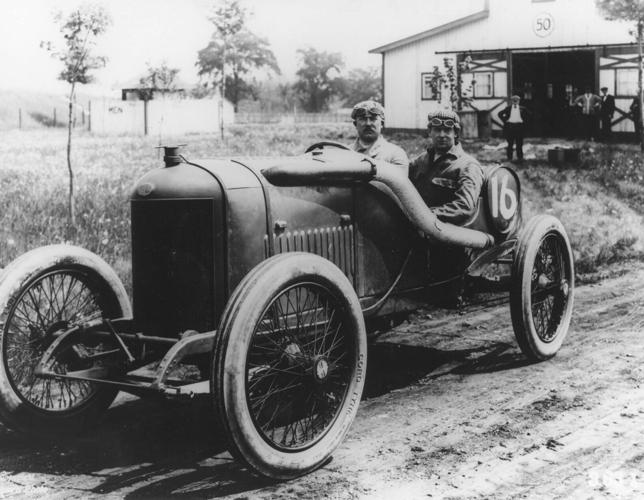
Rene Thomas, behind steering wheel, and Robert Laly, riding mechanic, in the #16 Delage car. The unidentified man in background is believed to be the team manager. Thomas won the May 30, 1914, Indianpolis 500 Mile race with an average speed of 82.474 mph.
1911: Rearview mirror
In the early days, racing cars had two seats: one for the driver, and one for a riding mechanic who checked gauges, communicated with the pit crew and alerted the driver to the chaos unfolding behind them. A riding mechanic's seat was typically exposed to the racetrack’s retaining wall and being flung to one’s death was as an occupational hazard.
People are also reading…
So when Pennsylvania-born driver Ray Harroun arrived at the Indianapolis Motor Speedway in May 1911 with a single-seat car he designed himself, other drivers and mechanics resisted the idea of a solo driver. The AAA Contest Board, then the 500’s sanctioning body, ultimately approved Harroun’s Marmon “Wasp” after the driver-engineer affixed a small rectangular mirror to its windshield so he could look out for other racers behind him.

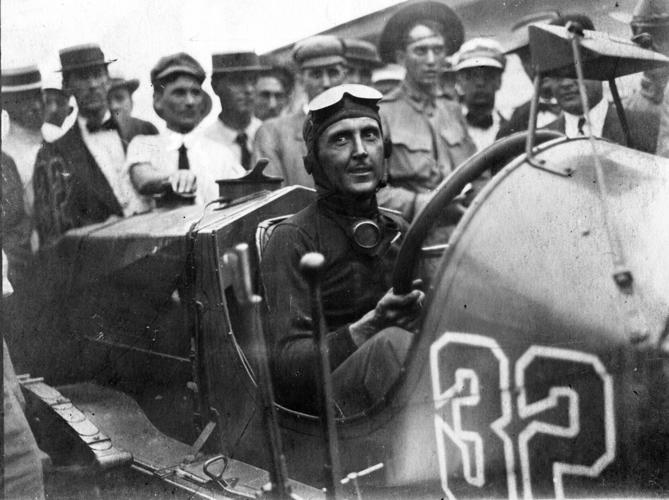
Ray Harroun sits in his Marmon Wasp after winning the first Indianapolis 500 in 1911. He averaged 74.602 mph in completing the first 500 in 6 hours, 42 minutes and 8 seconds. The Wasp's safety innovations, including the first known rearview mirror, allowed Harroun the car to be a singe seater without a mechanic reducing wait and aerodynamics.
Harroun, along with relief driver Cryus Patschke, sped to a first-place finish with a time just over 6 hours and 42 minutes — a full 1:43 faster than runner-up Ralph Mulford. The Knoxville Sentinel, in a recap titled “Harroun Used Mirror,” noted the winner finished the almost 7-hour slog “seemingly the freshest of all the pilots who went the long grind.”
Harroun was not the first person to stick a mirror on a vehicle, and car manufacturers didn’t incorporate mirrors into most of their vehicles until the mid-20th century.
Because cars were such a luxury product for the first few decades of their existence, new technologies in passenger vehicles usually lagged behind their counterparts at the raceway, even if they proved effective.
As such innovations "become more and more affordable from a cost standpoint, you start seeing them incorporated in your typical passenger cars, ”said Jason Vansickle, vice president of curation and education at the Indianapolis Motor Speedway Museum.
1921: Hydraulic brakes
In the early 1900s, stopping a car from within was accomplished via a series of pads and cables connected to a pedal that the driver depressed with his body weight.
In 1914, wire services mentioned “a hydraulic brake for automobiles that has been invented in England (that) operates on all four wheels of a car at the same time.” This new technology allowed the motorist to apply the same amount of friction with far less effort thanks to a series of tubes lined with highly pressurized liquid.
American aviation engineer Malcolm Loughead patented a second hydraulic brake in 1917, though similar devices were already used in race cars.
Indianapolis-based manufacturer Duesenberg is widely credited as the first to apply hydraulic brakes to its race cars, one of which notched a first-place finish at the French Grand Prix in 1921. Duesenberg quickly carried the technology to its passenger vehicles.

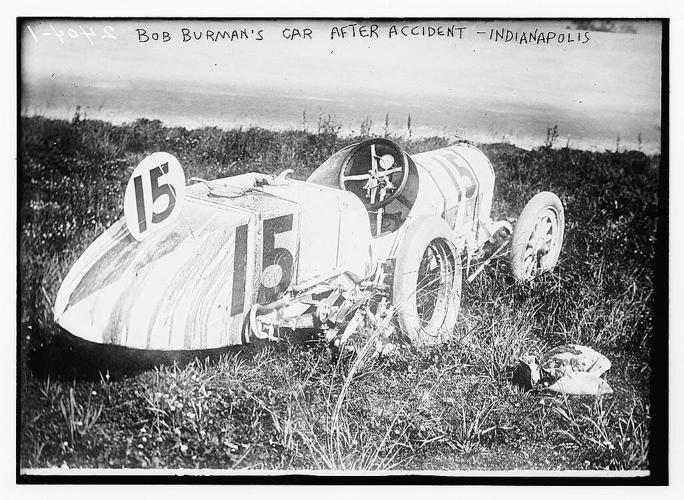
Bob Burman's car after an accident in turn 2 on lap 157 of the 1912 Indianapolis 500.
1922: Seat belt
In the Jan. 31, 1986, edition of the Sacramento Union, a columnist urging readers to obey freshly instituted seat belt mandates wrote, “Those who insist on their inalienable right to kill themselves may be interested to know that the fabled Barney Oldfield used a seat belt in his race car.”

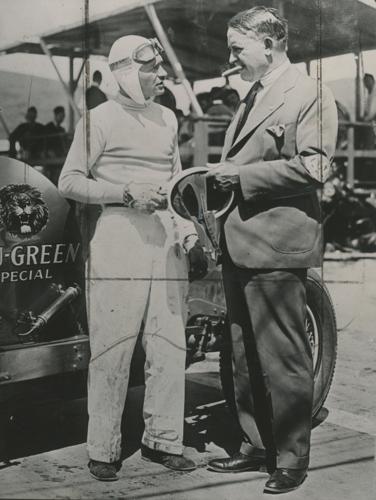
Three time Indy 500 winner Wilber Shaw, left, holds an early racing helmet while chatting with Barney Oldfield, the "Speed King,” at the Legion Ascot Speedway in California. Shaw used his experience working at Firestone to help develop synthetic rubber tires, The “channel tread" tire and self sealing inner tires to prevent blowouts. Oldfield is credited with wearing a safety harness long before it was standard and was the first to do a 100 mph lap at the Indianapolis Motor Speedway.
Oldfield was widely regarded as the greatest racer in his day. Though he only competed twice in the Indianapolis 500, he won several other racing crowns and was the first man to reach 60 miles per hour in a car. He also pioneered various contributions to motorist safety.
His Golden Submarine, built in 1917 with famed race car designers Fred Offenhauser and Harry Miller, is credited as the first open-wheel racer to feature an enclosed cockpit and roll cage. Oldfield presented the concept to Miller after his friend and rival, Bob Burman, was killed in a race in 1916.
It’s possible one of the safety features in the Golden Submarine was a seat belt, Vansickle said, likely adapted from the safety harnesses used in aircraft. However, historical consensus is divided. A spokesperson for the Brumos Collection, a Jacksonville museum that has a replica of Oldfield’s Submarine, said Brumos cannot confirm or deny whether the original car featured a safety harness.
The other name that comes up in discussions of seat belt progenitors is Joie Chitwood, an Oklahoman racer of Cherokee descent who competed in open-wheel racing from 1940 to 1950. The undersized racer told the Tampa Tribune in 1976 that at the 1941 Indianapolis 500 he installed a seat belt in his car to keep from bouncing while driving over the Speedway’s front stretch, then surfaced with brick. He later told the Indianapolis Star the story actually took place in 1946.
In 1949, Wisconsin-based Nash Motors Company became the first car company to offer seat belts in their vehicles.

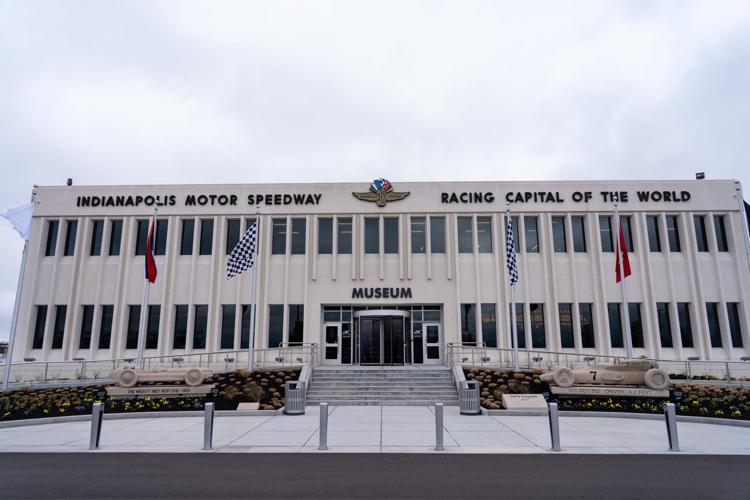
A March 31, 2025, look at the newly renovated Indianapolis Motor Speedway Museum.
1925: front wheel drive
When racers Dave Lewis and Bennet Hill arrived at the Speedway in May 1925 with a projectile-like roadster featuring an engine that rotated only the front wheels, the question on most spectators’ minds was if the car would cross the finish line.
Miller, the Wisconsin-born designer often heralded as the greatest creative mind in American motorsport, was behind the car. After making his fortune manufacturing carburetors, Miller entered the racing game in the early 1920s.
At this point, rear-wheel drive was the standard in most forms of driving, even though front-wheel drive was used in tractors, bicycles and carriages for decades (today, all Indy cars use a rear mid-engine, rear-wheel drive layout). Reporters at the time speculated Miller’s front-wheel-drive rig would allow its driver to take corners faster and experience less of a whipping effect.
Such predictions came to fruition; the Indianapolis News on June 1 featured the headline, “Dave Lewis proves it to those who doubted front wheel drives by winning second place.”
1932: four-wheel drive
The technology that powered all four wheels of a vehicle was already in limited use by the late 1800s, typically in tractors. Once again, Miller hopped on the budding phenomenon, though with decidedly less success at first. The 1932 Indianapolis 500 featured two four-wheel drive vehicles: Miller’s, driven by Iowa-born racer Gus Schrader, and the other built by Coleman Motors Corporation and piloted by Bob McDonogh.
Schrader’s oil pump blew on the seventh lap and McDonogh crashed 10 laps later. On a day when 26 of 40 racers failed to complete the race, they placed 38th and 39th, respectively.

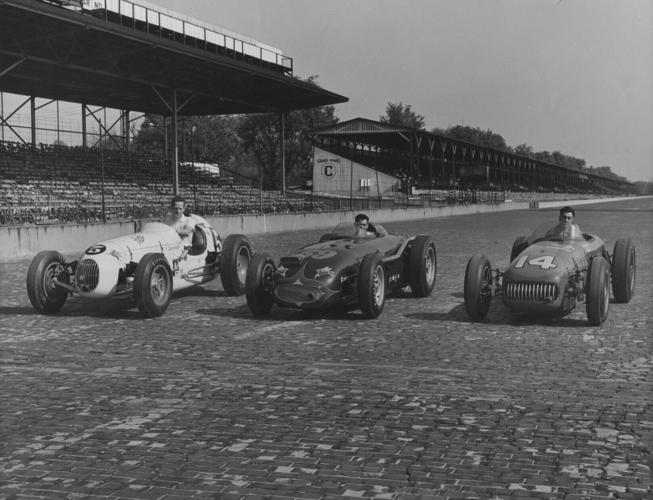
Front row for the 1953 Indianapolis 500, from left: Jack McGrath, Fred Agabashian and Bill Vukovich on the pole.
1952: turbochargers
In 1905, Swiss engineer Alfred Büchi filed a patent for a device that fed highly compressed air directly into a vehicle’s internal combustion engine. Denser air means more oxygen, more combustion, more speed.
Büchi and other inventors’ early turbochargers were primarily used on planes, ships and trains. Swiss truck manufacturers caught on in the 1930s.

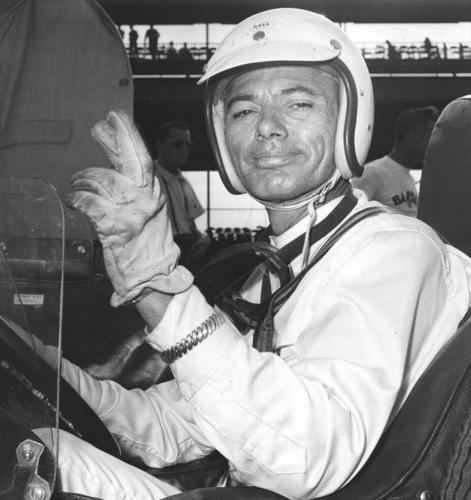
Indianapolis 500 driver Freddie Agabashian is seen in 1958.
In 1952, veteran racer Fred Agabashian nabbed the pole position for the 36th Indianapolis 500 with a record-setting average speed of 138 miles per hour driving a car equipped with a turbocharged Cummins diesel engine.
Coverage of the event in the Columbus Republic reported his front-right tire was “practically non-existent” when he finished his qualifying laps, as “the blistering speed had ripped it to shreds.”
Though Agabashian would finish 27th in the race after his car stalled, he is still credited as the first Indianapolis 500 entrant to make use of a turbocharger. The first driver to win the race with a turbocharged engine was oval legend Bobby Unser in 1968.
By the 1970s, car manufacturers got in on the action. Today, cars equipped with turbocharged engines are much more common.