

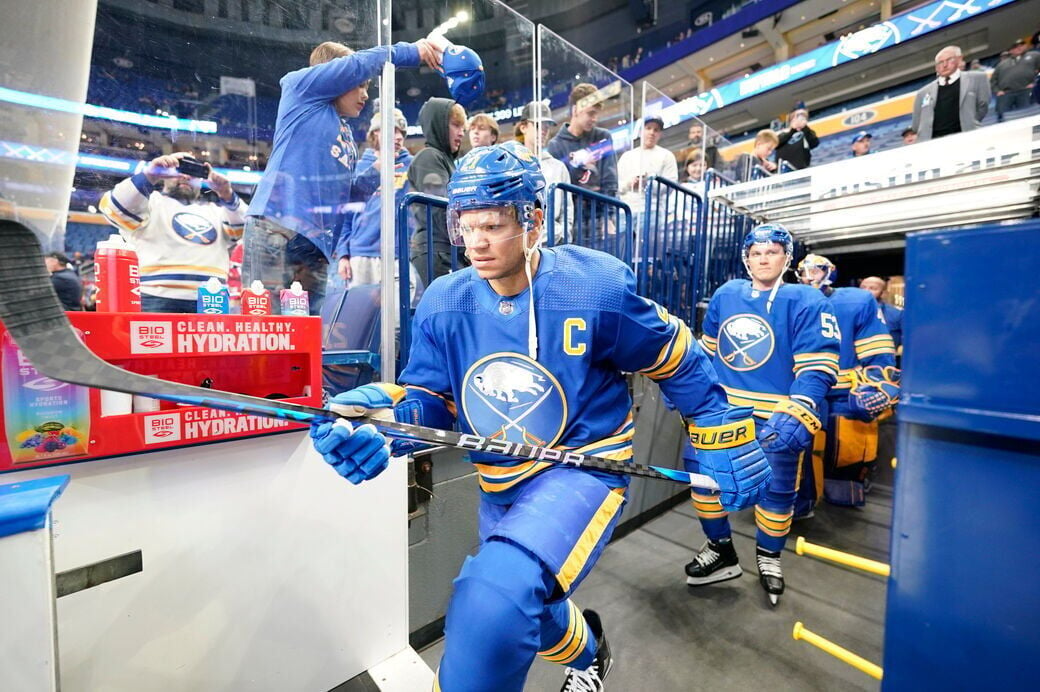
Kyle Okposo is close friends with Jack Eichel.
The former teammates still talk often. Eichel’s arrival in Buffalo was one of the reasons why Okposo chose to sign a seven-year contract with the Sabres in July 2016. They experienced a tumultuous five seasons together until the organization’s refusal to approve Eichel’s preferred surgery led to the former captain’s trade to the Vegas Golden Knights last November.
Okposo, now 34 years old and amid the final season of that contract, officially replaced Eichel as captain last month and spearheaded the behind-the-scenes changes in the Sabres’ dressing room that bonded the group. Okposo scored 21 goals, his highest output since 2015-16, while helping the club exceed expectations with Eichel gone.
People are also reading…
Okposo admittedly hasn’t been able to watch much of the Golden Knights this season. The Sabres (7-6) didn’t give Vegas (12-2) much thought until it was time to prepare for the rematch of the two clubs, which will occur Thursday night in KeyBank Center.
A self-described hockey fan, Okposo keeps a close watch on teams around the league, though. And he doesn’t have to see the games to know his former teammate is finally healthy and back to being an elite talent.
“I’m happy for him,” said Okposo. “I still talk to him quite a bit. He’s obviously a friend, so anytime you had somebody in the situation that he was in, you never want to see somebody hurt. You want to see somebody healthy and playing well and for himself and his life. So, I’ve been happy that he’s back on the right track, and we'll see if we can get him to take a night off (Thursday)."
Eichel, now 26 years old, has six goals, 15 points and a plus-10 rating through 14 games. He had a goal in the Golden Knights’ overtime victory at Toronto on Tuesday night, extending Vegas’ win streak to eight games. This is the best Eichel has looked since the 2019-20 season, when he totaled a career-high 36 goals and finished eighth in the Hart Trophy voting.
On the mend
Defenseman Henri Jokiharju practiced with the Sabres on Wednesday for the first time since he was struck in the face with the puck Oct. 20 in Calgary.. Jokiharju wore a yellow noncontact jersey and a tinted visor on his helmet to help with the sensitivity to light he’s experienced since the incident.
The Sabres don’t have a timeline for Jokiharju to return from his nine-game absence but practicing with the team is the next step in his recovery.
“Obviously, wearing a yellow jersey but speaking with him after practice, he said he didn't feel fatigued,” said Sabres coach Don Granato. “He hasn't skated a lot, obviously. He skated with our rehab skates on his own with our rehab coach, Mike Ansell. However, he looked fine, probably a little bit rusty because he hadn’t skated in a while. From the injury standpoint, it was a great day for him.”
Another change
Granato changed his forward groups in practice following the 4-1 loss to Arizona, most notably elevating winger Vinnie Hinostroza to the top line next to Tage Thompson and Jeff Skinner. Hinostroza has been a healthy scratch for five consecutive games and, according to Granato, will return to the lineup Thursday against Vegas.
Hinostroza, who signed a one-year contract in July to return to Buffalo, has five assists in six games this season. In other roster news, the Sabres assigned defenseman Jeremy Davies to the Rochester Americans.
Challenge ahead
Rookie winger Jack Quinn appears to be the odd forward out again with Hinostroza drawing back into the lineup. Quinn was the extra forward during 5-on-5 drills at practice Wednesday after totaling three assists in his last three games. He was taken off the power play and moved back down to the fourth line against the Coyotes.
Healthy at forward, the Sabres have sat Hinostroza, Quinn, Peyton Krebs and Rasmus Asplund for at least one game apiece this season. Granato wants to create a challenging environment, not a threatening one, but he acknowledged that's not easy when a young player is involved.
"I mean it’s tricky because that’s a perceived threat," said Granato. "We don’t have control over anybody’s perception, that’s their own. So we can take care of what we can take care of in actual and that would be communicating with them as best we can, giving them a vision of what we have for them here.
"Giving them targets to what they can do now or next, whether it be at practice or the next game out. Those would be ways to create a better focus for a player that might be losing his focus to the realm of being worried or feeling threatened. It’s always a challenge.”


