

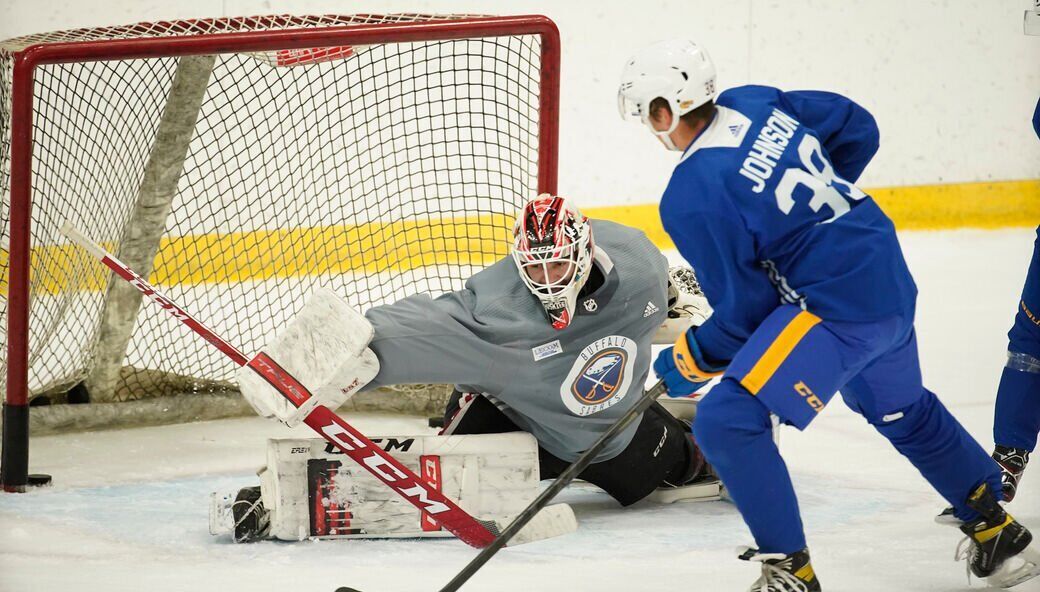
Devon Levi sat in the Sabres’ suite in TD Garden as his friend and Olympic teammate, Owen Power, competed in the first of two games at the Frozen Four in April and, a few weeks later, watched from the stands as coach Don Granato ran a morning skate in Boston ahead of a matchup against the Bruins.
Through both experiences, Levi forged a relationship with Sabres General Manager Kevyn Adams, who explained his plan to build a winner in Buffalo and the record-setting goalie’s role in the organization once he concludes his college career at Northeastern University.
“It’s really cool to see how good of a person he is,” Levi said Thursday following his second development camp practice in LECOM Harborcenter. “Usually, as a kid, you see like all these transactions and it’s a business and everyone tells you it’s a business. He really makes it seem like it’s a home. It’s really comfortable.”
People are also reading…
Adams also learned more about Levi’s decision to return to school for his junior season, rather than signing an entry-level contract with the Sabres. Levi, 20, impressed his boss by detailing why he’s in no rush to begin a professional career. He wants to experience playing under immense pressure following a season in which he was awarded the NCAA’s top goaltending award, ranked first in save percentage (.952) among all Division I men’s goalies, set school records and represented Canada at the Winter Olympics.
Levi doesn’t want to stop there, either. During his speech at the college hockey awards in Boston, he captivated the crowd by expressing his desire to help his teammates accomplish what they couldn’t in the spring when they lost in their first game at the NCAA Tournament. And Levi has proven throughout his career that he has the self-awareness to diagnose what’s best for his development.
“You play so many seasons that coming off a good season, how are you going to do it again?” Levi explained. “That’s the question. A lot of people have a hard time with that. It’s easy to get caught up in thinking you’re the best and you came off a really good season and trying to manage expectations. So, I’m really looking forward to going into that challenge and managing it and learning how to do it. … I think I’m gonna be one more step ready to come in next year.”
Levi’s ability to self-evaluate is rare for a player of his age and experience. He played three years of midget-level hockey when most that age move to a top junior league as soon as possible. Doing so helped Levi emerge as a legitimate NHL prospect, as he totaled a .941 save percentage in 37 games in the junior-level Central Canadian Hockey League.
The decision might have contributed to Levi falling to the seventh round of the 2020 draft, but his breakout performance at the IIHF World Junior Championship made him the Sabres' target in the trade that sent Sam Reinhart to Florida.
Levi showcased his precise technique during a record-setting performance at the tournament in which his .964 save percentage beat the mark previously held by Carey Price. However, an injury prevented Levi from competing for Northeastern as a freshman, robbing him of an important season of development.
He authored an exceptional sophomore campaign in 2021-22 that included the following accomplishments:
- Nationally, he ranked sixth in total saves, tied for second in total shutouts, third in goals against average and seventh in wins.
- In addition to the Mike Richter Award for the NCAA’s top goaltender, he won the National Rookie of the Year Award, Hockey East Goaltender of the Year and he was a finalist for the Hobey Baker Award, which is given to the top player in Division I men’s hockey.
- Levi owns the Northeastern record for going 121:25 before giving up a goal to start a career.
“I haven't really seen much like it before,” Northeastern goalie coach Mike Condon, who played parts of five seasons in the NHL, told The Buffalo News in a phone interview. "If Devon sees the puck, he's going to stop it. He’s one of those goalies, when there's a breakaway, you're not worried. When there's a two-on-one, you're not worried. I was so impressed with his performance in-game, but I'm very impressed with his just his demeanor as a person and what he brings to the team and how much he really cares about being a teammate.”
Though a bit undersized at 6-foot, Levi uses his athleticism, quickness and instincts to make difficult saves look easy. He wowed his teammates at development camp Wednesday with a few remarkable stops in a fast-paced, offensive-driven practice that include numerous odd-man rushes.
The season wasn’t perfect, though. On Jan. 22, the morning following a loss at UMass, Levi spent two hours at the rink training with a virtual reality headset. Back on the ice that night for the rematch, he had one of his worst performances of the season and allowed four goals on 12 shots.
Condon had to remind Levi that goalies, like pitchers in baseball, must monitor their workloads. Work hard but smart, Condon said. It’s a lesson Condon delivered throughout the season and the two wanted to spend another year crafting Levi's routine. He has an insatiable appetite to improve and has a cerebral approach to the position. He often stays on the ice 40 minutes after practices to get in extra work with his teammates, which Condon called, "overkill."
Condon, 32, has become a mentor to Levi and is using his role to help prepare the Sabres prospect for the challenges of professional hockey. Even the social dynamics on a team change when a player makes the move from college to pro. Condon doesn't want Levi going home every night obsessing about hockey. Mental breaks are necessary in an 82-game NHL season.
Condon’s presence at Northeastern is one of the reasons why Levi chose to return for another season. And the Sabres provide additional instruction and advice through goalie development coach Seamus Kotyk.
“I’m trying to instill in Devon that when you get to the next level, you can't always be grinding all the time,” said Condon. “Everyone wants to grind, and they think that will serve them well. And I did that a lot of my career. But I ran into a lot of injuries, I ran into a lot of energy issues and fatigue over the course of the year. So, I'm trying to teach him about efficiency, prioritizing what needs to be done. … It’s about finding that sweet spot so that every day when you come to the rink, you feel fresh.
"You can read as many books as you want about preparing for professional hockey. You can talk to as many former players as you want. But it's something you have to learn firsthand. We still have a lot of work to do about refining our process. There's still a lot to learn and a lot to gain."
In need of a starting goalie, the Sabres opted for a short-term solution this offseason rather than a long-term option. Adams doesn’t want to block Levi or fellow prospect Ukko-Pekka Luukkonen from eventually taking the job of franchise goalie.
Eric Comrie, a 27-year-old with only 28 games of NHL experience, signed a two-year contract to work in tandem with Craig Anderson next season, and Luukkonen will continue his development in Rochester, where he’ll be the starter on a talented, young Amerks team. At development camp this week, the Sabres also have Erik Portillo, who becomes an unrestricted free agent if unsigned by next summer, and recent second-round draft choice Topias Leinonen.
It’s suddenly a position of strength in the prospect pool, yet Levi isn’t concerned about having to surpass another goalie on the depth chart. He expressed confidence that he’ll be the one in the crease if he takes care of his own development. And while Levi’s decision to return to school disrupted the Sabres’ short-term plans, he alleviated any possible concerns with his nuanced explanation and determination to be a better goalie next spring when it’s time to put pen to paper on a contract.
“As a goalie, there’s really no rush,” said Levi. “I’ve kind of taken a slower path my whole life where I was a late bloomer. … I just focus on my development and I’m getting better every day. I’ve never really chased the highest level. I’ve just let it come. When the time is right, it’ll come. So, I’m just waiting for that.
“I feel really good and I’m confident in my abilities to be able to play. But I don’t think it will be bad to go back to college one more year, get better and come back even more ready.”


