

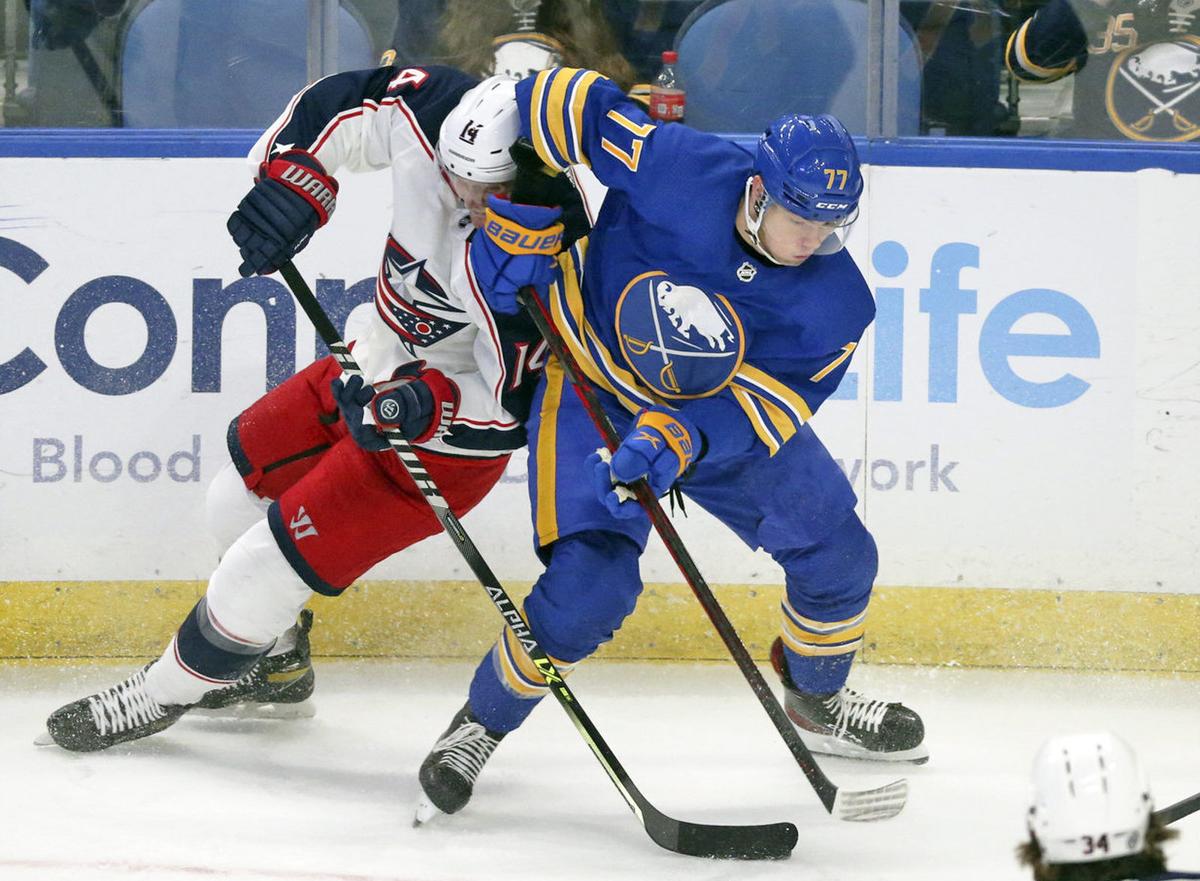
J-J Peterka wasn’t thinking about the National Hockey League when he was a child in Munich, Germany.
Peterka couldn’t watch the games or follow the players. He didn’t even join a team at a very young age because his first love was short track speed skating. His curiosity was piqued when he and his parents first saw a hockey practice.
“I just wanted to try it,” said Peterka, smiling while standing in the KeyBank Center atrium following a recent training camp practice with the Buffalo Sabres.
Peterka quickly fell in love with the sport and his heart belonged to Munich EHC, then a second-tier German club whose top players were Canadian. His childhood idol was a Swedish journeyman winger named Niklas Hede, who at 40 years old helped the team ascend to the country’s top division.
Peterka began to attend games and shelved his speed skates in favor of hockey equipment. Thus began a career that took the quiet teenager from Austria to the Czech Republic and, beginning last month, Buffalo. He eventually played for the same club as Hede and learned from him through EHC Red Bull Munchen's development program.
People are also reading…
Read the full story here.
Peterka’s goal has changed, though. As a child, he aspired to bring a championship to Munich. Now, he wants to be the latest German-born player to make an impact in the NHL. A 19-year-old winger selected by the Sabres in the second round of the 2020 draft, Peterka is using the skating stride honed through short track, and a dynamic skill set that appears close to NHL-ready, to make a case to remain in Buffalo beyond camp. Both were on display Monday night when Peterka sped past Columbus defenseman Zach Werenski to gain possession in the slot and score the Sabres' second goal.
“He’s got three big tickets,” said Sabres defenseman Ethan Prow, who played with Peterka in Munich last season. “It’s his speed, for one. He uses it well and when he takes guys wide, he can really burn people with his speed. But then the other two are his hands and shot. I think he has all three. You can see his great shot and it showed up in Munich when we were on the power play. That ability in tight with his hands. To have all three of those, and to use them at the right time, I think is a big asset.”
Those skills were evident at an early age. At 14 years old, Peterka’s talents earned him an invitation to join the Red Bull Hockey Academy in Salzburg, Austria. He was forced to leave home, a difficult change at first, and the club competed in Czech Republic’s Under-18 and Under-19 leagues.
In 2017-18, Peterka had 45 points in 13 games. He moved up an age group the following season and totaled 94 points in 48 games. Meanwhile, Peterka was wowing scouts while representing Germany at international tournaments. At 17, he played his first game for his EHC Red Bull Munchen in the DEL but struggled to produce in a lesser role against grown men, finishing with 11 points in 42 games.
Peterka looked elite when competing against his peers but projecting his game to the NHL wasn’t easy because he didn’t receive much ice time in Munich. Was he only good enough to dominate against lesser competition in Austria? This likely caused Peterka to slip to the second round of the 2020 draft, where Sabres General Manager Kevyn Adams traded up to select him 34th overall.
Less than one year later, Peterka has been a bright spot in Don Granato’s first training camp as coach.
“Peterka’s a great player,” Sabres center Dylan Cozens, who skated with Peterka on Monday night, said. “He’s super-skilled and he’s got a hell of a shot. You can see a lot of potential there. He’s going to be a great player in this league.”
While Peterka’s readiness may have surprised some, Prow saw this in Germany. During his final season in Munich, Peterka was elevated to a prominent role on one of the league’s top teams. He was the triggerman on the power play and used his left-handed shot to produce nine goals in 30 games. His on-ice vision and remarkable passing helped him produce 20 points.
Peterka also impressed scouts at the IIHF World Junior Championship in 2020 and 2021. In the latter tournament, Peterka produced 10 points in five games. His development in Munich under coach Don Jackson, a former NHL assistant who teaches a North American style of play, combined with talent that could be elite, convinced the Sabres to sign Peterka to a three-year, entry-level contract in June.
“Seeing him over there and seeing his game and how high-end it can be, and the talent that he brings, it’s something special,” said Prow. “He’s always working on it. Over there, he’s the last one off the ice. Always working on his shot and kind of just the little things after practice that gets him to level that he’s at.”
The adjustment to an NHL training camp hasn’t been seamless. Against lesser competition, Peterka can get away with forcing passes through the offensive zone. He’s learned there’s less time and space, lessons that were on display at the Prospects Challenge last month. During his first game against New Jersey Devils prospects, Peterka forced a pass near the blue line that turned into a 2-on-1 the other way.
Similar attempts in NHL preseason games also have led to turnovers. But Peterka hasn’t appeared overmatched. He can drive play from the wing, a valuable attribute the Sabres lack from that position. Peterka has made outstanding passes all over the ice and his shot is NHL-ready. Like he did in Germany, Peterka must learn how to apply his skills to a more difficult game. If the Sabres' lineup Monday was any indication, the club may be willing to allow him to experience those growing pains in Buffalo, but it's possible, if not likely, he'll start the season with Rochester, which opens training camp Tuesday.
“There’s lots of details that he hasn’t had to pay attention to, quite honestly,” said Granato. “It’s good that he’s played in a men’s league overseas. That’s helped and shortened his window adapting to the NHL whenever that is. It’s made it sooner than later I think when you’ve gone through that.
"For all of these guys, the highest end skill, they’re not held accountable at the lower levels. They just get by on their skill, so they don’t have to pay attention to any details and that’s a big part of the process once they try to enter the league. For him, he does have an awareness that, ‘OK, I’m going to have to catch (that).’ "


