

ABIQUIU, N.M. — The land announces that you're entering Georgia O'Keeffe country long before the road arrives in this tiny adobe town where the artist lived her last years. The sandbars in the muddy Rio Chama mirror the graceful lines of her paintings. The cliffs glow with her palette's soft roses and sunny ochres. The piñon-speckled hills seem to lack only a huge, white ram skull floating in the limitless sky above.
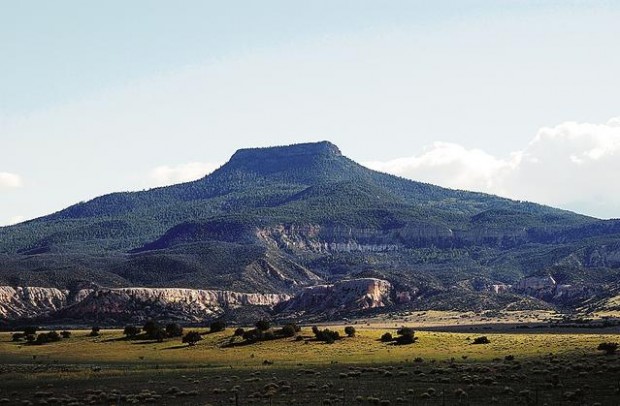
Then the road turns west and drops over a mesa, and the final sign of O'Keeffe country looms on the horizon: Cerro Pedernal, a 9,862-foot, square-topped mountain gouging the New Mexico sky like an enormous chisel.
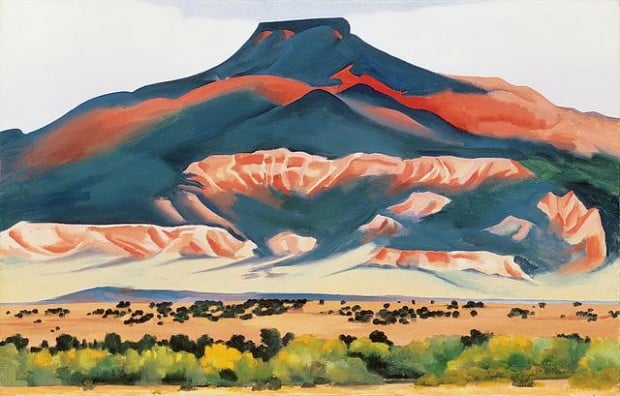
This was O'Keeffe's favorite. She painted the mountain more than a dozen times: in spring, in fall, lurking as a plumb-colored silhouette behind voluptuous red hills, glowing in the dawn light through the voids of a bleached-white pelvis bone.
People are also reading…
On canvas, she smoothed out the mesa's details, using what she called "that memory or dream thing I do that for me comes nearer reality than my objective kind of work."
It would be hard to know what the artist meant, if the mountain weren't a place you can visit. But it is. The third-class route up the back is one of New Mexico's classic hikes. And climbing one of America's favorite artist's favorite subjects can offer a rich understanding of the painter's style that can't be had wandering a gallery.
Seeing the mountain in infinite detail reveals the detailed work behind O'Keeffe's smooth canvases — the things she chose to isolate, the things she chose to emphasize.
O'Keeffe hiked Cerro Pedernal several times. She knew every turn in the trail and every side of the peak, yet chose to paint it from the north as a flat, hazy outline — not just once, but again and again until it became a symbol not just for her, but of her.
It became an icon that said "O'Keeffe." When Colorado Springs photographer Myron Wood published a book called "O'Keeffe at Abiquiu," he began with a shot of Pedernal. Another photo book focusing on her life at Ghost Ranch ends with O'Keeffe walking into the sunset toward the square peak.
She sometimes called it her private mountain, joking once that "God told me if I painted it often enough I could have it."
When she died, her ashes were scattered on top.
When I went to climb the mountain in September, I didn't understand how one mesa could mean so much to a person, but I thought going there would help me find out. I had visited the Georgia O'Keeffe Museum in Santa Fe several times and always been captivated by the Pedernal paintings. I've spent uncounted minutes staring into the dark silhouettes of the mesa, wondering how she managed to blend the colors so that they appear dark, in shadow, but somehow glowing with light.
When I was driving into New Mexico, the peak looked just like her paintings: flat, blue, smooth. But as I got closer, details seeped in: individual trees, cliff bands, barbed-wire fences running through the tall grass.
This was it — unmistakably the mountain she'd painted over and over, but different. More real. And less.
It's been 20 years since O'Keeffe died at age 98. She lived most of the last 60 or so in the isolated desert around Cerro Pedernal.
She valued the solitude that allowed her to work. Books about those years tell stories of her chasing off visitors to her small, adobe house by simply saying "Front side!" then turning and saying "Back side!" and slamming her front gate.
O'Keeffe was born in 1887 in Sun Prairie, Wis. She attended the Art Institute of Chicago, and, through her relationship with pioneering photographer Alfred Stieglitz, she became part of New York's modern-art scene. She caused a stir with her close-up, sensual paintings of flowers and her terse, iconic personality.
"I hate flowers," she once said. "I paint them because they're cheaper than models and they don't move."
But what she did with flowers made her a star. Alfred Barr, who was the founding director of the Museum of Modern Art in New York, wrote: "She has the gift of isolating and intensifying the things seen, or destroying its scale until it loses its identity in an ambiguous but always precise beauty."
It was a deceptively simple idea: Smooth over the things that don't matter. Leave what is beautiful.
O'Keeffe's love of shape and color drove her like an addiction. As a young woman, teaching art on the Texas plains, she got up before daybreak to try to memorize the color of the dawn sky over the prairie. Later, as an established artist, she spotted a stone, smooth and black and almost round, at the house of photographer Eliot Porter and, according to stories, stole it.
Lines mattered. Shape mattered. Color mattered — to a degree others found hard to fathom.
"I think that's what drew her to Pedernal — the form, the perfect contour," said Barbara Buhler Lynes, curator of the Georgia O'Keeffe Museum. "She had a view of it from the front patio of her house. She would see it every day."
I started walking up Pedernal at dawn.
The path was in the trees. There were none of those classic O'Keeffe long views, so it was easy to focus on details: cliff rose and paintbrush flowers everywhere, squirrels scolding from the branches, sharp pieces of flint in every color, from cloudy white to dark red, scattered on the road.
O'Keeffe glossed over these things. She glossed over the hidden meadows and the smell of piñon pines warming in the morning sun. She glossed over the birds.
"Nothing is less real than realism," she once said. "It is only by selection, by elimination, by emphasis that we get at the real meaning of things."
After an hour of walking, the road petered out. The way headed up a steep slope choked with blocks of basalt until it dead-ended at a sheer 50-foot rampart — the slanted jar lid.
I walked along the base for several hundred yards, and the path led to a narrow break in the cliff. I climbed hand over foot, then sneaked up a narrow rock ramp to a wind-blasted summit.
I had always imagined the top as broad and flat like a table. In reality, it was a narrow, rocky ridge, maybe 20 feet wide and a quarter-mile long — chisel-shaped.
At the highest point, a jumbled rock cairn stood steady in the wind, a summit register in an old peanut butter jar tucked in the stones.
In every direction the pastel pinks and yellows of the dessert glinted from beneath dark brows of junipers. On the far edge of sight, the blue Sangre de Cristo Mountains snaked into Colorado.
I was now in the painting, looking out; however O'Keeffe managed to paint shadow that was dark and glowing at the same time, I was in it. Somewhere down there was the patio where she painted.
Sitting on the top, I sensed no obvious enlightenment, only the company of rocks and piñons, and a few ravens surfing on the wind.
I had fallen into a trap. I'd come to find details about a woman who specifically eliminated them, gone looking for realism only to find the detritus the artist had purposefully stripped away. I don't think I'll ever be able to look at a painting of the Pedernal without thinking of the flint and the cliffs and the innumerable other details of this place, and the simple grace of brushing them aside for a clean portrait that somehow expresses the mountain more than the mountain itself.
I looked out at the horizon. If I didn't have a clear answer, at least I had a clear view. O'Keeffe said she always preferred color over words. It expressed things words couldn't. At the foot of the mountains lay O'Keeffe's voluptuous red hills. The distant mountains stood in shadow, somehow glowing.
O'Keeffe's home
Tours of the artist's home in Abiquiu, just east of Cerro Pedernal, cost $20 for the interior and $15 for the exterior. Reservations are required. For more information, call 1-505-685-4539.


