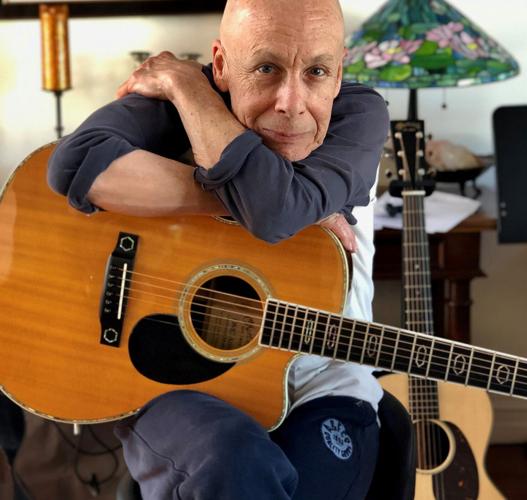
Lee Ritenour "noodled" on his guitar throughout our entire conversation. That was his word for it, not mine. What he called noodling sounded to me like a private concert — fluid runs, richly voiced chords, phrases that seemed to arrive fully formed. His hands never stopped exploring the instrument, even as we moved from his new album to B.B. King, Dave Grusin, a devastating fire and the lifelong tug-of-war between music and the music business.

Dr. Barton Goldsmith
For Ritenour, the guitar is where he finds his balance.
"If I keep these two hands in sync, and the guitar is working well, then my body is in sync. My spirit is in sync," he says.
That connection runs through his new album, "Live at Ronnie Scott's," out worldwide Oct. 23, which captures Ritenour and a gifted, largely younger band across eight nights at the legendary London club. After dozens of records in a career that began when he was still a teenager, this one clearly means something different to him.
People are also reading…

Lee Ritenour's new album, "Live at Ronnie Scott's" is available Oct. 23.
Making a live album isn't what it used to be, he told me. Nearly every show now gets pulled straight off a venue's soundboard, and his son and drummer, Wesley Ritenour, collects recordings from gigs all over the world.
"Live records happen every minute," he says. "So they don't have the same weight."
But Ronnie Scott's carries weight of its own. Open since 1959, the venue has hosted Nina Simone, Miles Davis and Jimi Hendrix — a living history Ritenour and his band stepped into for those eight shows. He and longtime engineer Don Murray had room to choose the strongest takes: most of the record comes from a Saturday night performance, with a few selections from Sunday's matinees, which the band had feared going in might feel low-energy but didn't.
Ritenour and Murray kept the ambient mics adjusted separately for each song, chasing a sound that holds a room's energy without losing studio clarity — something he compares to Keith Jarrett's concert recordings, where a listener can forget an audience is even there until the applause breaks the spell.
"It has a bit of a studio quality, but it's got the energy of the guys playing together," Ritenour says.

Lee Ritenour
That's largely down to the band. Wesley, now 33 and playing drums since he was five, gets his first major feature on one of his father's records. Pianist Georgi Mikadze, who teaches at Berklee, first crossed paths with Ritenour by winning one of his Six String Theory competitions. Brazilian bassist and vocalist Munir Hossn — fluent in several languages, well-traveled — brings what Ritenour calls "a nice worldly element," joined by fellow Brazilian vocalist Tatiana Parra and harmonica player Grégoire Maret, whom Ritenour considers perhaps the finest in jazz.
That mix produced one of the album's small surprises. Revisiting his early-'80s hit "Is It You," Ritenour handed the vocal to Hossn, who asked to drop the key, then admitted he'd never sung a song in English before. Parra stepped in alongside him, and the two traded the lyric in accented English that Ritenour says gives the track "a nice charm about it."
Ritenour builds that kind of openness into every show by refusing to use a set list. Musicians get a pool of maybe 20 songs to have ready, with no guarantee what comes next — sometimes Ritenour just starts an intro and waits for the band to recognize and join it. It keeps everyone present instead of coasting on muscle memory.
The album's most personal track, "For the Palms," came out of real upheaval. Ritenour and his wife, Carmen, lost their Malibu home and a newly finished studio to fire, and spent more than five years rebuilding. At a rental house, Carmen was upset that updated fire codes meant losing several palm trees that had survived the blaze. Ritenour was lying outside with a guitar across his stomach — not his usual position — when the piece arrived whole in about five minutes. He figured he'd develop it later in his recording software. Playing it back, he realized there was nothing left to add.
"When it comes out in one breath, that's like a gift," he says. "We have to thank the gods for allowing that to happen."
The fire took roughly 100 guitars, though a stroke of foresight softened the blow. Five months earlier, Ritenour realized his house, studio and instruments were finally all under one roof for the first time in years, and updated his insurance accordingly. Among what survived: a 1949 Gibson, a red ES-335 and his custom Gibson L-5, though flight damage later cooled his enthusiasm for touring with the L-5. These days, he favors a Sadowsky Jim Hall model for jazz dates and a Les Paul for funkier, fusion-leaning sets — one of which sat in his lap the entire time we spoke.

Lee Ritenour
Playing through interviews is an old habit, he says, born from finding that sitting still backstage made him more nervous, not less. Strapping on a guitar and wandering let him talk to anyone and arrive onstage already warm.
He offers younger musicians a simpler version of the same lesson: "Don't fall out of love with music because of the music business. The business of music is heartbreaking."
He's watched friends like B.B. King live on the road so completely that King sometimes slept on his tour bus rather than his own bed at home, and watched Dave Grusin, now in his 90s, stay sharp for decades by always having somewhere specific to aim his playing.
"You've got to fight to keep a balance between music and the music business and family and life," Ritenour says. "It's not easy."
"Live at Ronnie Scott's" sounds like the proof — a master handing his younger bandmates real room to shape the music.
He tells audiences that whatever chaos surrounds them, showing up to hear live music is still the right call.
"Keep the music in front of you," he says. "Keep that in your spirit and in your heart."
His fingers kept moving the whole time he said it.