

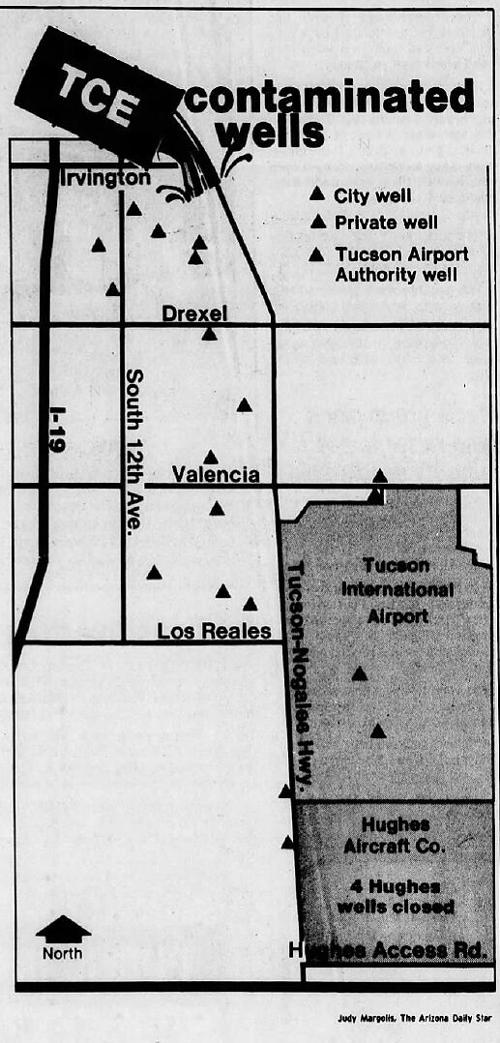
The cost of cleaning up Tucson's ground water may go as high as $79 million — almost four times as much as previously estimated, a city report concludes.
The report, to be presented to a legislative panel today by city officials, says Tucson's unfortunate experience with industrial dumping of trichloroethylene, or TCE, and other chemicals is a good reason to enact stricter regulations protecting the state's water quality.
According to the report:
• The cost of cleaning up TCE, chromium and other chemicals that seeped into the ground water from Hughes Aircraft Co. dumping has shot up from an earlier estimate of a high of $20 million to anywhere between $24 million and $79 million.
• The Air Force — which is paying the bills for the Hughes cleanup — is willing to leave more contaminants in the aquifer than the city "is comfortable with."
People are also reading…
The Air Force's current cleanup plan "presumes a 10-year operation" of pumping and purifying ground water "while cleanup probably will take longer." City and Air Force officials previously have said the cleanup could take 20 years or more.
• Seven city wells, at least eight private wells, an Arizona Air National Guard well, two Tucson Airport Authority wells and four Hughes wells have been shut down or are not being used for human consumption because their water contains TCE at more than 5 parts per billion.
Parts of the plume moving farther into the city and toward many municipal and private wells contain TCE concentrations as high as 16,700 parts per billion.
And the plume, which is apparently fed and enlarged by chemicals dumped at Tucson International Airport as early as the late 1940s, is spreading at 200 to 600 feet a year.
The Air Force has said the "jellybean-shaped plume" from Hughes — 14,000 feet long and 5,000 feet wide at concentrations of at least 10 parts per billion — is moving 500 to 1,000 feet a year.
A joint panel made up of the Senate Water Quality Study Committee and the House Study Committee on Ground Water Quality Protection will hear testimony today from Assistant City Attorney T.J. Harrison, city chief hydrologist Bruce Johnson and city lobbyist Bill Sheldon.
Sen. Greg Lunn, R-Tucson, and Rep. Larry Hawke, R-Tucson, co-chair the committee, established earlier this year to inform legislators on water-quality issues.
Two pollution cases are under discussion at today's hearing: "TCE and Hughes Aircraft Co. in Tucson" and "Green Valley Mines."
City officials are making the point that state and federal regulations governing waste disposal and water-quality protection have been inadequate.
Also, the city concludes in its report that the ground-water regulations that took effect in July are "fair, reasonable and potentially effective."
That enforcement program "is badly needed and should not be held in abeyance while interested parties battle over supervisory jurisdiction," the report said.
The report alludes to challenges by the Arizona Chamber of Commerce and the Arizona Mining Association, in and out of court and the Arizona Attorney General's Office, as to whether the Arizona Department of Health Services has the authority to force every potential polluter to stop contaminating rivers, lakes and ground water.
"Clearly, our existing means of waste disposal" landfills, pits and ponds "and our existing state and federal regulatory programs have failed to keep chemicals out of our water, soil and air. They have failed monumentally," the report said.
"Everything that Hughes did appears to have been under direct federal supervision, to have been within applicable standards and regulations and to be consistent with then-existing industry norms.
"That, in and of itself , is a valuable lesson to us. We cannot assume that chemicals will not migrate in the environment nor that they are harmless to humans," the report said. '
"Perhaps the most valuable lesson we have learned from this unfortunate event concerns relative cost — the low cost of proper disposal versus the very high cost of environmental cleanup."
Up to 25 percent of the aquifer underlying the Phoenix area already contains significant amounts of industrial and agricultural organic chemicals, the report said.
"We fancy ourselves the new Silicon Valley. But take a look at the original. They started before we did, have shallower water tables and sandy soils so they are an example and warning to us as to what will happen to us if we don't take proper precautions. Numerous chemicals from their electronics-manufacturing industries are showing up in their ground water in scores of locations."
The report quotes Phoenix hydrologist Ken Schmidt: "The worst aspect of this problem is the exotic nature of the chemicals. They are so new and are constantly changing so that no one knows what most of them will do to human beings. Moreover, they are not necessarily detectable by commonly used tests."
"In that sense, perhaps our problems are different than in other parts of the country; our problems may be worse," the report said.
Correction Sept. 25, 1984
A quote attributed in Friday's Arizona Daily Star to Phoenix hydrologist Ken Schmidt about the unknown nature of new chemicals used in the electronics-manufacturing industries should have been credited to a report by city of Tucson employees. Schmidt did comment about the chemicals appearing in ground water in scores of locations in northern California's Silicon Valley.
