

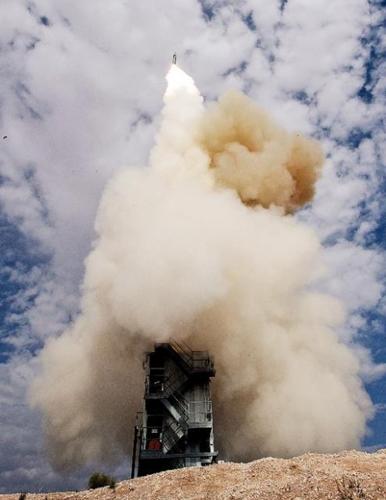
As a missile she helped build ascended into the desert sky above White Sands Missile Range in New Mexico, Jennie Elrod could sense the tension in the air. She knew that one miscalculation could mean disaster for her and her team.
But most of all, she knew she had come a long way from her high school classroom, which she had left only a few days before.
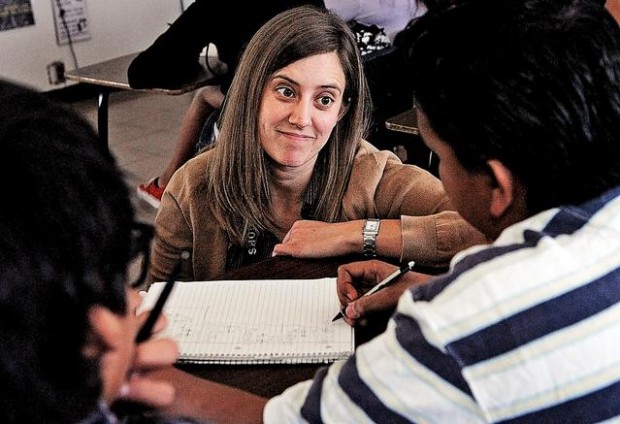
Elrod, an algebra and trigonometry teacher at Pueblo Magnet High School, 3500 S. 12th Ave., was part of new master's degree internship program that paired 20 local teachers with nine Tucson businesses, enabling the teachers to earn industry wages while they gained credit toward a degree.
Elrod, who analyzed numerical data as part of the Standard Missile-6 program, was one of 10 teachers to work at Tucson-based Raytheon Missile Systems, said Colleen Niccum, director of community and government relations for Raytheon.
People are also reading…
The internship, which was offered through a partnership between The Southern Arizona Leadership Council, the University of Arizona, Science Foundation Arizona and local business participants, lets the teachers take techniques used in industry and transfer them to the classroom. Science Foundation Arizona also paid 75 percent of the teachers' tuition.
The goal of the program, which places the teachers in internships over three consecutive summers, is to increase teacher retention while trying to get high school- and middle-school students excited about math and science, Niccum said.
"As you look at projections, we are very concerned about the decreasing number of engineers graduating from universities and colleges in the United States," Niccum said. "As a defense contractor, we have to hire U.S. citizens that can qualify for clearances. We don't have the option of recruiting from India and China, where those numbers are actually increasing."
Benefits all around
While introducing teachers into the work environment was not, initially, a popular idea, the experience ended up benefiting all parties, said Ronald Reid, engineering director of special projects at Raytheon.
"It really did not take them very long to get in and start contributing," Reid said. "Once they saw some of the equipment we were using, they got pretty stoked."
Julia Olsen, director of the Southern Arizona Science and Math Internship Center at the UA, said in the future, the partners will look to expand the internship program to other fields besides math and science.
"What you did in your high school math class is not what you do at work," Olsen said. (The question is) how can they make that high school- or middle-school learning experience more like developing the skills that the students will need?"
Over the summer, participants worked four days a week at their assigned business and took two courses on the fifth day. During the school year they must take five science or math courses that can be spread out over the course of the three-year program.
As part of her internship, Elrod was responsible for monitoring and evaluating data that the missile sent back to the design team. She was allowed to observe, from afar, the Sept. 5 missile test at White Sands.
Elrod said she had been looking at various master's programs but could not justify going into debt to earn a degree that would not have an exponential impact on her future earnings. She said this particular program allowed her to make a living, during the summer, while she got valuable experience that could be used to motivate her students.
"Being a high school teacher, I don't feel like my number one job is making sure they can all do algebra — I want to teach them those life skills," she said. Her experience at Raytheon has given her some new "street cred" with her students, she said.
Teamwork lesson
Two other Pueblo teachers, Elaine Straub and Joanna Stevens, also interned at Raytheon this summer. They said the biggest thing they took away from the experience was the idea of incorporating teamwork into the classroom.
There was an overwhelming response from teachers and businesses looking to join the program for next year, Niccum said. In order to make sure that participating teachers want to remain in the classroom, companies must sign an agreement to not hire the teachers for at least five years after the program begins.
Both Niccum and Elrod said they do not see that becoming an issue.
"Their mission is to be educators," Niccum said. "While they really appreciate the experience, they are excited about what they are taking back into their classrooms."
While there were some major differences between working on rockets and being a teacher, Elrod said, some things remained the same.
"What I try to get my students to do is, accept that mistakes happen, and we just work through it," she said. "At Raytheon, they make mistakes and they just redo it — it costs a lot of money, but that is what they expect to happen."
Other businesses that participated in the internship program were Sundt Inc.; BioVigilant Inc.; Beach Fleischman & Co PC; SEBRA; Texas Instruments; UA Biosphere 2; Fort Huachuca and General Plasma Inc.