

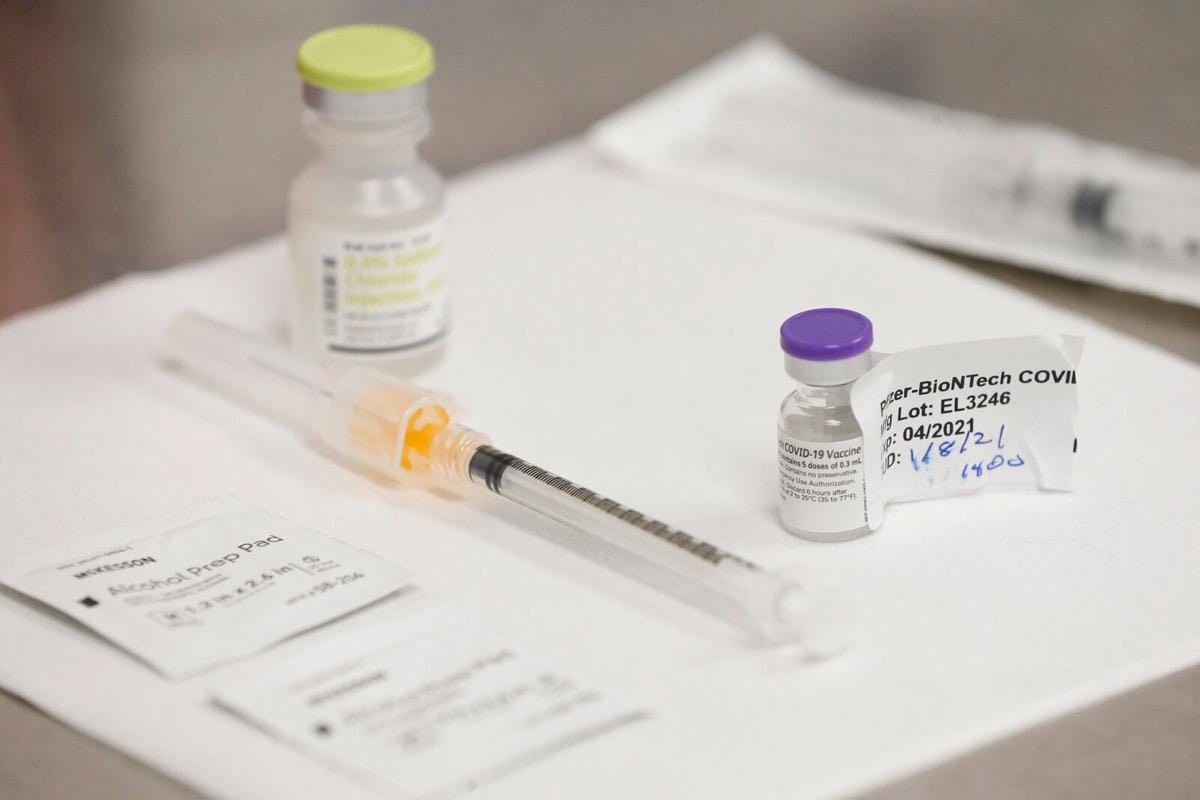
With just one of every four hospital workers in New York having received a Covid-19 booster shot, health care providers across the state know they have their work cut out for them to comply with a mandate that was approved Tuesday by a state public health council.
And many providers also are wary the requirement, which mandates health care workers get a booster shot within two weeks of becoming eligible, could drive more employees out of the industry during a staffing pinch.
"I'm concerned as a provider about the impact of this mandate this time, given where we're at as a provider community," said Thomas Holt, president and CEO of Lutheran Social Services in Jamestown. "Another 1% or 2% of the workforce out at this point, I think, is just going to have devastating effects potentially, and I struggle with balancing what I believe is the right thing to do, which is to get the booster, against our ability as a provider to provide care at this point."
People are also reading…
Holt was among the members of the Public Health and Health Planning Council to express concerns over the booster mandate during a special meeting called Tuesday to weigh several pandemic-related measures. While the council signed off on the booster requirement for health care workers, several members urged the state Health Department to take its worries into consideration as it prepares guidance on the mandate.
"The Health Department will provide workers and employers with clear guidance for implementation shortly," spokesperson Erin Silk said late Tuesday afternoon, noting the regulation is effective once it publishes in the State Registrar.
Like the state's requirement this fall that health care workers get vaccinated, the only exemption to the booster mandate is a valid medical reason, and there is no opt-out for getting tested instead of boosted, Gov. Kathy Hochul said Friday in announcing plans for the directive.

Like the original vaccine order last fall, there will be no opt out for getting tested instead of boosted. “You would want to make sure that anyone taking care of you is fully protected," the governor said.
Even before Hochul confirmed Dec. 22 the state was considering a booster mandate, health care employers had been encouraging eligible staff to get the shot, seeing it as the best layer of protection for the workforce and for patients against the virus.
A concern remains the large number of health care workers who have not gotten a booster, though not all are eligible yet because of when they completed their vaccine series. Current federal guidance calls for getting a booster shot at least five months after completing the two-dose Pfizer-BioNTech or Moderna vaccine.
As of Jan. 4, about 26%, or 129,582, of the state's 505,150 hospital employees had received a booster dose, according to figures provided by the Health Department.
The percentage was even lower in New York nursing homes, at 19.4%, and at adult care facilities, at 18.6%.
Bea Grause, president of the Healthcare Association of New York State, which represents nonprofit and public hospitals, expects those percentages to rapidly rise as more health care employees become eligible.
"If you've had both vaccines, why wouldn't you want to get the booster?" she said. "Why wouldn't you want to protect yourself? It doesn't make any sense to me, and why wouldn't you want to protect your family, and why wouldn't you want to protect your patients? People have to make their own decisions, but I think the vast majority will choose to get the booster."
During the state's vaccine mandate this fall, which went into effect Sept. 27, most employees complied and got the vaccine, though a low single-digit percentage of workers opted to lose their jobs instead. While that percentage was small, it still added up to thousands of employee terminations across the state, including hundreds in the five-county Western New York.

While the number of workers who lost or are losing their jobs is a small percentage of total workers, every little bit hurts amid a staffing shortage that means hospitals can't operate as many beds – especially during yet another wave of Covid-19 hospitalizations.
Now amid a surge of the highly contagious Omicron variant, health care employers are seeing an increasing number of workers testing positive for Covid-19, knocking employees out of work for at least five days and worsening staffing challenges. Hochul said the booster mandate will help keep essential health care workers on the job.
"Staff is getting sick, they're leaving," Hochul said Friday. "We need them to get well, we need them to have the best fortification they possibly can and that means getting a booster shot as well."

The fast-spreading Omicron variant also is hitting health care workers, with several hundred out sick with the virus as of Tuesday.
The state's large hospital systems, from Catholic Health System and Kaleida Health in Western New York to Long Island-based Northwell Health, said Friday they would comply with the mandate and have already been encouraging employees to get the booster shot. At Kaleida, 48% of the health system's roughly 10,000 employees have received a booster shot, Michael Hughes, Kaleida's chief administrative officer, said Friday.
But some providers also are wary of imposing another mandate on a beleaguered staff that is more tempted than ever to retire, quit or join the ranks of traveling workers who make more money.
Jericho Road, which provides health care for Buffalo's underserved and marginalized communities, said it has been advocating for its staff and patients to be fully vaccinated against Covid-19, including getting the booster shot. A joint statement from founder and CEO Dr. Myron Glick and Chief Medical Officer Dr. Allana Krolikowski said the vaccination and booster doses continue to save lives in the community.
"While we 100% believe in the vaccine and the booster, we are also concerned that the proposed mandate will drive away even more staff at a time when the field is sorely challenged by a pandemic deep into its second year," their statement reads. "Many clinics, doctors' offices, and hospitals are already short-staffed, which is concerning at the best of times. Unfortunately, these aren't the best of times and additional short-staffing is not only dangerous, but utterly unsustainable."
Christopher Koenig, president and CEO of Niagara Lutheran Health System in Lancaster, shares similar concerns, worried about how the loss of staff to this point has eroded the quality of care across the state. A booster mandate, he said, could worsen the staffing situation at Niagara Lutheran, which employs about 500 people.
"At Niagara Lutheran, we are all for the vaccines and the boosters, but what we definitely need is people on the ground," he said.
