

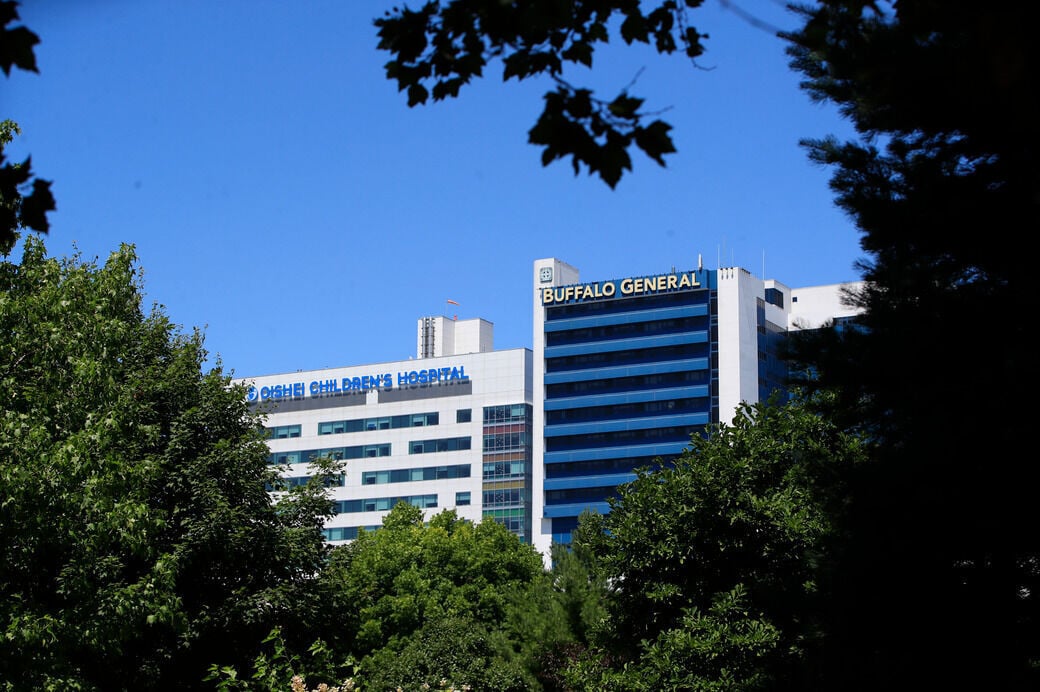
Kaleida Health and the unions representing its hospitals' workers have reached an agreement on an incentive program for employees who pick up additional shifts, seeking to ease a staffing crunch.
Like other New York hospitals, Kaleida's staffing situation has been aggravated by the pandemic, the state's vaccine mandate and a patient volume increase stemming from an ongoing strike at Mercy Hospital.
The agreement was reached Friday and went into effect Sunday, according to a copy of the memorandum of understanding posted on Communication Workers of America Local 1168's website.
CWA Local 1168, International Union of Operating Engineers Local 17 and 1199SEIU United Healthcare Workers East negotiated the "Critical Staffing Incentive Program" with Kaleida in talks that started last Tuesday.
The program allows registered nurses, technical and clerical workers, and service and maintenance employees to earn an extra payment of between $225 and $450 if they sign up for an additional scheduled shift each work week "over and above their regular schedule," the agreement states.
People are also reading…
The deal comes as Kaleida and Western New York's other health care providers juggle more patients amid a strike that has hit Catholic Health System's Mercy Hospital of Buffalo, which has temporarily idled many services at the South Buffalo facility as negotiations continue.
One of the primary issues that led to that strike, now in its 18th day, revolves around staffing levels, a topic that has proved difficult to remedy.
Shortly before noon Monday, Catholic Health spokeswoman JoAnn Cavanaugh had no updates but said the two sides were "still talking." The union representing the striking workers, CWA Local 1133, said Catholic Health presented a new offer over the weekend, which the union characterized as containing "positive movement."
"While we still have work to do, we feel that we're in a good position and will work as hard as possible this week to get to an agreement with the hospital that will benefit all of our members," the union said in an update to its members Monday afternoon.

The reasons health care workers cite for striking are similar: They have endured the demands and exhaustion of working through the pandemic and insist hospitals staff up to help shoulder the workload.
As it is, Mercy Hospital is operating with replacement workers but has suspended inpatient elective surgeries, labor and delivery services and has temporarily diverted incoming ambulances to alternate facilities.
That has put more pressure on Kaleida's hospitals and, as of 4 p.m. Monday, the emergency room wait times at Buffalo General Medical Center and Millard Fillmore Suburban Hospital were at least an hour.
In an Oct. 12 message to Kaleida's workforce, CEO Bob Nesselbush said the health system is facing challenges across its footprint. For instance, he wrote, Buffalo General is seeing record-high volumes in the ER, inpatient admissions and daily discharges. Oishei Children's Hospital, meanwhile, has seen high ER volumes, along with an additional four to six deliveries daily. And Millard Fillmore, too, is juggling high demand, while DeGraff Medical Park in North Tonawanda is seeing ER volumes not seen in four years.
"There are ambulance backups at all hospitals," Nesselbush wrote. "The Kaleida Health Laboratories, the Visiting Nursing Association of WNY, our ancillary services and staff, all sites, all locations... everyone is stretched to the max but delivering for our patients."
In the staffing incentive program, the first incentive period covers Sunday through Saturday. During this one-week period, registered nurses and professionals can get an incentive of $225, while technical and clerical workers can earn $162.50 and service and maintenance employees would get $112.50.
In a normal biweekly pay period, those totals jump to an additional $450 for nurses, $325 for technical and clerical staff and $225 for service and maintenance employees.
Moving forward, Kaleida will review the program on a pay-period-to-pay-period basis. The health system has the right to extend or end the program at any time, the agreement states, but will have to provide three days' notice to the unions.
The unions and Kaleida plan to meet to review the effectiveness of the plan after the first 21 days and then periodically as needed.

