

CHICAGO — Dilbert never had it so good.
Office work spaces keep getting smaller and privacy scarcer. But you'll be amazed at what's happening to the claustrophobic, high-walled cubicle that turned offices into ratlike mazes.
Some furniture designers are radically changing the cube in ways that provide privacy without closing workers in, while others are doing away with enclosures altogether to keep Generation Y happy.
In one new version of the cubicle, curvilinear panels of translucent glass with sliding doors and windows surround workers with light while screening out distractions. There are enough amenities inside these bright little spaces to coax even recalcitrant managers out of drywalled offices.
The new system by Herman Miller Inc. is one of many on view recently at NeoCon, the National Exposition of Contract Furnishings.
People are also reading…
The annual show is to the world of office, restaurant and hotel furnishings what Comdex was in its heyday to the computer industry. Exhibitors roll out products intended to dazzle the designer elite while providing a glimpse into interiors of the future.
This year's offerings reflected an industry reinvigorated by a healthy economy and commercial office market. Early registrations were up 40 percent compared with last year, to 45,000 attendees.
"It's all cyclical," said Cheryl Durst, chief executive of the International Interior Design Association. "All these industries feed off one another. When there's more building, there's more design."
The newest designs reflect more than changing sensibilities. Businesses operate differently from the way they did 40 years ago, when the open-office plan was introduced as a solution for fast-growing corporations.
"They were expanding internationally and turning over their space by 50 percent or more a year," said Jon Ryburg, president of Ann Arbor, Mich.-based Facility Performance Group Inc. "Reporting lines were being redrawn. The top-down hierarchy was beginning to flatten out.
"The idea was to leave floors unencumbered with walls, as big open spaces, and move in this very flexible furniture system that could be torn down almost overnight," Ryburg said.
Companies were willing to pay more for furnishings that provided interior walls. Cubicles with 6-foot panels, the kind satirized in "Dilbert" cartoons, also allowed them to cut costs by squeezing more workers into smaller spaces.
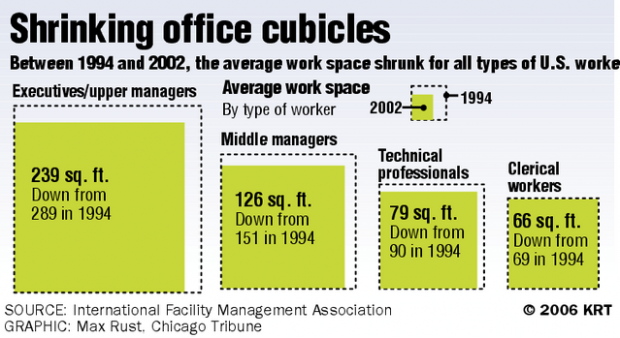
And that squeeze is continuing. The average middle manager's work space shrank by more than 16 percent in an eight-year period through 2002, to 126 square feet, while clerical staffers lost 4 percent, ending up with an average 66 square feet, according to the International Facility Management Association.
Today's corporations are equally cost-conscious, but they are changing even faster than when cubicles were novel. Technology has made workers far more mobile, and more work is done collaboratively. Cubicles, once the epitome of flexibility, are seen as cumbersome. "Scootable" furnishings are all the rage.
Some organizations also are looking for spaces that make employees happier and more productive, because competition is increasing for so-called knowledge workers: researchers, planners, programmers, engineers and the like.
"They're asking: What are we doing to address issues of personalization and control?" said Jan Johnson, marketing vice president for Allsteel Inc.
A recent study by Knoll Inc. of 850 white-collar workers found that 40 percent of Generation Y workers, ages 18 to 29, preferred open work spaces without panels.
"Young people do not want to work in a sea of cubes," said Christine Barber, Knoll's director of workplace research. "There's a very negative association."
Herman Miller's latest offering is glass-paneled workstations outfitted with doors, closets and furniturelike build-ins. Opaque interior walls are high enough to screen occupants from adjoining workers, but panels slide open to allow neighbors to talk face-to-face. Larger panels on outside walls also function like windows.
The My Studio system was developed by Montreal designer Douglas Ball, whose Clipper CS-1 computer workstation, housed in the permanent collection of London's British Design Museum, caused a stir at NeoCon in 1994.
"People are driving bigger and bigger vehicles, and they live in monster houses," Ball said. "When it comes to the office, the pressure of real estate costs, the need to squeeze more people on each floor (means) people don't have much say. My goal was to create the optimal small workstation."
The price tag, from $4,000 to $6,000 based on size and amenities, easily is triple that of a fabric-walled cubicle but many times less than a standard office.
Bill Clegg, managing partner at Connecticut-based Schoenhardt Architecture + Interior Design, chose My Studio for a financial institution's insurance operations.
"The sliding door is very important, because this is a sales operation where a lot of (employees) are coming out of private offices," Clegg said.