


There was a time when visitors to Tucson International Airport were greeted with a sign that read "Welcome to Tucson! Optics Valley" with a picture of a smiling Mayor Bob Walkup.
The sign's absence now — it was removed during airport renovations in 2005 and never replaced — is perhaps symbolic.
Local leaders say the industry is in need of revitalization after the departure of two local optics firms and layoffs at others.
Some say the name "Optics Valley" doesn't carry the same weight as it once did.
"You hear people call Tucson Optics Valley, but the name is not out as much as it used to be," said Ken Steele, director of operations for Kamen Aerospace.
But Bob Breault, chairman of Breault Research Organization, and chairman and founder of the local optics industry cluster, has big plans for the optics industry and high-tech industries across Arizona — including a goal of spinning off 100 startup companies from technologies developed at the three state universities.
People are also reading…
Many decades here
While efforts to build Arizona's biosciences industry into a national powerhouse have attracted much of the state's economic-development attention and money in recent years, optics have remained an important and growing high-tech sector.
Tucson's optics industry traces its roots back to 1942 when Henry Boeckeler founded Boeckeler Instruments Inc.
The industry grew rapidly in support of the state's observatories, bolstered by what is considered one of the nation's leading optical schools at the University of Arizona.
The Optical Sciences Center was established at the UA in 1964 with the backing of the Air Force Institute of Technology and the Optical Society of America. The UA created the College of Optical Sciences in 2005.
In 1992, Business Week magazine dubbed Tucson "Optics Valley," creating an economic-development mantra that boosted the local industry. The Arizona Optics Industry Association was founded the same year.
The local sector has grown from 72 members in the Arizona Optics Industry Association in 1995 to 365 members listed on the industry-cluster group's Web site this year.
The optics and related nanotechnology industries employ more than 25,000 people and account for about 1 percent of the state's gross domestic product, a report from the University of Arizona's Office of Economic and Policy Analysis shows.
Closures, job losses
More recently, the optics industry's future has been clouded by some significant company and job losses.
KLA-Tencor, which makes manufacturing controls and test products used by computer-chip makers, announced last summer plans to close its South Side facility and consolidate those operations at its headquarters in California and in Singapore, eliminating 100 local jobs.
Laser component maker Spectra-Physics said in August that it was laying off 79 of its roughly 200 employees as it outsourced some work to Asia. Texas Instruments is shedding 300 workers and consolidating its local offices.
And Aurora Optical Inc., part of Multi-Fineline Electronix Inc., shut down its South Side facility earlier this year, with 40 workers losing their jobs.
"Anytime you lose optics companies, it's a concern," said Bruce Wright, associate vice president for economic development at the University of Arizona.
There are also concerns over the ability to attract and keep highly qualified workers, and a drop in research and development funds from state and federal agencies.
"The optics industry has hit hard times," said Dave Dozor, CEO of Infrared Laboratories, a local optics cluster member that makes infrared microscopic cameras for industrial use. "The expectation is that the government will assist."
"It's not just optics; nothing is doing well," said James C. Wyant, dean of the UA College of Optical Sciences.
But industry leaders said optics is intertwined with so many different related fields and applications, it can weather almost any economic strife.
"It's the technology behind almost all other technologies," said Joe Snell, president and CEO of Tucson Regional Economic Opportunities Inc.
Other optics centers
Tucson also faces competition in marketing itself as a world center of optics technology.
"Of course, we in Rochester (N.Y.) claim to be the 'optics capital of the world,' " said Duncan T. Moore , a former associate director for technology in the White House and professor of optical engineering at the University of Rochester's Institute of Optics.
Tom Battley, executive director of the Rochester Regional Photonics Cluster, said the optics industry is seeing a delayed reaction to the nation's overall economic crisis. Most optics companies have flat earnings but are not seeing significant declines in revenue.
Some local leaders say a new marketing push is needed to help drive growth in Tucson's optics industry.
In 2001, the local optics industry launched a major marketing campaign aimed at Tucsonans and visitors. It was supported by a $26,000 grant from the Arizona Department of Commerce. Billboards were part of the campaign and read "Tucson's Future, Optics Valley."
But since then, many have noticed the lack of marketing of Tucson as Optics Valley.
"We can't rest on our past laurels," Wright said. "We need to ramp up our marketing campaign and stay at the forefront of the industry."
Wright cited the study from the Office of Economic and Policy Analysis that recommended, among other things, that the optics cluster organize a program of market development and assistance for cluster members.
Tucson is perhaps not as well known as an optics center as in the past because it's now more diversified with industries like aerospace and biotechnology, Snell said.
But Breault said Tucson is as visible as it can be, and other centers are envious of Tucson's visibility.
"I feel no shame in saying we are optics valley — the world knows that and if people in Tucson are so myopic that they don't get it, then I'm not going to let them put us down," Breault said.
Plans for the industry
Breault, who founded his optical software company in 1979 after earning a doctorate in optical sciences from the UA, also has some plans to boost the local industry.
Breault is known around the world for his optics-industry development efforts, and has been called the Johnny Appleseed of optics cluster groups for his work helping other regions create their own clusters.
"Bob has been a real driver in optics, and he's the guy who drove clusters," Moore said. "Bob embarrassed us in Rochester into moving forward because of his success in Tucson."
Breault said his latest plan for the local industry is to take optical and other technologies from Arizona's universities, turn them into commercial ventures and "wrap the clusters around them."
The universities would waive technology licensing fees for a finite time, but Breault said the startup companies would contribute to state funds in other ways.
Breault wants to create about 100 new technology companies with five students each that he says will make around $1 million a year in revenue. But, Breault said, even if the companies don't make money, the employees will buy houses and pay income taxes and contribute to state funds.
"It's only going to work if I get the cooperation of all the powers that be, but it's been done," Breault said.
One example Breault cites of how this will work is a similar plan in South Korea that he said created $1 billion in revenue over three years from 297 small optics firms.
"The real goal of this plan is employment," Breault said. "We're in uncharted economic times, and this is a plan to employ people and generate revenue."
Arizona optics and nanotechnology at a glance
• 68 percent of firms are in Pima County and 28 percent are in Maricopa County.
• 46 percent of optics firms have been in operation for more than 10 years.
• 56 percent of firms export to other countries.
• 25,535 people are employed in Arizona's optics industry.
• Local optics companies employ an average of 25 people each.
• The Arizona optics industry has annual revenue of more than $2 billion.
• Arizona companies have been involved in major international projects, including Composite Mirror Applications — recently honored by the European Organization for Nuclear Research for its work on the Large Hadron Collider.
Optics losses
Several local optics or optics-related employers have announced closures or cut jobs since mid-2007, including:
• Texas Instruments, 300 jobs
• KLA-Tencor, 100
• Spectra-Physics, 79*
• Aurora Optical, 40
• EOS Technologies, 30
*Includes 50 layoffs to take effect through the first-quarter of 2009.
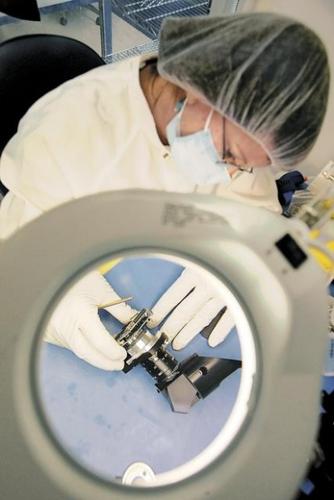
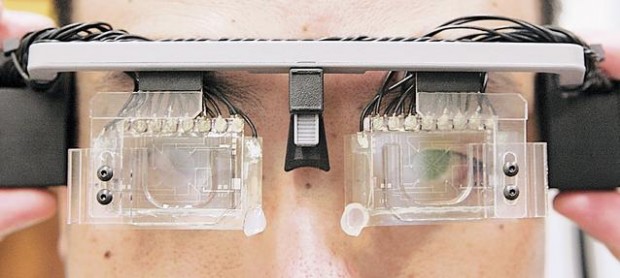
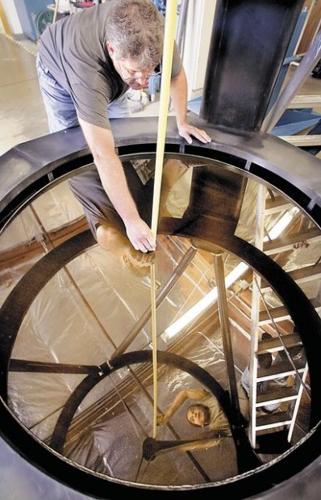
arizona daily star file photos Optics research areas in Tucson include so-called "smart glasses,'' upper left; work with fiber-optic strands, upper right; and assembly work, large photo.