

This summer, we are taking a look at some of the people in Tucson who help make the arts a reality in the Old Pueblo. This week: Stephen and Elaine Paul and their sculpted furniture.
Watch Stephen Paul caress a shapely piece of hand-sanded, delicately oiled mesquite and it's abundantly clear: This is not just a fleeting fling with wood. It is love.
"When I opened our business in 1984, I wanted to take this wild wood of the desert and turn it into really fine furniture," says Paul, co-owner with his wife, Elaine, of Arroyo Design.
The custom furniture company, at 224 N. Fourth Ave., crafts handmade pieces so exquisite that they've attracted buyers varying from Paul McCartney to the Dalai Lama — and corporate clients such as Warner Bros. Studios and the Ritz-Carlton Aspen.
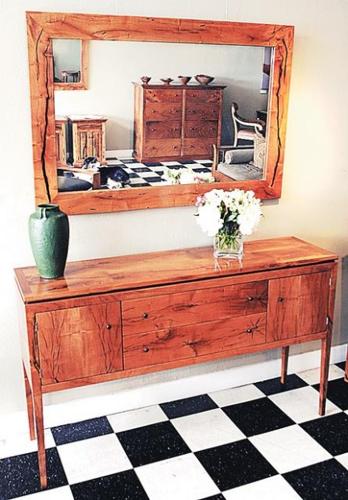
Known for his outstanding mesquite creations, Paul also designs furniture in other woods such as cherry, maple and walnut.
People are also reading…
His staff — eight people including himself — works in an expansive shop covering more than 6,000 square feet including a showroom and office.
Their handmade chairs, tables, armoires and other pieces — even a custom-made coffin — are produced one by one on an order basis for clients in this country, Europe and elsewhere. Prices reflect the painstaking craftsmanship and the company's reputation, bolstered by media coverage and advertising. A basic chair might sell for about $1,000, but some Arroyo armchairs go for $3,600 apiece and an art nouveau sideboard sold for $45,000 last fall.
"We basically reinvent the wheel with each piece," says Paul. "We have a wonderful little niche that's been keeping us going all these years."
Today, Stephen and Elaine Paul and some of their employees tell us about Arroyo Design and the art of making fine furniture.
Paul, 58, who moved with his family from California to Tucson when he was 11, attended Canyon del Oro High School and the University of Arizona. He became a schoolteacher and taught environmental education at the Kino Learning Center from 1972 to 1980.
Paul says he loved teaching but felt other callings as well. He attended architecture school at the UA for two years while Elaine was in law school.
The couple began restoring historic houses, and Stephen eventually dropped out of architecture school. It was the restoration work — dealing with old houses with limited closet space — that led him to design and build an armoire.
"I found I really liked working with wood," Paul says. "One thing led to another. I've been making furniture since the early 1980s, and it's always been learning as you go."
He founded Arroyo Design in 1984 while Elaine was working as a deputy Pima County attorney, and moved the shop to its current location in 1986. In 1989, Elaine left her law career to join in the furniture business.
Ask Paul what makes Arroyo thrive and he'll tell you it's the artisans in his shop and the great care they take with each piece they produce.
He speaks with admiration of Luciano Valencia,with whom he has worked for 22 years.
"Luciano has to care very much about what he's doing — about the product he produces," Paul says. "And he must have the technical ability. It's caring, ability and vision that allows you to carry out the product."
Walking through the shop, Paul drops kind words about other craftsmen, including Will McArthur and apprentice Rocky Serna.
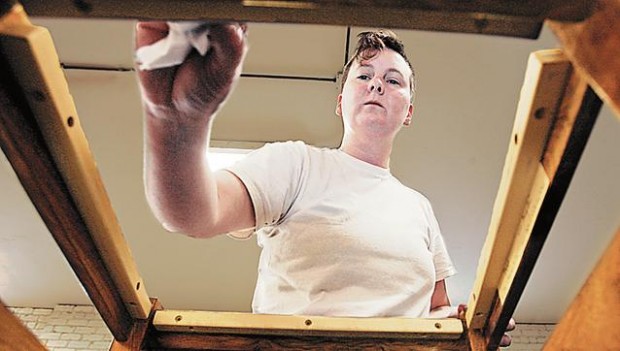
In the shop's sanding room, he stops to chat with finishing manager Angie Brock and finisher Brandon Phillips.
"The woodworkers kind of get the glory, but Angie and Brandon make us or break us," Paul says.
Among their tasks: applying eight to 10 coats of oil to each piece of furniture.
Brock appears to share Paul's infatuation with mesquite.
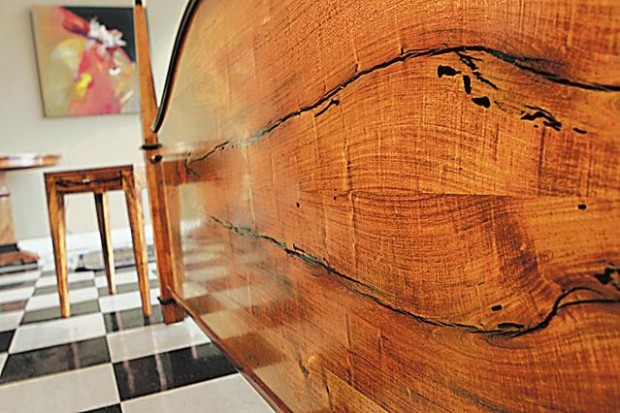
"It's beautiful wood," she says. "The patterns, the swirls, the knots — even the cracks — are beautiful."
Paul, for all his love of the wood that plays such an important role in his work, says the relationship between man and mesquite can be very trying.
"Everything with mesquite is a pain in the neck," he says.
For example?
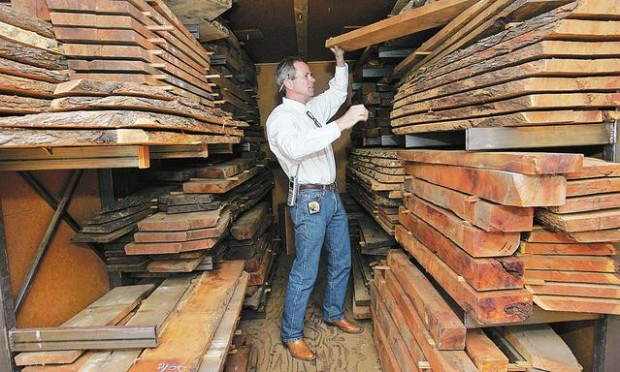
First, Paul says, there is the task of maintaining good relationships with suppliers in Sonora, where Arroyo Design obtains much of its mesquite.
And then there is the moisture thing.
"Wood for furniture has to be dried down to a 6 percent moisture content," Paul says. "Mesquite can be 80 to 88 percent moisture when it's cut."
Paul says that means air-drying freshly cut mesquite until its moisture content is about 20 percent — and then placing it in a kiln outside his shop. The kiln, with a propane heater, completes the drying process — creating a sweet fragrance as the moisture comes out of the wood.
Another challenge in making fine — rather than rustic — furniture from mesquite is dealing with cracks that are common in the wood. Paul and woodworkers in his shop fill the cracks with epoxy — a time-consuming process.
Ask Paul about the art of making fine furniture and he says: "I shy away from the term 'art.' What sets us apart is the effort we put into design. That's the title I feel most comfortable with: designer.
"But design can be excruciating at times — working to get it right," he adds. "What people often respond to in a piece of furniture is a whole set of nuances."
Elaine Paul, overhearing her husband's comments, suggests a sort of terminology compromise. "It's functional art," she says.
Clients — including singer Linda Ronstadt, actor Gene Hackman and writer Larry McMurtry, in addition to the aforementioned McCartney and Dalai Lama — apparently appreciate their functional art.
Several of the specially ordered items have brought a bit of mirth to Arroyo Design.
Paul recalls getting a kick out of "getting to sit cross-legged in the Dalai Lama's 'double-wide' chair before it got delivered."
And then there is the mesquite coffin.
Paul proudly shows off the beautiful burial box — a $9,000 creation special-ordered by a client who asked that it be lined with fabric from his old blue jeans.
"The buyer plans to use it as a coffee table" until it is required for its primary purpose, Paul says.
Stephen Paul's work will be part of an upcoming exhibition at the Etherton Gallery, 135 S. Sixth Ave.
The exhibition will include a new line of lighting fixtures resulting from a collaboration by Paul and Tom Philabaum of Philabaum Glass Studio & Gallery.
The show opens Sept. 12 and continues through Nov. 28. Gallery hours are 11 a.m. to 5 p.m. Tuesdays through Saturdays, with hours extended until 7 p.m. on Thursdays.
Contact
For more information on Arroyo Design, visit the company's Web site — www.arroyo-design.com — or call 884-1012.


