


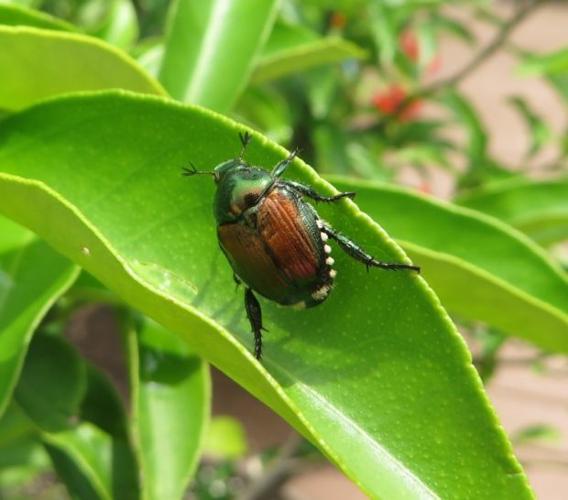

I found what looks like Japanese beetles on my roses. What should I do?
Japanese beetles have not been found in Arizona. We have some related native species that look like them and may feed on roses but not to the extreme that we see in other parts of the U.S. where Japanese beetles are common pests. The species you found is another scarab beetle, affectionately called Strigoderma sulcipennis, that is native to the Southwest. It has a green metallic color, and copper-colored front wings. You can tell them apart by noticing the white tufts of hair that Japanese beetles have on the sides of their abdomen.
The native species may have a few hairs there but nothing like the Japanese beetles. What you should do about them depends on your tolerance for a few holes in your leaves and the population on your plant roots. If the beetles are bothering you, walk around the roses with a bucket of soapy water and knock the beetles in. They can’t swim and the soap reduces the surface tension so they won’t float.
People are also reading…
If the grubs are eating roots so much the plants are suffering you can either dig the grubs out or treat the soil where they feed.
There has to be a lot of them to be concerned enough to treat, and you need to be careful if you choose to use pesticides. Make sure the product matches the problem and be sure to read the label to protect yourself and other non-target organisms.
Organic solutions that can work include beneficial nematodes. They move through the soil and get into the grubs and release bacteria that kill the grubs. The nematodes can’t survive light and heat and they require water in the soil to move about so late summer and early fall is a good time to treat with them as long as your plants are irrigated.
My mother-in-law plant has many leaves that droop and appear wrinkled for months. I have decreased the amount of watering and placed it near the west window. Miracle Grow was added recently. Would this plant fare best on a patio?
This plant that is sometimes called snake plant or mother-in-law’s tongue (Sansevieria trifasciata) is native to West Africa and likes bright indirect light although they can adapt to full sun. They do not like too much water and can rot if they are kept that way so it’s good you reduced the amount. It would be good to let it dry out between each watering and back off to once a month in the winter. I would use a cactus fertilizer during the growing season and none in the winter.
I am having a problem with my lemon tree. The leaves start out normally, then curl and have a whitish/grayish line on them. I am hoping that someone can help me figure out what to do.
An insect called thrips is feeding on your citrus leaves. These tiny insects get inside the leaf bud and feed on the new growth. Their feeding damage causes the disfigured leaves but it doesn’t do any serious damage to the tree.
The leaves are still able to photosynthesize and the tree will still produce fruit. So the nice thing is you don’t have to do anything.
Peter Warren is the urban horticulture agent for the Pima County Cooperative Extension at the University of Arizona. Send questions to plwarren@cals.arizona.edu


