


Anne-Marie Russell's favorite review of the minimalist exhibit currently at the Museum of Contemporary Art in Tucson came from a 9-year-old girl who turned to her mother and said: "When there is less to see, you look more carefully."
Looking, or "apprehending," is the innate skill that Russell, the executive director and chief curator of the museum, wants visitors to the former firehouse to employ, starting when they walk in and are confronted by a work from a previous show - a sentence painted on the wall that reads: "I'll try harder next time."
Inside, the pieces in the exhibition are unmarked - no artists' names, no year, no list of materials.
What is it? That's something you'll have to apprehend all by yourself.
Those details are available, of course, but Russell thinks it's important for museum visitors to "have a response to confronting something new. Everyone has the capacity to have an idea about something they've never seen before."
People are also reading…
Apprehending Art
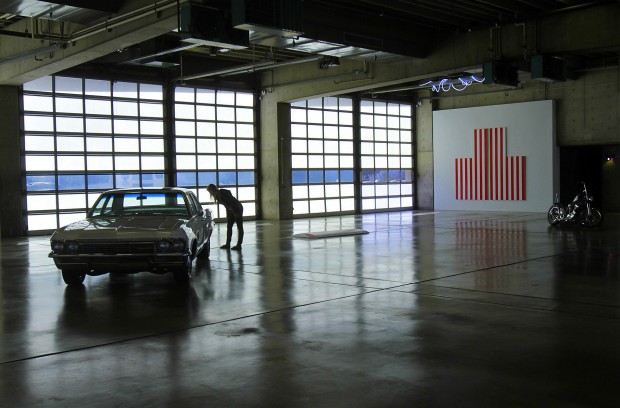
Here is what you would see today, if you walked into the museum's Great Hall, which until last year housed the giant ladder trucks and emergency vehicles of Tucson Fire Station One:
• A custom-painted and detailed 1965 Chevrolet Bel Air.
• A one-of-a-kind Harley motorcycle assembled by sculptors.
• A painted speed hump.
• A fluorescent light fixture with a neon tail.
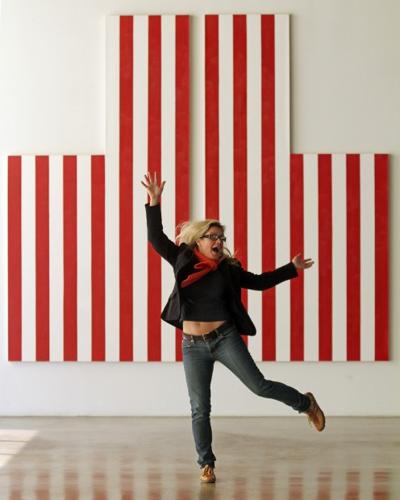
• Two large geometric paintings.
• Space - space big enough to make the large objects appear small and the collection of them sparse.
The current exhibition, "The Artist as Collector: Olivier Mosset," was assembled by Swiss artist Mosset, who now calls Tucson home.
Mosset "sought to democratize art through radical procedures of deskilling," according to the catalog prepared for the 2008 biennial show at the Whitney Museum of American Art. He painted circles on canvas - over and over. He painted monochromes in multiple iterations. He led movements of artists in Paris and New York that, in the words of MOCA's catalog for this show, "questioned authenticity, representation and the commodification of art."
It is the kind of art that makes you say: "Well, I could do that." Which is part of the point of democratization and deskilling.
Mosset's collection, gathered from friends, collaborators, teachers and students, has fun with his themes. The museum's smaller galleries are studded with riffs on minimalism - monochromes done in metal, covered in fake fur or painted with iridescent nail polish. There is even a set of "nesting" monochromes - canvasses behind canvasses, each a different color.
The only representational art in the collection is a series of posters by Emory Douglas, former minister of culture for the Black Panther Party in Oakland, Calif.
The posters, originally drawn for the back cover of the "Black Panther" newspaper in the '60s and '70s, remain politically provocative, even as historical artifacts.
"it's a beautiful space"
Sculptor Dave Lewis, who left Tucson for Brooklyn when MOCA was still housed in a warehouse on Toole Avenue downtown, is sold on the new museum space.
"It's beautiful space," Lewis said.
"It is real space, with the polished concrete floor and the concrete columns and beams. It doesn't have the structure of that sort of religious space a lot of museums do - the preciousness of grand foyers and unfolding views around galleries."
The building, mostly poured-concrete and aluminum-clad glass in a variation of the style known as Brutalism, is the work of William Wilde, one of Tucson's founding Modernist architects. You are tempted to believe that the frosted windows on the south bay doors are an exhibit themselves when they glow in mid-afternoon winter.
$1-a-year lease
The fire station is a good fit for contemporary art, said Russell, who also knows that it may be temporary space.
MOCA is leasing the former fire station from the city of Tucson for $1 a year for five years.
The museum is spending $125,000 to upgrade and remodel for its purposes. It is also paying all the bills.
"Do the math," said Russell, who has had to defend the arrangement against charges it was a "sweetheart" deal. "This is a building the city couldn't rent or sell," she said.
Russell said the building is being saved from possible demolition and the city is being spared the cost of upkeep, insurance and maintenance over the life of the lease.
The museum was the only bidder when the city requested proposals for use of the fire station. Russell said she's not surprised that others wouldn't risk it. "If and when the city gets a better offer, well, we have a five-year lease with a 365-day notice. If that means we have to leave, we have to leave."
"can-do spirit"
A year's notice is actually an improvement. At one time, MOCA was subject to 30-day eviction by the Arizona Department of Transportation.
When MOCA was founded in 1997 by a trio of artists - Julia Latané, James Graham and David Wright - its home was an ADOT warehouse on Toole Avenue where 20 artists had studio space.
"The old MOCA had some really can-do community spirit," said Lewis, "and it leaked and the lights didn't always work. There was zero budget. We learned how to plumb and borrowed money to build the walls. Latané schooled the rest of us on framing. Good old leaky, drafty, unheated, uncooled, uncomfortable MOCA."
Russell, an art historian who calls herself a "boring bureaucrat," joined in 2003 and took on the task of building an organizational plan for the curatorial, financial, educational and archival duties of a real museum.
She started a membership program and figured the museum needed "two solid years of programming" before it could apply for grants. "And that just worked out a little bit better than expected," Russell said.
MOCA was invited to apply for a Warhol Initiative from the Andy Warhol Foundation for the Visual Arts and received $110,000 in 2007.
It was later given an additional $50,000 by the Warhol Foundation to remodel its current building and an $80,000, two-year grant for programming. "That's what the big organizations get," said Russell.
Its budget for the fiscal year that ended in September 2010 was $274,000, with half the revenue coming from grants and gifts and the other half from memberships, fund-raising events, admission fees and sales in the gift shop.
Russell is still the only fulltime employee. Other duties are performed by part-timers, interns and volunteers. "Our shoestring is a little less frayed, but still a shoestring," she said.
MADE IN TUCSON
Russell said the museum has grown from its days as "the scrappy, crazy kids down the street in some old warehouse," but strives to retain the vision of its founders, who saw it as a way to showcase Tucson artists, while connecting to the larger art world.
That was the point of the museum's two-part opening exhibition: "Made in Tucson, Born in Tucson, Live in Tucson."
It featured works by artists who live here and artists from elsewhere with Tucson ties.
Taylor Baldwin, a Catalina Foothills High School graduate who now teaches at the University of Richmond, said he was impressed by the museum's new space when he was invited back to show his sculpture, but even more so by Russell.
"Anne-Marie is the first curator I've ever met who is really and truly excited about art. It seems like a really simple thing, but the first things she wanted to talk about were 'How did this piece happen?' and 'What were you thinking?'"
Baldwin said the show was a realization of MOCA's stated vision to be a "hub of community and a place where artists can gather. I met 40 different Tucson artists I never would have met if the venue hadn't brought us together."
MOCA Essentials
• Open: Noon to 5p.m., Wednesday-Sunday.
• Address: 265 S. Church Ave.
• Phone number: 624-5019.
• Free: Members, youth under 17, veterans, active military and public safety officers. Free for all the second Wednesday of each month.
MOCA events
• Tonight: 6 p.m., MOCA/Triple Canopy Vis a Vis with artists Robert Breer, Peter Young, Olivier Mosset and Alex Hay.
• Saturday: MOCA/Triple Canopy Solstice Party
• Jan. 15: 4 p.m., Genius talk by Jane Poynter and Taber MacCallum
• Jan. 29: 4 p.m., Genius talk by Diana Liverman
• Feb. 5: 4 p.m., Genius talk by Leslie Marmon Silko
• Feb. 19: MOCA Local Genius Awards Gala
• Details: For prices and reservations, visit http://moca-tucson.org
MOCA continuing events
Next Lounge: A free after-school program for high school students, Wednesdays 3-5 p.m., resuming Jan. 19.
MOCA Horizon
March: The works of Los Angeles artist Aili Schmeltz, who earned her master's of fine arts in sculpture at the University of Arizona, will be exhibited in the Great Hall.
Contact reporter Tom Beal at tbeal@azstarnet.com or 573-4158


