

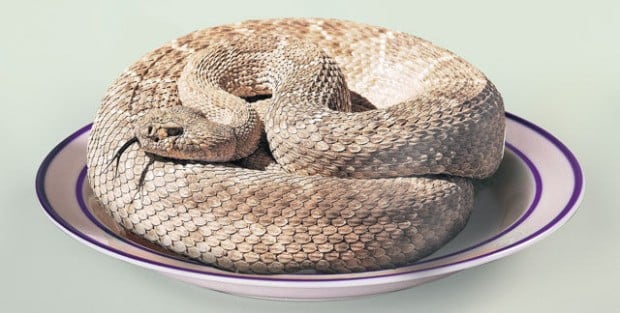
Rattlesnakes would just as soon not sink their fangs into human flesh, but they don't hesitate when disturbed.
More and more people are returning the favor and biting into the viper without fear — after it's dead and on a dinner plate, that is.
"We've seen a real jump in the popularity of eating rattlesnake," said Russell McCurdy, owner of Exotic Meats, a Texas company that sells everything from kangaroo to yak on its Web site.
"Rattlesnake is light and chewy," according to exoticmeats.com, "with a delicate flavor that resembles chicken. Rattlesnake chili is a favorite dish at a number of restaurants in the Southwestern United States."
We couldn't find even one joint in these parts that served rattlesnake chili (if you've seen it on a menu, let us know), but rattlesnake fillets are proudly served at one local restaurant.
People are also reading…
The Lodge on the Desert added rattlesnake about a month ago, and those who have ordered it so far are probably still chewing.
In her Jan. 9 review, The Star's Valerie Vinyard said the snake was "about three times chewier than calamari."
Chef Thayer Johnson has since tinkered with the way he prepares rattler.
"The toughest thing is just to get it tender enough," he said. "I marinate it in plain yogurt, rinse it and then put it in a citrus and cilantro marinade. Then I tenderize it with a meat tenderizer.
"After the marinade and everything, I dredge it in blue corn meal and fry it."
The result?
"Let's put it this way," Johnson said. "It's as tender as I'm going to get it."
Reaction from customers has been mixed, he added. "Some thought it was too chewy. A lot of people loved it."
Johnson says that there are only two ways to cook rattlesnake — "real fast or forever."
"Rattlesnake is basically one big muscle, and it's the most difficult thing I've worked with in terms of cutting and preparing. It's pretty laborious."
It's also really expensive, said Johnson, who buys it from a small purveyor in Phoenix that he declined to name.
"I pay $21 a pound and we serve a 4-ounce portion for $12," he said.
Johnson said he doesn't know of any other restaurants in Tucson that serve the lean meat.
"It was half a marketing idea and half a food idea," he said. "I wanted to get people talking, and it's gotten a lot more hype and publicity than I expected."
Of course, there's no law stopping you from finding, killing and cooking your own rattler. The Sonoran Desert, after all, is home to more rattlesnake species than any region on Earth.
If you'd rather not mess with live rattlers, knowing how they act when disturbed, you can call D'Angelo Bros. in Philadelphia at 1-215-923-5637. Rattlesnake meat sells for $25.50 a pound (bone in) or $35.50 a pound for boneless 8-ounce portions.
Exotic Meats, meanwhile, is sold out of rattlesnake and won't get more until May.
"But we do have python," said McCurdy, the owner.
Founded in Seattle in 1992, Exotic Meats went online in 1995 and moved its headquarters to San Antonio in 2006.
"Rattlesnake is exceedingly popular," McCurdy said. The biggest problem, he said, is that producers fail to keep up with the demand.
"The ever-growing challenge is to convince the public as to how good it is for them and to convince the farmers that people are buying it," he said.
"It's one of the very few products we have where we have to wait for the production schedule. We usually get it two or three times a year. We flash-freeze everything and we ship to all 50 states."
The farmers keep the snakes in a "contained situation," where they are fed "basically organic mice," McCurdy said.
Producers must process the snakes in a USDA- and state-recognized facility, said McCurdy, who added that there are no federal standards for snake meat.
It doesn't look like just another pound of hamburger when it's delivered to customers.
"When you unwrap it and look at it, you can say, 'Ooh, that's a snake.' Then all you have to do is thaw it out, stretch it out, cut it up and put it on the grill."


