

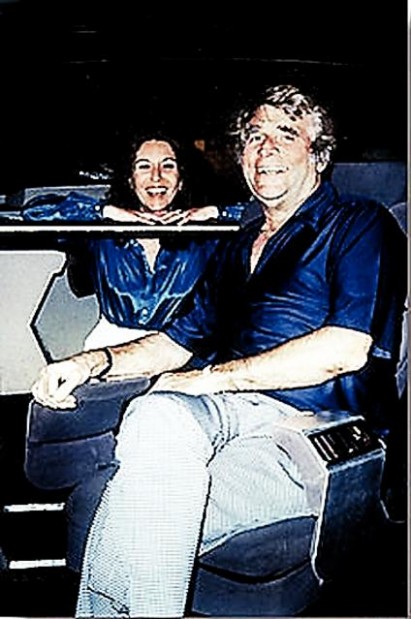
Susan Sackett was at "Star Trek" creator Gene Roddenberry's side for most of the final 17 years of his life.
She started working as his assistant in 1974, and was his production assistant on "Star Trek: The Motion Picture." She also worked with him on several other "Star Trek" films.
She was a production associate during the first five seasons of the television series "Star Trek: The Next Generation," and wrote scripts for episodes that aired in 1990 and 1991.
She has written 10 books, including a how-to guide about getting on game shows, but her most frequent subject has been "Star Trek" and her experiences with Roddenberry.
In her book "Inside Trek: My Secret Life With Star Trek Creator Gene Roddenberry," published in 2002, she alleges they had an affair during his marriage to actress Majel Barrett.
People are also reading…
Today Sackett travels the country talking to secular humanist groups about the movement's concepts, often tying them into "Star Trek."
"Gene was an optimist, and one reason 'Star Trek' had success and does hold up still is its outlook on the future. It's an optimistic one," Sackett said.
"It said that we had managed to overcome our differences, prejudices and wars and that we had made it into a successful, creative, productive future. That was the message he was trying to get across. It was all about the human condition."
Sackett watched the new "Star Trek" film by director J.J. Abrams Tuesday night at a Tempe press screening.
"I enjoyed the new 'Star Trek' very much. The new timeline will go a long way toward allowing future stories to develop without having to adhere to strict precedent," Sackett said. "I was especially pleased that the villain, Nero, turned out to have a reason for his actions — inappropriate though they were — rather than just being the 'heavy.' I also thought the casting, particularly the new Kirk and Spock, was spot-on."
Roddenberry introduced Sackett to secular humanism, which eschews supernatural beliefs and religion to focus on ethics and logic. She is now a board member of the American Humanist Association, and works with the Arizona chapter, which has more than 300 members.
Sackett moved to Scottsdale a few years after Roddenberry died of a heart attack in 1991, and lives with her two dogs.
Last fall she opened a bike shop in Tucson, the Arizona Electric Bicycle Company at 2563 E. Fort Lowell Road, but leaves most of its operation to her business partner.
What do you think about the "Star Trek" franchise wiping the slate clean and starting over?
"My original thoughts were that Chris Pine looked too young to be playing Kirk, but the actor showed the necessary maturity, plus his voice has a strong commanding authority that goes beyond his youthful appearance. He does make for a convincing captain.
"I also enjoyed the potential for a continuing romance between Spock and Uhura — brilliant! I think the franchise has been resurrected and will, hopefully, live much longer and help the studio to prosper."
Do you think "The Next Generation" is the best of the "Star Trek" series?
"Yes, but I worked on it. I'm a fan of the first 79 episodes (in the original series). The stories still hold up. I caught one the other night. . . . I think people relate to it because it has a purpose. It's not just a lot of flashing lights and gee-whiz special effects. It's got something to say."
Why did you wait so long write about your relationship with Roddenberry?
"At first I was just doing it for myself because it was so important to me. I had whole conversations in my head that I wanted to get down on paper. I'm a very organized person and I started chronicling and listing all these things — conversations we had and places we went together and I came up with pages and pages."
Is there anything about Roddenberry you'd like to share that might surprise people?
"He liked motorcycles. Not when I knew him, but before. He had been a pilot. He was a renaissance man. One of his hobbies was jewelry-making. . . .
"He was a voracious reader and his favorite character was Horatio Hornblower. Captain Kirk was patterned off of Hornblower."
How did Roddenberry introduce you to humanism?
"He gave me 'Asimov's Guide to the Bible,' which piqued my interest and led me to find out more about humanism. I became more involved in it than Gene, really."
What were the humanist aspects of "Star Trek"?
"There is respect for diversity, peace and philosophy. People fulfill themselves not by looking to higher sources or asking invisible deities to aid them. You have one life and you have to make the most of it."


