

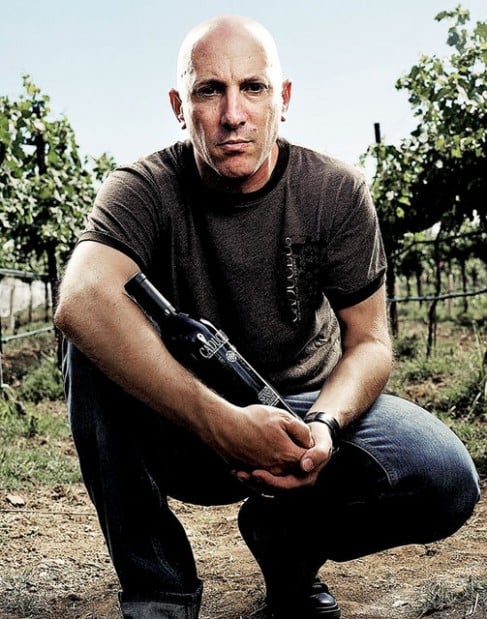
Maynard James Keenan, the frontman for hard-rock act Tool, the progressive group A Perfect Circle, and the experimental outfit Puscifer, is notoriously reclusive.
So when an e-mail arrived asking if we wanted to talk with him ahead of his Tuesday appearance at Whole Foods Market to promote his winery, Arizona Stronghold, it was a little like being asked if we'd be interested in talking with the Easter Bunny.
Keenan has lived in Jerome since 1995, although his presence in the state has always seemed more like urban legend.
He was drawn to the quirky Northern Arizona town after the area appeared to him in dreams.
"Trust your intuition," Keenan said recently from Los Angeles, where he was rehearsing for Puscifer's first concert.
Keenan, 44, is a longtime wine connoisseur whose great grandparents were vintners in Italy.
People are also reading…
It didn't take long before he started making wine in Arizona.
His Caduceus Cellars and Merkin Vineyards in nearby Cornville started releasing limited batches in 2004.
In 2007, he partnered with winemaker Eric Glomski to found Arizona Stronghold Vineyards, which has released three reds and one white.
According to the Web site, www.arizonastronghold vineyards.com, Arizona Stronghold produces wine primarily from its own vineyards near Willcox, but also uses small amounts of fruit from Colibri Vineyards in the Chiricahua Mountains, and smaller amounts from Page Springs Vineyards near Sedona. Some blending grapes also come from Paso Robles and Lockwood, both in Calif.
Keenan and Glomski have been doing West Coast bottle-signing tours at Whole Foods Markets to promote Arizona Stronghold.
While other interviewers have noted how funny and down-to-earth Keenan was in conversation, his tone with us more matched his music in Tool: intense, deadpan, with little room for nonsense.
The things bothering Keenan at the moment weren't exactly the existential — he had just set up his new Apple Mac Pro Tower computer and hadn't known that the hardware to connect to Apple's wi-fi network, AirPort, didn't come pre-installed.
"I'm just going what? What person in the current world does not need AirPort hardware for their computer?" he said. "Come on."
Here's a few other things Keenan spoke about in our 15-minute conversation.
You once called Arizona the evil anti-California, but you've never really seemed to have had a great deal of love for California. Is that part of why you like it here so much?
"When you say, 'the evil anti-California,' it's always like, when you're watching cartoons there's the Elvis and the evil anti-Elvis. He's not evil-evil, he's just kind of his counterpart that doesn't really go by the rules. Arizona's definitely that state. We have scorpions and black widows and rattlesnakes and javelinas that attack you and Republicans."
Initially, I think people were surprised to hear you were getting involved in doing (winemaking), but it sort of seems like wine is really just another extension of being an artist. Is there a sort of delicate art of achieving that taste you're looking for? I'm imagining it correlates to music, too. Could you talk about that?
"Well, I guess the reason I haven't spoken too much about the music in the past is because people don't really want to hear.
. . . They have this vision of you sitting down and you have this song in mind and you write it down and then you go in and go 'Here's how it's going to be,' and you have it all planned out. And you've got this idea of how the album's going to sound and how the songs are going to sound and what they're going to specifically be about.
"And it really isn't like that with us. And that's probably what separated us from every other musical process in other bands, because we don't go in with any preconceived notions.
"We get in a room and we listen. And we react. And we listen. And we react.
"And that's, to me, the exact same way you have to work with making wines. You have to listen and look and smell and taste and touch and react. The weather is going to present you with different challenges. Whatever happens with those particular grapes is going to present you with different challenges. Some grapes ferment faster and hotter than others, and you got to wrangle that in and kind of guide it. But you basically have to react."
But I'm assuming you have a specific thing you're looking for. Is it kind of like you'll know when you get there? You'll know when you taste the wine that it's right?
"Yeah. What we want to do with the wine we're making in Arizona is make sure that we allow it to taste like Arizona.
"There's ways to kind of manipulate a wine into making it taste exactly like some particular area or some other area of the world. And that's OK if you're looking for a nice, easy way to sell wine to people that are familiar with that taste from that particular area. And the buzzwords that surround that particular kind of wine. What we're trying to do is allow Arizona to express itself.
"So our goal, if there is one, is to allow that to happen. Which means we have no actual pre-conceived notions of where it's going to go. We're allowing it to lead us."
How are you doing that? When you say, "let it taste like Arizona," how can you do that with wine?
"Just by not getting in the way. Don't over-oak it. Don't put new oak on the wine. Don't manipulate it too much."
Let it talk to you?
"Yeah, you let it talk to you. If a wine is well made . . . and you're familiar with an area. And that's the other part, you kind of have to be familiar with the area. Because then sitting there in the middle of Burgundy (France), having a little glass of wine and a small snack at a small bistro, and you've been out walking through the fields and you've smelled the surrounding smells and see the landscape and feel the weather. If there's a wine from that spot, you should be able to drink that wine from wherever you are in the world, and remember that specific spot."
Are you finding now there's less time to sort of dig into the emotional depths that fans, musically, in your writing, have come to expect? Is there still time to do that now?
"I just think it's a different set of emotions. A different set of challenges. Whether or not someone who's 12 can relate to it, I've never really taken issue with that. From the beginning we've always been about expressing . . . if we were as true as we are about expressing what we're expressing, diving into whatever it is that suits our fancy. Whether it's some issue we need to work out or whether it's some idea we want to see through, we've always been, with all my partners, Eric, Billy (Howerdel of A Perfect Circle), (Tool band mates) Danny (Carey) and Adam (Jones) and Justin (Chancellor), everybody, everybody — it's always been about us being true to that process. And seeing it through. And it's never been about whether or not someone is going to relate to it or not."
These wine signings are at Whole Foods. I'm guessing the crowds that come out to these signings aren't the typical Whole Foods customers. Could you talk a little about your experiences doing these?
"It's been good, because you have a lot of people that some would consider them coming out for the wrong reasons. I just think they're coming out for a reason. What I think they don't expect is that they might actually go home and then realize that they might have gone there for one reason, but now they've discovered a whole other reason to go back."
And you're obviously for that.
"Yeah. It's opening up a whole new understanding. A whole new realm of art that they might not have gotten before. This is something that I really related to with Peter Gabriel, David Bowie. There are artists who just were artists. They're not necessarily just the one-dimensional rocker dudes. They're artists. They're painters, they're chefs, they're actors, producers, architects."
So it's just another extension like we were talking about . . .
"You need to remind people that you're allowed to do other things."
This is sort of moving away from the wine thing, but you mentioned in a 2003 interview about how you see a lot of patterns in the behavior of this country being parallel to the fall of Rome and Germany. What do you make of where this country is at now?
"I think we're doomed (laughs). Sorry (laughs). But I don't necessarily think that that's a bad thing. I think we've fallen short. I'm not sure if you're a fan of (comedian) David Cross."
Yeah.
"But he's being cynical of course, and he's being funny, but he's saying if electric scissors and Paris Hilton is all we're going to do with our freedom, then we probably should have some of it taken away and start over. (Laughs). If that's what you're going to do with it, then you probably don't deserve it. So I think in some ways there's got to be some struggle to kind of grow and move forward. So perhaps an economic crunch will get people back to focusing on what's really important and what really matters: keeping things a little closer to the home and building from there. Rather than completely losing touch with simple things, like where your water comes from, how to make food for yourself, how to survive without an ATM card."
Do you have hope for the future?
"Of course. I wouldn't be doing what I'm doing if I didn't. I think vineyards definitely are that cornerstone."
Of the?
"Vineyards are one of the cornerstones throughout Europe of a strong community, a bullet-proof economy, a bullet-proof local community, family orientated, farmers and architects and artists all coming together to survive the hard weather."
If you go
• What: Maynard James Keenan with Eric Glomski signing bottles of wine from Arizona Stronghold Vineyards
• When: 4:30-7:30 p.m. Tuesday.
• Where: Whole Foods Market, 3360 E. Speedway.
• Cost: Free when you buy a bottle of wine from Whole Foods at the event.
• More info: arizonastrongholdvineyards.com and wholefoodsmarket.com.


