

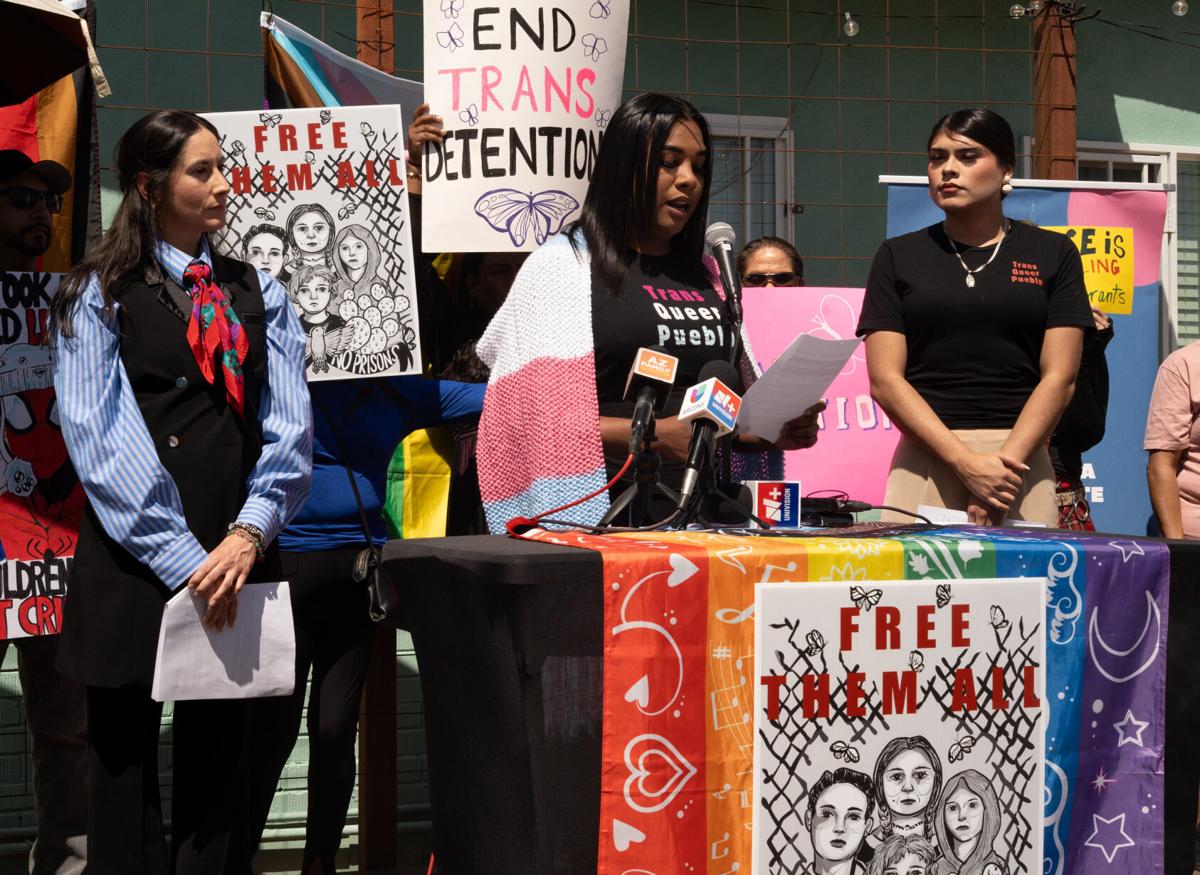
Karla Saenz is a 26-year-old asylum-seeker from Venezuela.
During a routine March 9 check-in with U.S. Immigration and Customs Enforcement, the transgender woman was taken into custody by federal immigration officials and transported to an immigration detention center in Eloy.
To her horror, she was placed in an all-male unit even though she requested to be placed with women. While in the all-male unit, Saenz says she experienced abuse by detention officers.
The guards "went out of their way" to verbally abuse Saenz by intentionally misgendering her, she said. She said they disparagingly called her "man" as many times as they could to humiliate her.
The guards at the Eloy Detention Center withheld Saenz's prescribed hormone therapy for a month while she was at the facility, she said April 28 at a news conference organized by the advocacy group Trans Queer Pueblo.
People are also reading…
ICE did not respond to requests for comment on why Saenz was detained or why her medication was withheld from her.
Before President Donald Trump returned to the White House in 2025, the conditions for trans people in ICE detention were "already at a really dangerous baseline," said Yasemin Smallens, LGBT Rights acting researcher for Human Rights Watch.
Research conducted by Human Rights Watch showed that trans women in ICE detention face high risks of "stigmatization, sexual violence, denial of medical care, or prolonged wait times in terms of receiving that care," Smallens said.
Since Trump signed the "Defending Women from Gender Ideology Extremism and Restoring Biological Truth to the Federal Government" executive order on Jan. 20 during his first day in office, Smallens said the conditions for trans people in ICE detention have "only deteriorated."
What was ICE's policy for trans detainees before Trump?
The executive order required that people in federal custody, including immigration detention, be "placed in facilities based on their sex assigned at birth rather than their gender identity," according to a report from the Vera Institute and the Jan. 20 executive order.
Before the executive order, ICE issued its "Transgender Care Memorandum" on June 19, 2015, which provided guidance to ICE Enforcement and Removal Operations, or ERO, "regarding the placement and care of transgender detainees" in ICE custody.
To ensure the safety of trans detainees, the memo said ICE ERO "shall make individualized placement determinations" for detainees who identify as transgender.
The memo has since been removed from the ICE website, according to Smallens and the Vera Institute. The Arizona Republic referenced a copy of the memo provided by the Vera Institute via the Internet Archive Wayback Machine.
Smallens said the guidance on the memo "was acknowledged but it didn't really fix the problem" of risks faced by trans people in ICE detention.
The memo "lacked certain enforcement mechanisms that would have made it stronger," Smallens said.
The memo was "a patchwork policy" that did not provide specific guidance on placing trans detainees, Smallens said.
Even before the executive order was put in place, Smallens said, Human Rights Watch encountered several trans women who were still put in all-male units while in ICE detention.
"Placing trans women in men's units is not a failure to follow the rules anymore. Rather, it is kind of the federal guidelines that's been set forth," Smallens said.
'The guards made my life hell'
When Saenz was in ICE detention, she said she went a week before she was able to take her first shower because the guards were afraid that she would be "abused or raped by the other detainees," said Sonix Flores, a spokesperson for Trans Queer Pueblo.
"Even ICE admitted they do not have the infrastructure necessary to keep me safe," Saenz said.
Saenz said the guards frequently and intentionally called her "man" to break her mental health.
While in ICE detention, Saenz was accidentally given medication that she "did not need nor solicit," she said. The medication made her mind "cloudy" and "confused."
She did not know the name of the medication, but the guards told Saenz that it was for anxiety, she said. Saenz said the guards admitted to her that they prescribed the medication to her on accident.
"The guards made my life hell," Saenz said.
ICE did not immediately comment regarding the medication incident.
Back into her 'organizer mindset'
This was not Saenz's first time being placed in an all-male immigration detention unit.
When Saenz first immigrated to the United States two years ago, she was put in an all-male unit at an immigration facility in Texas while she went through the process of seeking asylum, Flores said.
Saenz was shortly released from ICE detention and chose Arizona as the state to undergo the asylum process, Flores said.
Saenz chose Arizona because she had heard from a friend she made on her journey to the United States that Trans Queer Pueblo was based in Arizona, Flores said.
For two years, Saenz has been an active organizer with Trans Queer Pueblo, Flores said.
Even while she was in the Eloy Detention Center, Flores said Saenz told the male and trans women detainees about the "know your rights" sessions held by Trans Queer Pueblo.
Saenz even held informal transgender history lectures for the male detainees to teach them that "transgender people have always been here," Flores said.
Flores said she believes that Saenz was almost meant to be an organizer because as soon as Saenz was placed at the Eloy Detention Center, "she went back into her organizer mindset."


