TusCon, Arizona’s longest-running science fiction, fantasy and horror convention, will return this fall with a unique interactive theatrical partnership.
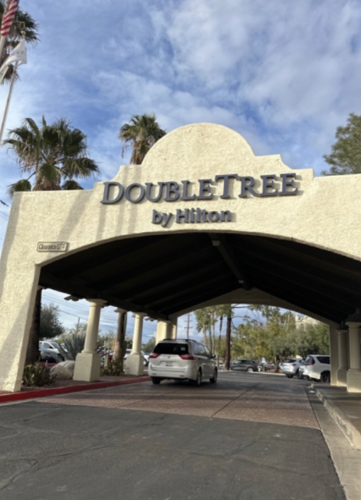
Running Nov. 13-15 at the DoubleTree Suites by Hilton Hotel Tucson Airport, the event features a collaborative performance with the University of Arizona School of Theatre, Film & Television.
In addition to the theatrical showcases, the convention will host workshops, gaming, an art show and autograph sessions with major genre creators.
The convention started in 1974.
Screening history
A central highlight of the event this year is a reenactment of Karel Čapek’s 1920 play, “R.U.R.,” or “Rossum’s Universal Robots.”
The work famously introduced the word “robot” to the English language. Today, the term is a cornerstone of daily life, science fiction and artificial intelligence, said director of the play, Gloria McMillan.
People are also reading…

The DoubleTree by Hilton Hotel Tucson Airport is the venue hosting the upcoming TusCon science fiction convention on Nov. 13-15.
“We have a generation here with absolutely ground zero knowledge,” she said. “They use the word robot all the time, but they have no idea of the historic origin and development of that term. The robot melts with AI. They’re both together; they’re linked to this.”
McMillan, an alumna of the UA playwriting program and a member of the Dramatists Guild, partnered with UA professor Rowena Mackay to recruit student performers for the project.
For McMillan, bringing the script to TusCon is a personal mission.
“The man who wrote this play, Karel Čapek, was nominated for the Nobel Prize seven times, and his play went all over the world,” she said. “He was as famous as Stanley Kubrick. Much more so, maybe. But times change, and some things fall through the cracks. That’s what our theater specializes in. I have a personal passion for this play because of the overlooking of something so major.”
From assembly lines to AI
“R.U.R.” served as a foundation for the modern sci-fi genre, McMillan said.
The narrative follows an aging scientist named Rossum who invents a chemical substance that mimics living tissue, attempting to engineer biological life to prove that God does not exist. Later, a factory manager explains that the engineered robots possess no souls, feel no pain and exist solely to serve humans.
“It was closely related to the Russian Revolution and to the labor issue, because this play addressed contemporary issues of its time,” McMillan said.
Čapek’s vision of technology was remarkably ahead of its time when written a century ago, she said.
“We just had industrialization, and Henry Ford’s assembly line had just come in,” she said. “Imagine being in 1920 where horses were still out on the streets, cars hadn’t totally taken over, and somebody writes something that is so contemporaneous and even looking toward the future now.”
In the play, a crisis arises when human birthrates drop to zero. A doctor secretly modifies the robots to give them consciousness and feelings. The robots, realizing they face extinction, develop deep connections with one another as they prepare to inherit the Earth.

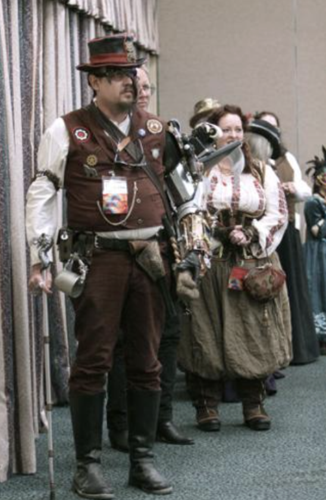
Jeff Bohnhoff leads an interactive session on sci-fi worldbuilding and fandom history during the 2017 TusCon session at Tucson Convention Center.
Challenging expectations
Rather than performing on a distant stage, student actors will bring the narrative to life by roaming the convention floor. For the cast, diving into a 106-year-old script shattered modern preconceptions of the genre, they said.
“I thought it was going to be stereotypical robots or AI, but the images of the characters look very human,” said Julia Ferret, a senior studying live and screen performance alongside communication. “They look almost like prisoners. People who had cardboard names on them and were so sad. I became so interested to figure out where that came from and how that evolved into the robots we know today.”
Camille Rosenthalle, a senior majoring in live and screen performance from New Jersey, who has been acting for 10 years, said the biological nature of Čapek’s creatures gives the cast richer material to perform.
“Knowing that they were almost humanlike is what makes it more fun for us as actors,” she said. “If it was what we thought it was, the surface-level metal robot, there wouldn’t be much to do with that.”
Bringing humanity to the floor
Staging a thought-provoking play in the middle of a bustling sci-fi convention presents an unusual structural challenge for the production team.
“This is not just a theater where people show up at 2 o’clock to see a play. You have to know what the venue is,” McMillan said. “This venue is a convention where people will be pulled to go to the art show, the masquerade and various events. We have to draw them in and make it fun.”
To cut through the noise, the interactive setup uses student actors to break the fourth wall and pull convention attendees directly into the narrative. McMillan said this human element demonstrates why live theater remains vital in a digital world.
“Theater is one step removed from sitting before a screen and clicking a button. So why would anybody want to see people in person? That brings up the whole issue of humanity,” she said. “Theater gives an added note of humanity. We’re bringing that important human aspect in with the robots who will be singing robot songs and acting as MCs around the convention.”
Rosenthalle said she hopes the performance encourages attendees to view history through a modern lens.
“In college, it’s all about exploring new things, and this is something I’ve never really heard of before,” she said. “I would challenge people to come try something new that they wouldn’t usually attend.”
Full weekend and single-day passes can be purchased directly at the registration booth in the hotel lobby or through the official TusCon Convention website.
Arizona Sonoran News is a news service of the University of Arizona School of Journalism.