


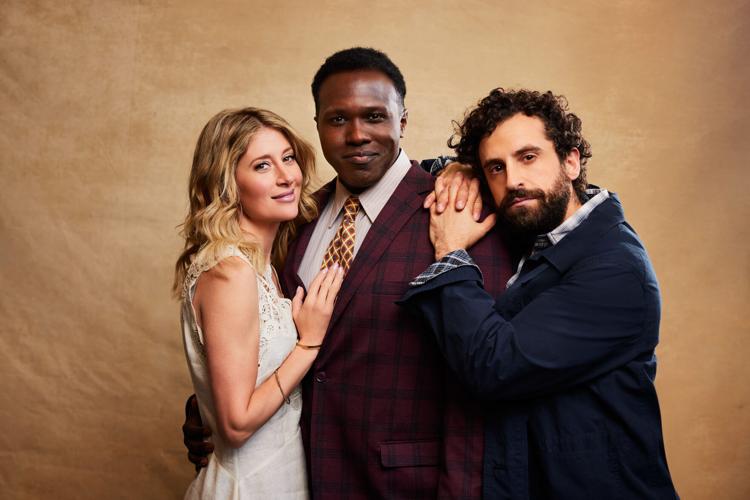

"Ragtime" is a lot like “Chicago”: It arrived at the wrong time. When it debuted in 1996, “The Lion King” also was on the boards and wowed Tony voters.
Now, after a bit of distance — and with Lear de Besonnet’s timely direction — it’s the perfect show for 2026.
Based on E.L. Doctorow’s novel, Terrence McNally’s book, Stephen Flaherty’s music and Lynn Ahrens’ lyrics, comment on the divides evident in America.
Three distinct groups clash at the start of the 20th century. Wealthy business owners, immigrants and minorities have their own ideas of the American dream and don’t necessarily agree with the others. How they intersect — a hallmark of Doctorow’s story — is why this musical works so effortlessly now.
Joshua Henry wows as Coalhouse Walker Jr., a ragtime musician who wants the spoils of his own success. When others trash his car, he’s incensed and tries to appeal to authorities. When they don’t respond, he takes matters into his own hands. Meanwhile, a wealthy fireworks family fears what Walker’s advocates could do if he continues to call on a woman at their home. An immigrant (Brandon Uranowitz) grazes both sectors and, soon, this revival of “Ragtime” parallels 21st century fragmentation.
People are also reading…
Working on a simple turntable, the actors slide in and out of the story, surprising as Mother (Caissie Levy) finds her own voice when Father (Colin Donnell) is away. When she finds a baby in her garden, she takes him in, finds his mother (Nichelle Lewis) and connects them to Walker.
Before long, Harry Houdini, Emma Goldman, Booker T. Washington and Henry Ford also are in the story.
De Besonnet has streamlined the sprawling journey so that it’s accessible. In the process, characters who may have been trampled by others come to the front. Chief among those is Ben Levi Ross as Mother’s Younger Brother. He sympathizes with Coalhouse, but lives in the world of the powerful. He identifies with the immigrants, too, and supports Goldman’s causes. He’s the hub of this spinning wheel, thanks to Ross’s enlightening performance.
As the story heats up, Henry grows in stature. He’s the force that gets us to rethink our stance on capitalism and racism.
Levy isn’t as strong, and Uranowitz frequently gets overlooked. But they’re still cogs in the wheel that just keeps spinning.
When “Ragtime” cycles down, it’s clear it has left an impact. Will it change those who see it? Perhaps not. But it should nudge them to pause before doubling down on their beliefs.
“Ragtime” is a force.


