

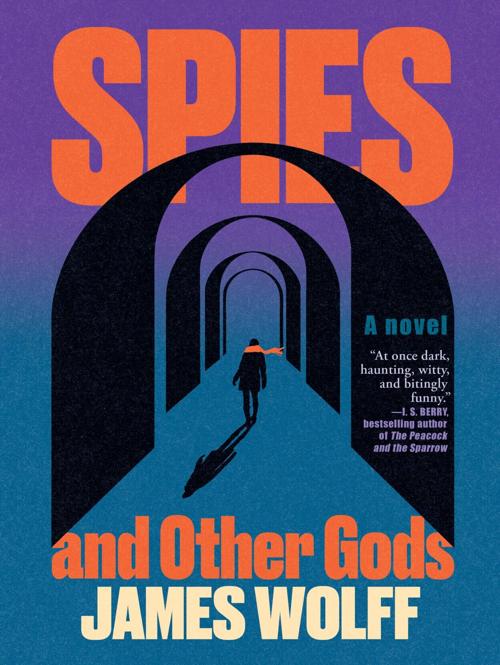
James Wolff is not his real name, but the former spy who writes under that nom de plume is the author of “Spies and Other Gods,” a splendid mystery set in the world of espionage. It’s got a unique way of telling its story, which we won’t spoil, and characters who are unexpectedly more than you first imagine.
Wolff agreed to answer our questions, and left his encoded responses at a secret dead drop location. Or did he?
Q. Please tell readers about your new book, “Spies and Other Gods.”
The seed of the idea for “Spies and Other Gods” lies in an official report written by the U.K. parliamentary committee that oversees the spy agencies. In this report, the committee complained that spy chiefs were blocking their staff from whistleblowing directly to the committee, instead forcing them to make their complaints through internal channels. This started me thinking along two lines. The first was that spies can be extremely obstructive and unhelpful! The second was a question: what would complaint number 1 look like? From there, my story took me to an Iranian assassin, an international manhunt and an awful lot of dark secrets.
People are also reading…
Q. You worked in intelligence (as have other authors in your genre): Why do you think former intelligence officers write books (and do you all get together in an undisclosed location to compare notes)?
Great question! I wish I could give you a definitive answer. For me, the answer lies in the way that spying is all about character, psychology and motive – which are things that preoccupy fiction writers too. Spies are natural observers, natural watchers. They like to collect details that allow them to build up a profile of an individual. As for the secret meetings with other spies-turned authors in an undisclosed location, I can’t possibly comment…
Q. A follow-up to the previous question: You write, “Anyone who chooses writing spy novels over spying can’t have been much good in the first place,” and I’d love to hear more about that. (While I’m sure it’s a winking joke, if you have more to add on the subject, that’d be great.)
I’m really just poking fun at myself with this line. There’s a lot of myth-making in spy literature. And there are a lot of people in the spy world itself who take themselves just a little bit too seriously. I want people to read this book because they enjoy the writing, the characters and the humour, not because they think it was written by a super spy.
Q. Without giving anything away, you have a unique approach to how you tell this story. Is there a way you can talk about that?
I’ve been preoccupied for a while now with the idea of collective identities. In an organisation like MI5 or MI6, you have all the thousands of employees with their separate identities and then above them all, floating like a kind of deity, is the organisation’s identity. So often it’s hard to pin down responsibility for a decision or a policy to one individual, because the truth is that the decision has been taken collectively, by this supra-identity. I thought it would be interesting to write a novel with the organisation itself providing the narrative voice. In this case, a voice that is spiky, provocative, argumentative, defensive, cynical and – I hope – lots of fun.
Q. What are you reading now?
I am reading “Lonesome Dove,” which is every bit as gripping as I was led to believe. I’ve always loved Cormac McCarthy’s westerns, like “Blood Meridian,” and it’s been so interesting to see the same landscape from a different perspective. It’s also made me very glad that I wasn’t born into that exceptionally violent and brutal world.
Q. Is there a book or type of book you’re reluctant to read?
I hate to admit it, but I very rarely read spy novels. It might be that I spent fifteen years as a spy, which gives me a low tolerance for unrealistic scenarios, or that writing my own spy novels means that I’m desperate for a palate cleanser at the end of the day. There are spy novels I love – like “Harlot’s Ghost,” “The Quiet American” or “The Untouchable” – but it’s not my genre of choice.
Q. Is there a person who made an impact on your reading life – a teacher, a parent, a librarian or someone else?
I remember an English teacher when I was aged around 12, and a lesson in which we were going around the class reading our essays aloud. Mine was a pretty unremarkable account of something, but I still remember the way the teacher stopped me, asked me to re-read a sentence and then said that the essay was worth it for that one sentence on its own. I realised in that moment that a sentence can be a thing of beauty.
Q. What do you find the most appealing in a book: the plot, the language, the cover, a recommendation? Do you have any examples?
When Henry James was asked about his books, he replied that his objective was to write interesting things in one beautiful sentence after another. I can’t think of a better way of putting it. I love words, a distinctive style, a writer who knows what they’re doing and has interesting things to say along the way.


