

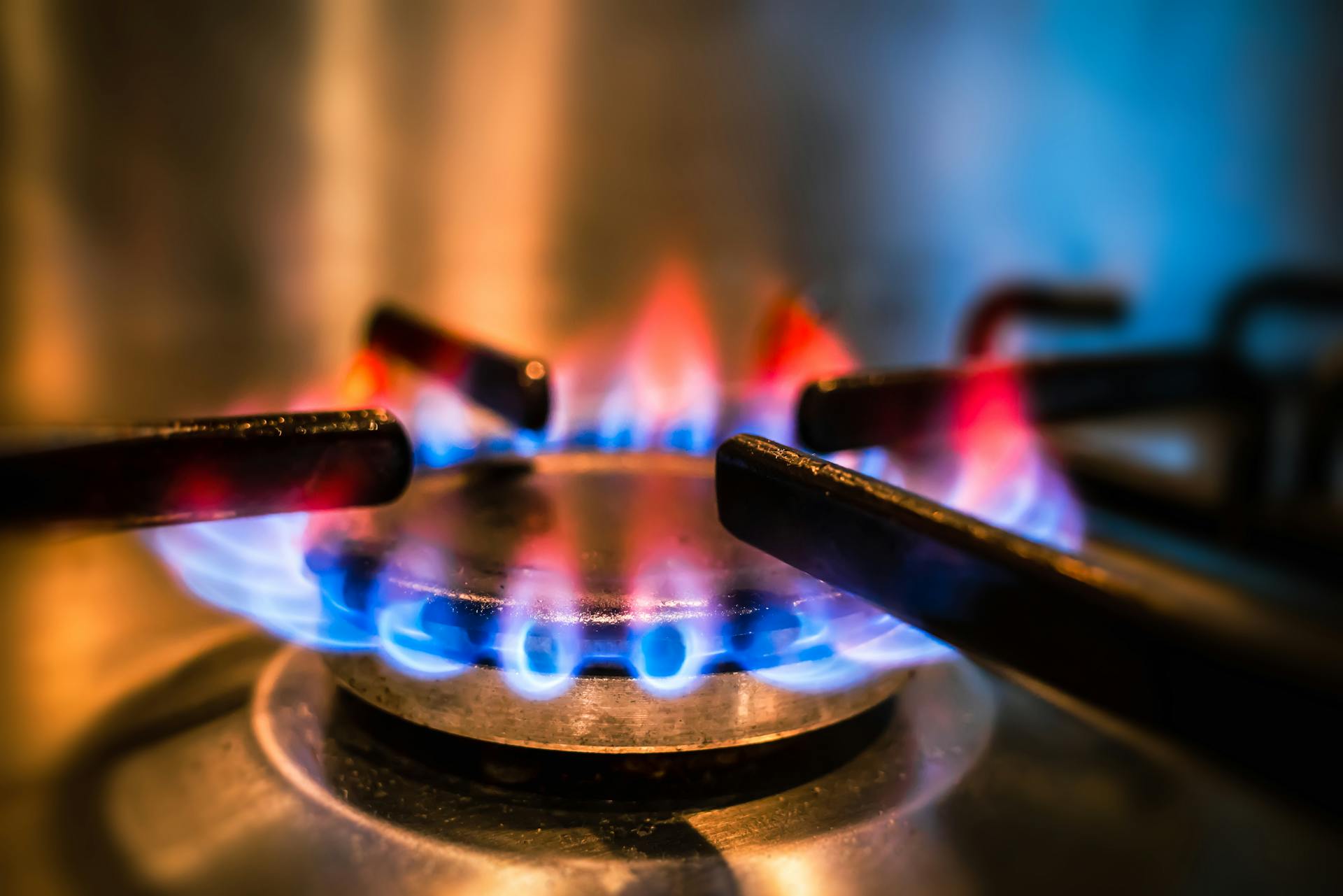
 A growing body of research suggests that gas stoves can pose health risks, especially for people with respiratory ailments. Sean Gladwell/Getty Images
Cooks love their gadgets, from countertop slow cookers to instant-read thermometers. Now, there’s increasing interest in magnetic induction cooktops – surfaces that cook much faster than conventional stoves, without igniting a flame or heating an electric coil.
Some of this attention is overdue: Induction has long been popular in Europe and Asia, and it is more energy-efficient than standard stoves. But recent studies have also raised concerns about indoor air emissions from gas stoves.
People are also reading…
Academic researchers and agencies such as the California Air Resources Board have reported that gas stoves can release hazardous air pollutants while they’re operating, and even when they’re turned off.
As an environmental health researcher who does work on housing and indoor air, I have participated in studies that measured air pollution in homes and built models to predict how indoor sources would contribute to air pollution in different home types. Here is some perspective on how gas stoves can contribute to indoor air pollution, and whether you should consider shifting away from gas.
Natural gas has long been marketed as a clean fuel, but research on its health and environmental effects is calling that idea into question.
Respiratory effects
One of the main air pollutants commonly associated with using gas stoves is nitrogen dioxide, or NO₂, which is a byproduct of fuel combustion. Nitrogen dioxide exposures in homes have been associated with more severe asthma and increased use of rescue inhalers in children. This gas can also affect asthmatic adults, and it contributes to both the development and exacerbation of chronic obstructive pulmonary disease.
Nitrogen dioxide in homes comes both from outdoor air that infiltrates indoors and from indoor sources. Road traffic is the most significant outdoor source; unsurprisingly, levels are higher close to major roadways. Gas stoves often are the most substantial indoor source, with a greater contribution from large burners that run longer.
The gas industry’s position is that gas stoves are a minor source of indoor air pollutants. This is true in some homes, especially with respect to exposures averaged over months or years.
But there are many homes in which gas stoves contribute more to indoor nitrogen dioxide levels than pollution from outdoor sources does, especially for short-term “peak” exposures during cooking time. For example, a study in Southern California showed that around half of homes exceeded a health standard based on the highest hour of nitrogen dioxide concentrations, almost entirely because of indoor emissions.
How can one gas stove contribute more to your exposure than an entire highway full of vehicles? The answer is that outdoor pollution disperses over a large area, while indoor pollution concentrates in a small space.
How much indoor pollution you get from a gas stove is affected by the structure of your home, which means that indoor environmental exposures to NO₂ are higher for some people than for others. People who live in larger homes, have working range hoods that vent to the outdoors and have well-ventilated homes in general will be less exposed than those in smaller homes with poorer ventilation.
But even larger homes can be affected by gas stove usage, especially since the air in the kitchen does not immediately mix with cleaner air elsewhere in the home. Using a range hood when cooking, or other ventilation strategies such as opening kitchen windows, can bring down concentrations dramatically.
Ventilation is an essential tool for improving indoor air quality in homes.
Methane and hazardous air pollutants
Nitrogen dioxide is not the only pollutant of concern from gas stoves. Some pollution with potential impacts on human health and Earth’s climate occurs when stoves aren’t even running.
A 2022 study estimated that U.S. gas stoves not in use emit methane – a colorless, odorless gas that is the main component of natural gas – at a level that traps as much heat in the atmosphere as about 400,000 cars.
Some of these leaks can go undetected. Although gas distributors add an odorant to natural gas to ensure that people will smell leaks before there is an explosion risk, the smell may not be strong enough for residents to notice small leaks.
Some people also have a much stronger sense of smell than others. In particular, those who have lost their sense of smell – whether from COVID-19 or other causes – may not smell even large leaks. One recent study found that 5% of homes had leaks that owners had not detected that were large enough to require repair.
This same study showed that leaking natural gas contained multiple hazardous air pollutants, including benzene, a cancer-causing agent. While measured concentrations of benzene did not reach health thresholds of concern, the presence of these hazardous air pollutants could be problematic in homes with substantial leaks and poor ventilation.
Reasons to switch: Health and climate
So, if you live in a home with a gas stove, what should you do and when should you worry? First, do what you can to improve ventilation, such as running a range hood that vents to the outdoors and opening kitchen windows while cooking. This will help, but it won’t eliminate exposures, especially for household members who are in the kitchen while cooking takes place.
If you live in a smaller home or one with a smaller closed kitchen, and if someone in your home has a respiratory disease like asthma or chronic obstructive pulmonary disease, exposures may still be concerning even with good ventilation. Swapping out a gas stove for one that uses magnetic induction would eliminate this exposure while also providing climate benefits.
Slashing Home CO2 emissions: IRA can "...supercharge home electrification by providing generous rebates and tax credits to install heat pumps, solar panels and other appliances." IRA also has $4,000 rebate to help pay for electrical system improvements. https://t.co/Fh5r7KOzdK
— John Raymond Hanger (@johnrhanger) August 18, 2022
There are multiple incentive programs to support gas stove changeovers, given their importance for slowing climate change. For example, the recently signed Inflation Reduction Act of 2022, which includes many provisions to address climate change, offers rebates for the purchase of high-efficiency electric appliances such as stoves.
Dozens of U.S. cities have adopted or are considering regulations that bar natural gas hookups in new-construction homes after specified dates to speed a transition away from fossil fuels. At the same time, at least 20 states have adopted laws or regulations that prohibit bans on natural gas.
Moving away from gas stoves is especially important if you are investing in home energy efficiency measures, whether you are doing it to take advantage of incentives, reduce energy costs or shrink your carbon footprint. Some weatherization steps can reduce air leakage to the outdoors, which in turn can increase indoor air pollution concentrations if residents don’t also improve kitchen ventilation.
In my view, even if you’re not driven to reduce your carbon footprint – or you’re just seeking ways to cook pasta faster – the opportunity to have cleaner air inside your home may be a strong motivator to make the switch.
___
Jonathan Levy has received funding from the National Institutes of Health, the U.S. Environmental Protection Agency, the U.S. Department of Housing and Urban Development, and the Health Effects Institute for studies on the contribution of outdoor and indoor sources to air pollution levels in homes.
___
These cities are better at enduring extreme heat. Here's how they're doing it
Beating the heat

Blistering heat has returned to western Europe, as some countries like France enter into their third wave of the summer with temperatures expected to reach over 100 degrees Fahrenheit (37 degrees Celsius), while more than 80% of the U.S. population will experience temperatures over 90 degrees (32C) within the next week, including in the Mid-Atlantic and Northeast. Around 100 million Americans have been under heat alerts for eight of the past 16 days.
This means hundreds of millions of people living in urban areas are again desperately trying to stay cool.
Air conditioners might keep the indoors cool, but they only add to heat outdoors. And in most cases, they are adding to the climate crisis by increasing planet-warming emissions. Public transportation may be unbearable on a hot day, but driving a car that runs on gas instead just worsens traffic, also adding to heat and emissions. A lack of trees means a lack of shade, and buildings made of dark materials bring hotter interiors, which means more air conditioning.
It's a vicious cycle, but there are other solutions.
Here's how eight cities are taking some of the heat out of their summers.
Medellín, Colombia: Grow trees on the streets, not just in parks

When it gets really hot, people with air conditioning might stay indoors, but not everyone has that luxury and — well, who wants to say in all the time?
For cities that aren't on the coast, parks that offer shade are a good option. Colombia's second-largest city, Medellín, however, has created an entire metropolis of shade with its award-winning Green Corridors project.
The web-like network has transformed 18 roads and 12 waterways into lush green cycling lanes and walkways that connect the city's parks and other frequently visited sites.
Temperatures have come down in these areas and their surrounds by as much as 5.5 degrees Fahrenheit (around 3 degrees Celsius), and officials hope that before 2030, it could shave off up to 9 degrees Fahrenheit (5 Celsius).
"Urban forests are the very best thing for city heat," Kathy Baughman McLeod, director of the Adrienne Arsht-Rockefeller Foundation Resilience Center (Arsht-Rock) at the Atlantic Council, told CNN. "Medellín has dropped the city's average summer temperature, which is remarkable."
By 2019, the city had planted more than 8,000 trees and over 350,000 shrubs. It also uses an area beneath a raised Metro line to collect rainwater that flows down from the bridge, capturing it in a system of pipes to help water the green belts.
Vienna: Splish, splash, splosh

Like in much of Europe, many in Vienna don't have air conditioning, so water is a big part of how the Austrian capital keeps cool.
For those who don't have time for a dip in the Danube, the city offers cooling parks with mist-spraying "trees" that people can either "shower" in, or just sit near to enjoy the cooler temperatures they bring their surrounds.
Children, who are generally more vulnerable to extreme heat than adults, are often seen playing in the city's splash pools or running around in pop-up water features — typically hosepipes with holes punched in them — that the city government brings out on the hottest of days, including in areas like Karlsplatz, a popular city square.
Vienna also has a huge number of water fountains for drinking to keep people hydrated — more than 1,100 for its population of 1.9 million — which is important in preventing heat-related illness.
"Air conditioning in homes may sound like a quick and easy solution. But it's not a long-term sustainable solution because of the source of the power and the waste heat that comes off the unit," McLeod said. "So thinking about how to get more airflow, use water features and get windows to open in some of the oldest buildings is key. The nature-based solutions are the best for extreme heat."
Paris: Get really organized

The French capital gets seriously hot.
Temperatures there have surpassed 104 degrees Fahrenheit (40 Celsius) this summer, but the combination of high-rise buildings, limestone monuments and busy asphalt roads means it can feel even hotter.
The city has a strong urban heat island effect, where it is often 18 degrees hotter in the city center on a summer's day than it is in the Parisian hinterlands.
But Paris Mayor Anne Hidalgo has been credited with putting in place some of the world's most innovative measures to combat heat, and the city's heat plan is truly comprehensive.
The main result is a city full of "cool islands." Parisians can use an app called EXTREMA to guide them to more than 800 cool spots — parks, water fountains and air-conditioned museums, for example — and get there via a naturally cooled walkway. The idea is that a cool island is always a maximum seven minutes' walk away for everyone.
Like Vienna, Paris uses mist machines on hot days. It also has dozens of new "splash fountains," in addition to its many traditional fountains, which are very shallow pools with fountain-like effects.
Paris' heat plan involves a register that identifies the most vulnerable, so officials can check up on them by phone and offer advice on staying cool. Kindergartens get temporary air conditioners in their classrooms, and public parks and pools stay open for longer hours into the night. And like LA, Paris is trying to take the heat out of its roads and sidewalks by "demineralizing them," using more porous materials. Now that sounds like a plan.
