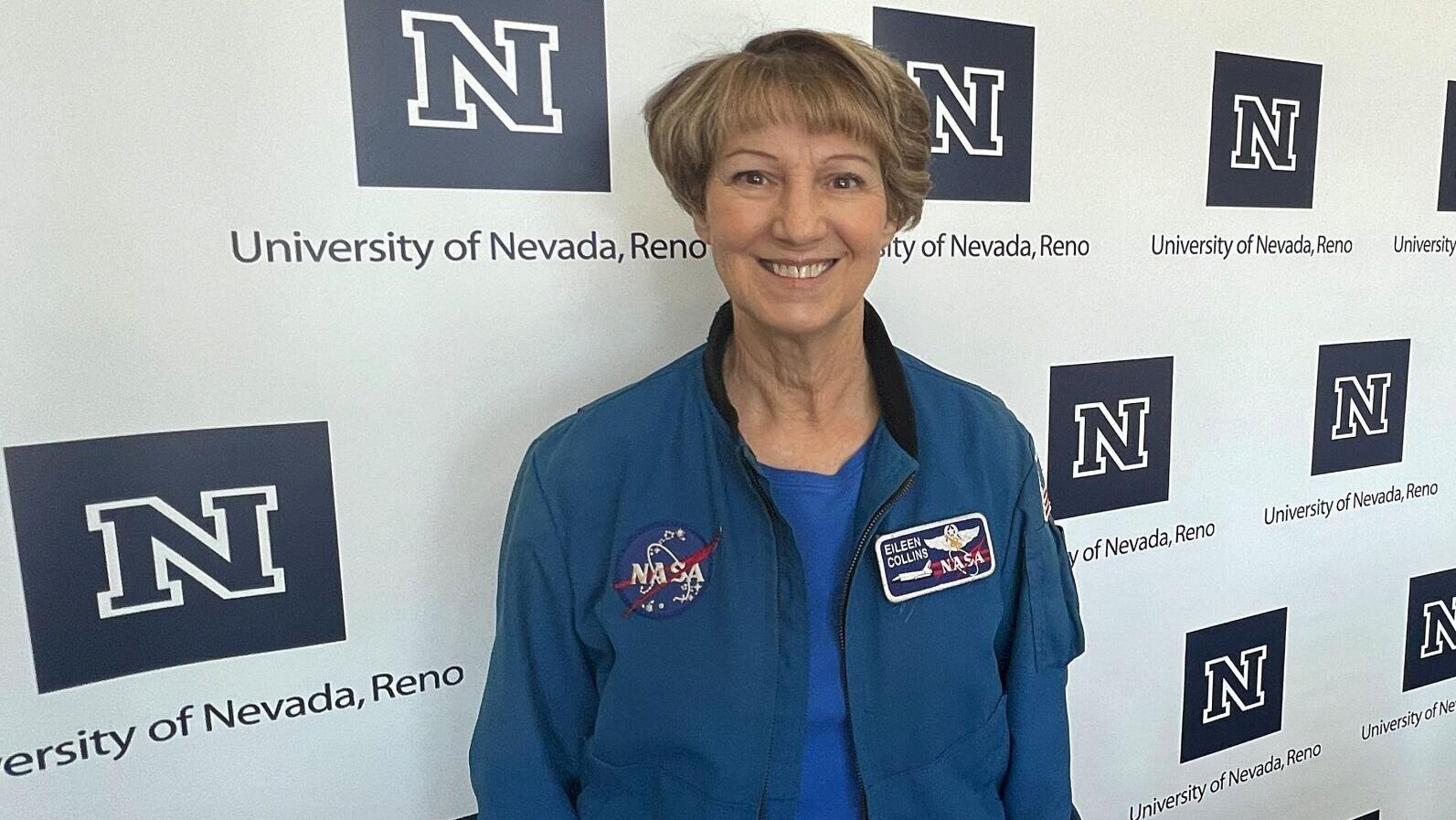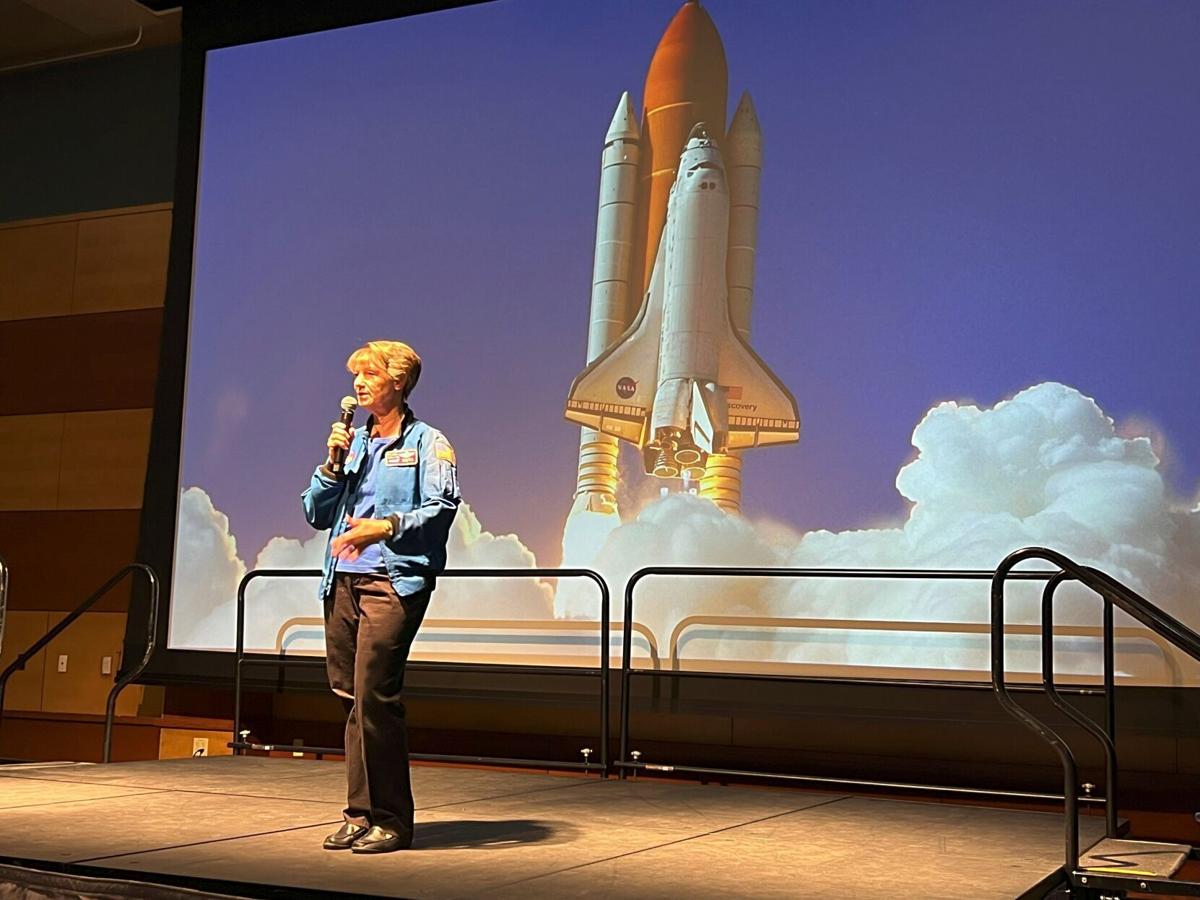
RENO — The first woman to pilot a space shuttle touched down at the University of Nevada, Reno on March 21 to remind women there is no glass ceiling in space.
NASA astronaut Eileen Collins' visit to the university's Women in Space event, a family-friendly gathering during Women's History Month that celebrates the world of aerospace and provides a glimpse into possible career options involving aviation or space. Over 500 visitors of all ages attended.
To begin the night, the Joe Crowley Student Union ballroom hosted vendors including the University of Nevada Reno Aerospace Club, Women in Aviation International, the Reno-based defense contractor Tactical Air Support, the Nevada NASA Space Grant and even a small inflatable walk-in planetarium, which previewed a program from the university’s Fleischmann Planetarium. A table of free packets of astronaut ice cream proved popular during the evening.
People are also reading…
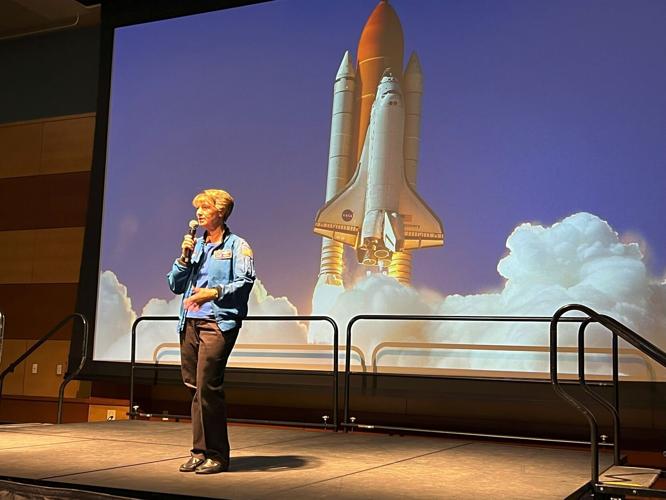
The centerpiece of the event was an educational keynote talk with Collins, who was the first woman to pilot a space shuttle on the NASA's 1995 STS-63 mission flying the shuttle Discovery with a crew that included Russian cosmonauts.
“Working with Eileen was always a pleasure,” former NASA flight director Paul Dye said as he introduced Collins. “She was a steady, calming influence and always knew how to steer things towards a good solution. She knew that … she understood that our problems were not just technical, but they were also social. We all needed to work together.”
Collins said space is key to moving society forward. “I think the most important issue taking place in the world today is the mission of space exploration,” she said. Before sharing a detailed reflection on the past and present of space travel, Collins shared how she first fell in love with the idea of flying through the sky.
She said her parents were instrumental role models in her journey to become a pilot, with her mother Rose Collins affirming her identity as a one-of-a-kind person and her father James Collins encouraging her to forge her own path instead of following the crowd.

Marce Herz Middle School teacher Mollie Hull receives the Washoe County Teacher of the Year Award for STEM, at the University of Nevada Reno Women in Space event. Photo taken March 21, 2024.
She said she appreciated her mother taking her on trips to the library during her youth in Elmira, New York. With books such as “The Stars at Noon,” an autobiography by WWII Air Force Pilot Jackie Cochran, she built an interest in aviation. “I didn't really have the money to take flying lessons when I was younger. So I learned through books,” she said.
“My first memory of space was in fourth grade. I was sitting at my desk in school and I read a magazine about the Gemini astronauts,” Collins added. “I remember thinking, ‘I want to be a pilot and I want to go farther, faster and higher.’”
So, Collins committed to the dream, saving money from part-time jobs to pay for flying lessons at age 19.
“I was very scared to call the airport or visit the airport and ask them to teach me to fly, because I thought they would say ‘You're a girl’ or ‘You're too young’ or ‘We're not going to teach you.’ So it took a lot of courage on my part to actually make that call, to go up and learn how to fly,” she said.
“I remember calling and they said, ‘Oh, we'd love to teach you how to fly. Come on up.’” So I went up to the airport. I met the instructors,” she said. “They actually taught me to develop a love for flying.”
Collins said it was important she found courage to overcome the fear of being told “no.”
“I like to tell young people, have faith in yourself, have confidence in yourself. Sometimes, just taking that first step is the hardest thing,” she said.

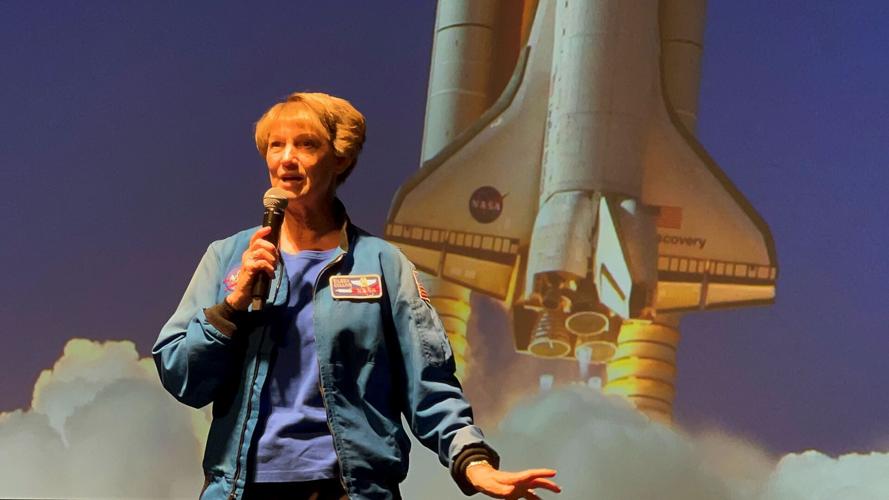
Former NASA astronaut Eileen Collins speaks at the University of Nevada, Reno Women in Space event on March 21.
“That summer, I flew my first solo. I joined Air Force ROTC in college, and the Air Force paid for my tuition. I just happened to be there at a time when there was a test program for women in the Air Force,” Collins noted.
“They said they were going to send me to Vance Air Force Base. I had never heard of it but it's in Enid, Oklahoma. And at graduation I packed everything I owned into my little car.”
There were 40 students in the program, 36 male and four female, Collins said. Women stood out as an uncommon sight among the 500 pilots on the base.
“How did we get through that year? Well, it turned out the program was successful because the women flew just like the men. After a couple years, it was determined successful and women were integrated into pilot training,” Collins said.

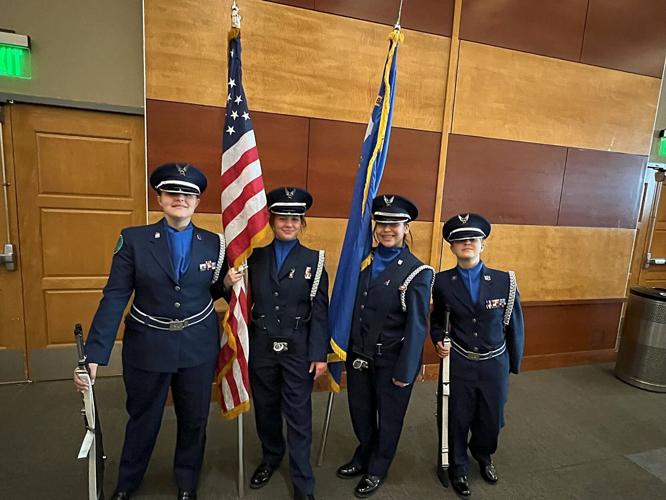
Members of the North Valleys Air Force JROTC present colors at the University of Nevada Reno Women in Space event, March 21, 2024.
“Not only did we have to get through for ourselves, because we wanted to be the best pilots we could be to graduate — also, how we did was going to determine if women that followed us would be able to fly. So there was a lot of pressure on us,” she said.
“Looking back, I think what really worked was focusing on why we were there,” she said. “We got through by just doing our mission every day, studying, being at class on time, being prepared for the weather. People saw that the women were there because we were serious about being the best that we could be,” she said.
“In 1990, I was now eligible to apply to the astronaut program. So I was very fortunate to be asked to join the team at NASA,” Collins said, adding she said she enjoyed the culture there.
“I never felt different because I was a woman. I think women were accepted as part of the team," she said. “We all had a commitment to exploring space. It didn't matter what you looked like, it mattered how you performed and whether you were dedicated.”

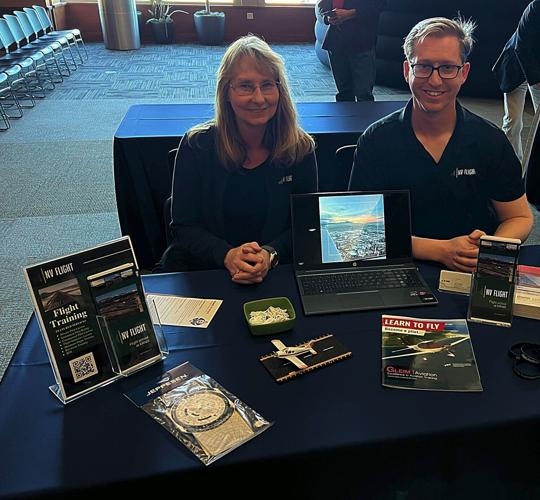
Collin Justis and Cherie Justis, mother and son, help operate Reno-based flight school NV Flight. Photo taken at University of Nevada Reno's Women in Space event on March 21, 2024.
Her STS-63 mission was one of four trips to space for Collins. “I was lucky to fly in space four times and to work on this great team at NASA. So, I would say that dreams really do come true. There were a lot of bumps along the road, a lot of failures for me along the way. But I eventually made it to my dream of going in space.”
Collins told her audience what going into space is like, using her flight on STS-114 in August 2005 as an example. That flight aboard Discovery was the first mission since the loss of the shuttle Columbia and its crew on Feb. 1, 2003.
In the days before launch, astronauts underwent strict quarantine conditions. For instance, they were only allowed visitors if the visitors underwent a medical check first.

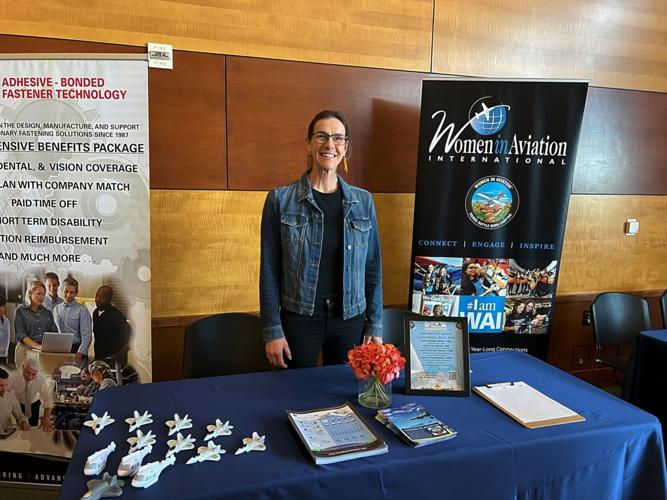
Rebecca Calder runs the booth for Women in Aviation International at the Women in Space event at University of Nevada Reno, March 21, 2024.
The hours before launch included “talking to the Launch Control Center, checking your gear, running procedures, watching the clock countdown and you get down to 10, nine, eight, seven. At T-minus six seconds, the main engines light and it sounds like this big rumble and the whole thing starts shaking and it sounds like you're in a room on fire.”
The ascending rocket slammed the contents of the cabin around aggressively, including Collins herself.
“I remember thinking, ‘I wonder why they made the switches so big in the shuttle cabin.’” They were big because they would be hard to press otherwise, due to how much the cabin bumped around,” she noted. “If you try to write something down, you’ll never be able to read it again.”

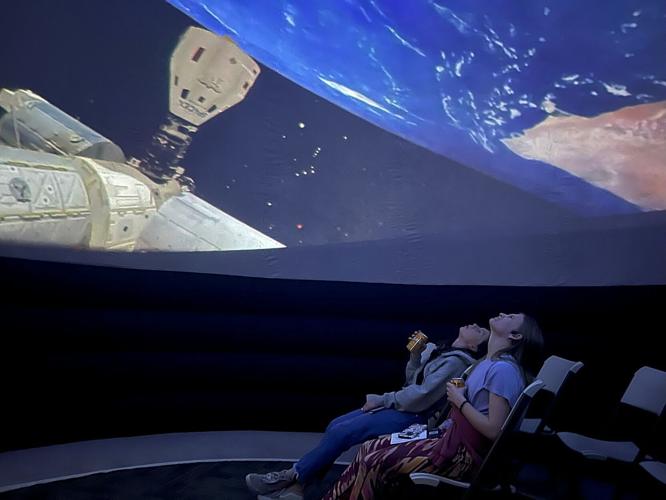
The University of Nevada Reno's March 21, 2024 Women in Space event featured an inflatable planetarium simulation, presented by Fleischmann Planetarium.
“Usually, it's about seven-and-a-half million pounds of thrust pushing six and a half million pounds of mass off of Earth's gravity,” Collins said. “While in launch, we go up to three g.”
That's three times Earth's gravity. “So let's say you weigh 100 pounds on Earth,” she said. “If you could stand on a weight scale during the shuttle launch, it would say 300 pounds because that’s how much force you have on your body as you launch into space — in primarily the last two-thirds of the launch.”
Then, the engine cuts off about 8:20 into the flight. “The engines cut off automatically and everything instantly goes to zero gravity,” she said.
“So it goes from three g to zero g,” she said. “And I noticed my tethers were floating, my checklist pages were floating, the neck ring on my flight suit was floating up around me and was blocking my vision. It was very eerie, because it was nighttime, all this dust was floating around. I'm the first woman pilot, so I don't want to make a mistake. ‘Eileen, focus.’”
She continued. “I'm doing all my procedures and my flight engineer who sits behind me,” Mike Foale, the first British person to perform a spacewalk, “said to me, ‘Eileen, stop working so hard. Look out the window. You're in space.”
Collins gazed out at her first space sunrise, which she said looked like a rainbow. She said what most stood out to her, though, was being able to visualize how the Earth is round.

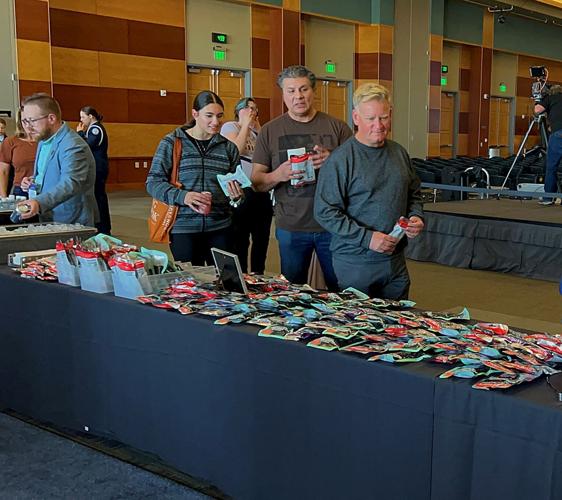
Visitors to the University of Nevada Reno's Women in Space event grab packets of astronaut ice cream, March 21, 2024.
“We did a series of burns to approach the space station, because our mission on this one was to rendezvous a dock with the space station. All of these burns were hand flown by the pilot and commander. This was what we called the rendezvous pitch maneuver,” she noted, docking “at 0.2 feet per second.”
“There's something on the space station called gyroscopes. They help the station maintain its altitudes. There are four of them. One of them had a catastrophic failure. So we were asked to change out the broken gyroscope. It weighs 600 pounds on Earth, but in space it’s weightless.” She said the broken gyroscope was brought back “to be evaluated.”
The mission also included an unprecedented removal by hand of damaged heat tiles by astronaut Stephen Robinson.
How did Collins stay in shape on her space missions? Through an advanced resistive exercise device, which allowed astronauts to perform exercises with bungee cords for two hours a day.
With a separation maneuver and a series of altitude adjustments, the shuttle set off from space station once its mission ended, heading back to Earth at 25 times the speed of sound. The Discovery landed at Edwards Air Force Base out in Southern California and the astronauts got out and adjusted back to Earth’s atmosphere.
Going into space causes the fluids in the human body to equalize and shift around, which is different from on Earth, where gravity pulls fluids downward.
“We don't want to faint after we land, so the doctors developed a protocol called fluid loading. About two hours before coming home, we drink salt water,” she said. “So, you have a very hydrated body.”
“The mission was very successful. It was kind of sad coming back, because we had worked on this flight for so long," Collins said.
"There was a crew from Kennedy Space Center who met us after the sun came up. You could see tears in their eyes. They were so into this mission. They were so proud of what they did in their job in taking care of the Discovery. And we brought it back in very good condition.”
Collins explained, “The space shuttle was retired 12 years ago. But NASA still is operating at full speed with a full budget.”
“Astronauts have been on the space station continually since the year 2000. They’re up there right now as we speak,” testing technology such as “closed-loop life support systems, where we have to recycle the carbon dioxide that we breathe out and convert that to oxygen,” Collins explained. Also, the space station is perfecting water recycling technologies, as about 97% of its water is recycled, she added.
“And we're learning how to live in space safely and successfully in preparation to go to Mars. The space station is in low-Earth orbit. It’s only about 200 miles above the surface. The moon is about 200,000 miles away. It’s 1000 times further than the space station.”
NASA is also still working with the Russian space program, she noted, as well as Boeing, which is sending its Starliner spacecraft into space later this summer.
“NASA would like to turn low-Earth orbit over to the commercial companies,” Collins noted. “So now we are in contracts with SpaceX, which launches their Falcon 9 rocket to and from the space station.”
In the near future, instead of NASA owning the International Space Station, they will financially incentivize private companies to build new space stations, she said.
“I supported the retirement of the space shuttle because it was expensive and it was aging and we had a safer and a better method of going up which is the SpaceX Falcon 9. The same thing is going to happen with the International Space station,” Collins noted. “We have to be willing to change if we want to be successful.”
Another aspect of space travel will be tourism, she said. “It's very expensive now, but as time goes by, it's going to get cheaper, and it's going to be safer,” she said. “We're going to have a better appreciation for planet Earth.”
Meanwhile, “NASA will spend limited funding to go to deep space,” she added. NASA is running the Artemis program, which involves “sending astronauts back to the moon — not just to do what we did during Apollo, which was great — but to take it one step further to build space stations and research stations on the moon and test the equipment that we will need to survive when we go to Mars someday,” she said.
“I want a diverse group of astronauts, men and women with different heritages and people with different backgrounds,” she said.
“I'd like you, especially the young people, to think about revolutionary inventions and discoveries that have taken place over human history that have made our lives better. You can go as far back as the printing press. And then we got the telephone. And then the car. Then we got airplanes, then computers, rockets and now we have satellites for communication and navigation,” Collins said.
“And I wonder, what is the next big revolutionary change that will affect our lives? Some people say artificial intelligence. I think in the area of transportation, it is in propulsion, because when we discover — and I believe we will — another planet that is like Earth out there somewhere, we're going to want to go there.
“We certainly do not have the means to do that now. So someday I think some very smart person or team of people will invent a way to allow us to go farther, faster and higher.” She said technology for travel to distant planets is not a reality yet. It is something which present-day humans must dig up undiscovered scientific principles to create, much like the transporter from "Star Trek."
So, Collins said the ultimate key to future space advances lies in unlimited imagination.
Collins’ autobiography, “Through the Glass Ceiling to the Stars: The Story of the First American Woman to Command a Space Mission,” is available from most booksellers.