MOUNT VERNON, Va. — George Washington never did cut down the cherry tree, despite the famous story to the contrary, but he did pack away quite a few bottles of the fruit at his Mount Vernon home.

George Washington's residence is set to undergo a $40 million revitalization project in Mount Vernon, Va.
Dozens of bottles of cherries and berries — impossibly preserved in storage pits uncovered from the cellar of his mansion on the banks of the Potomac River — were discovered during an archaeological dig connected to a restoration project.

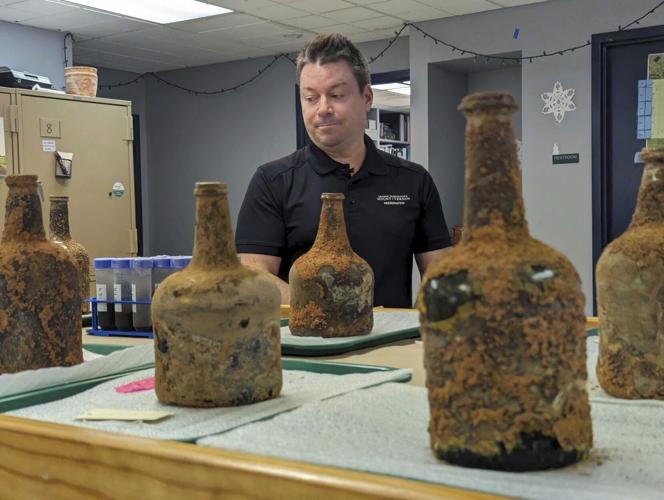
Archaeologist Jason Boroughs discusses artifacts found underneath George Washington's residence Monday in Mount Vernon, Va.
Jason Boroughs, Mount Vernon's principal archaeologist, said the discovery of so much perfectly preserved food from more than 250 years ago is essentially unprecedented.
“Finding what is essentially fresh fruit, 250 years later, is pretty spectacular,” Boroughs said in an interview. “All the stars sort of have to align in the right manner for that to happen.”
Whole pieces of fruit, recognizable as cherries, were found in some of the bottles. Other bottles held what appear to be gooseberries or currants, though testing is underway to confirm that.
People are also reading…
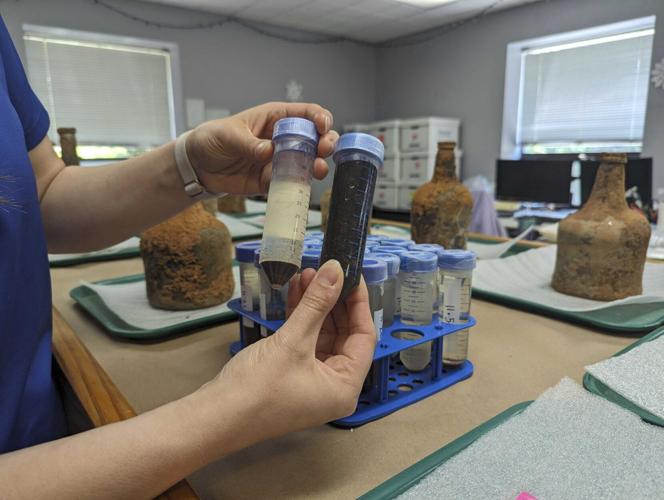
Mount Vernon is partnering with the U.S. Department of Agriculture, which is conducting DNA testing on the fruit. They are also examining more than 50 cherry pits recovered from the bottles to see if they can be planted.

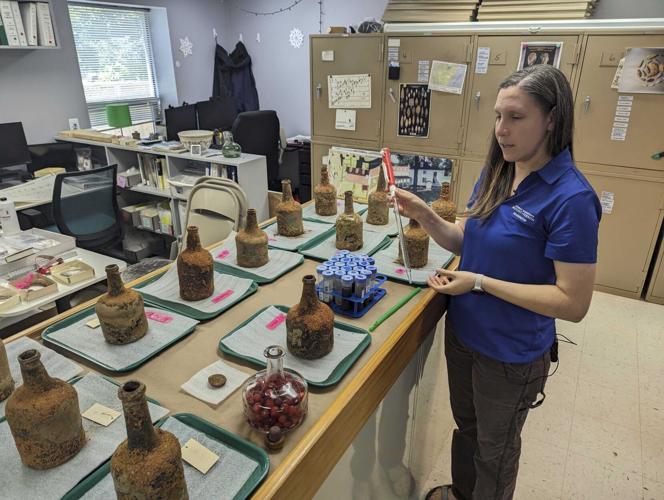
Curator Lily Carhart shows a pipette they used to extract liquid from a few dozen 18th-century glass bottles that contained fruit after they were unearthed from the cellar of George Washington's residence Monday in Mount Vernon, Va.
“It's kind of a longshot,” said Benjamin Gutierrez, a USDA plant geneticist, of the chances of using a cherry pit to grow a tree. Seeds preserve best when they are dry, and most of the samples found at Mount Vernon were waterlogged. A couple of pits tested initially were not viable as seeds.

Curator Lily Carhart holds up samples of liquid they extracted from a few dozen 18th-century glass bottles that contained fruit after they were unearthed from the cellar of George Washington's residence, Monday in Mount Vernon, Va.
Still, he said the bottles are a remarkable find. In addition to DNA testing, he said chemical testing may be able to show if particular spices were used to preserve the fruits.
Records at Mount Vernon show that George and Martha Washington were fond of cherries, at least when mixed with brandy. Martha Washington's recipe for a “cherry bounce” cocktail survives, and Washington wrote that he took a canteen of cherry bounce with him on a trip across the Alleghenies in 1784.
These cherries, though, were most likely bottled to be eaten simply as cherries, Boroughs said.
The quality of the preservation reflects a high caliber of work. Slaves ran the plantation's kitchen. The kitchen was overseen by an enslaved woman named Doll, who came to Mount Vernon in 1758 with Martha Washington, according to the estate.
“The enslaved folks who were taking care of the trees, picking the fruit, working in the kitchen, those would have been the folks that probably would have overseen and done this process,” Boroughs said. “It’s a highly skilled process. Otherwise they just wouldn’t have survived this way.”
The bottles were found only because Mount Vernon is doing a $40 million revitalization project of the mansion that they expect to be completed by the nation's 250th birthday in 2026.
“When we do archaeology, it’s destructive,” Boroughs said. “So unless we have a reason to disturb those resources, we tend not to.”
“In this case, because of these needed structural repairs to the mansion, the ground was going to be disturbed. So we looked there first,” he continued. “We didn’t expect to find all this.”
They know the bottles predate 1775 because that's when an expansion of the mansion led to the area being covered over with a brick floor.
Mount Vernon announced back in April, at the start of its archaeological work, that it had found two bottles. As the dig continued, the number increased to 35 in six distinct storage pits. Six of the bottles were broken, with the other 29 intact. Twelve held cherries, 16 held the other berries believed to be currants and gooseberries, and one larger bottle held both cherries and other berries.
Boroughs believes they have now uncovered all of the cherries and berries that survived.
“There is a lot of information that we’re excited to get from these bottles,” he said.
How to properly store 10 fruits and vegetables
How to properly store 10 fruits and vegetables

We've all opened the fridge to discover the shelf life of fresh produce isn't what we expected.
Discovering the cilantro from a few days ago has turned brown before you could make salsa, or that the carrots are too floppy to roast, isn’t just an inconvenience—it also has an impact on the environment. American consumers let about 67 million tons of food go to waste each year, according to a report from the Commission for Environmental Cooperation.
Pela compiled a list of 10 tips for properly storing fruits and vegetables to extend their freshness. Tips were sourced from GRACE Communications Foundation’s FoodPrint project and farm and education center Cedar Circle, as well as a variety of news outlets and authoritative food and recipe sites.
Some of the forthcoming produce hacks just require thinking ahead, such as separating certain vegetables and fruits. Others just require a basic understanding of the tools already at your disposal, such as your fridge’s crisper drawers. Since these drawers are more humid than the rest of the refrigerator, they’re ideal for storing leafy greens and thin-skinned vegetables like asparagus.
Keep reading to learn 10 easy ways to extend the shelf life of your produce.

Keep tomatoes out of the fridge

Anyone who’s ever had the pleasure of eating a homegrown, sun-ripened tomato fresh off the vine knows there’s a huge difference in flavor from the typical grocery store tomato. Food science has revealed exactly why store-bought tomatoes have a mealy texture and bland flavor: Temperatures below 54 degrees actually stop the fruit from creating substances that contribute to its taste. A quick trip from the farm to the grocery store is enough to diminish a tomato’s freshness if it was held in a cold storage truck.
Whether you’re growing your tomatoes in your backyard or buying them from the farmers market, storing them at room temperature results in the most vibrant flavor and juicy texture. Once tomatoes hit peak ripeness, try to eat them as soon as possible—they spoil quickly thereafter.
A Serious Eats test found that fully ripe tomatoes can be moved to the fridge to extend their lifespan with minimal effects on the flavor.
Store potatoes separately from onions

Though potatoes and onions make perfect partners in a breakfast hash, they don’t store well together. Onions give off gasses that speed up ripening in potatoes, causing them to sprout faster.
Instead, store your potatoes in a cool, humid place, ideally between 38 and 42 degrees Fahrenheit and between 80% to 90% humidity, such as a basement or root cellar. Potatoes won’t last as long in the fridge. Either way, make sure not to rinse potatoes until you’re ready to prepare them: they last longer if they’re unwashed.
Keep apples and bananas away from vegetables

Just because you carry all your fresh produce home from the market in the same bag doesn’t mean they can all be stored together. Some fruits like apples, bananas, citrus, and tomatoes give off ethylene gas as they ripen, which can also speed up the ripening process of other vegetables stored nearby. In fact, some ethylene producers should be stored alone to avoid anything becoming unintentionally overripe.
Keep your apples, apricots, bananas, avocados, melons, mangoes, onions, pears, persimmons, tomatoes, and plantains away from each other for best results.
Keep basil in room-temperature water

Fresh herbs can be particularly tricky to store due to their delicate nature. Basil is a great example: You might think the fragile leaves would require some coddling in the fridge, but they’ll actually turn brown in cold temperatures. Instead, keep your bunches of basil fresh for longer in a cup of water at room temperature as you would a bouquet of flowers (trim the stems first to maximize water uptake).
If the basil came with roots intact, place the plant in a small gardening pot and backfill with a high-quality potting mix. Water the plant regularly and be sure it has access to full sunlight.
Wrap celery tightly and keep in fridge

Celery is one vegetable that should never be stored at room temperature, as the stalks will quickly become limp rather than crisp.
For optimum results, wash and dry the celery, then wrap it tightly in a dry towel and store in the crisper drawer. It should remain fresh for about two weeks. If you can’t use it all up by then, try chopping it into small pieces, then freezing it. Though the celery will lose its signature crispness in the freezer, it still works in soups, stews, and any recipes requiring a mirepoix.
Remove avocados from plastic produce bags

Even if the avocados you brought home from the grocery store seem like they’ll never get ripe, resist the temptation to leave them in plastic produce bags. Plastic traps moisture, which can cause the fruit to rot before it ever gets ripe. Instead, store avocados alone at room temperature. Like apples, avocados emit ethylene gas as they ripen—a helpful trait if you’re trying to get a rock-hard avocado ready to turn into guacamole. Simply place the avocado and apple in a paper bag for a day or two, then check to see if the avocado has softened.
Store green onions in a glass of water

During the first few months of the COVID-19 pandemic in 2020, regrowing scallions, otherwise known as green onions, in a glass of water went about as viral as any home cook project can. Whether you plan on sprouting your green onions or not, they should be stored root-down in a glass of water.
You can either store scallions at room temperature in a sunny spot to keep them growing or set the cup in the fridge with a plastic bag over the top for extra humidity. The refrigerated method works equally well for asparagus, but you cannot regrow asparagus the same way green onions regrow.
Keep peaches in the fridge once ripe

Sweet, juicy peaches are one of summer’s greatest joys. Next time you bring home a haul of this stone fruit, remember to store them at room temperature until they’re fully ripe.
To speed up the ripening process, you can use the same paper bag method that you’d use for unripe avocados. Once they’re soft and fragrant, peaches are ready to eat—but if you’re not quite ready, you can place them in the fridge in a loose bag for up to five days. Watch out for wrinkly skin: That’s a telltale sign that you’re running out of time to eat a peach before it spoils.
Keep summer squash wrapped in the crisper drawer

Summer at the farmers market often means an abundance of summer squash like zucchini. Place the unwashed zucchini in an open paper or plastic bag, then store it in the crisper drawer for one to two weeks.
If you have more squash than you can handle before it goes bad, try freezing it. Wash and slice the zucchini into rounds, then blanch it in boiling water for one minute. Drain and cool the zucchini, then keep it in the freezer for up to three months. A quicker method is to simply shred the squash and freeze it in a vacuum-sealed bag. Large quantities of the vegetable can be used later for breads, casseroles, soups, and homemade veggie burgers or pancakes.
Store carrots in crisper or fully submerged in water

If you’re lucky enough to have a root cellar, it’s easy to store carrots: They’ll remain fresh for as long as six months. Those of us with limited space can turn to the refrigerator for an assist.
First, remove the carrot tops from the root—the tops can be wrapped in a wet paper towel and stored for use in herb-forward sauces like pestos. You can keep the carrot roots fresh for up to three weeks in the fridge by submerging them in cold water. Just remember to change the water every four days or so, once it becomes cloudy. Don’t want to fuss around with a pitcher full of water? You can also store carrots in an airtight, zip-top bag in the crisper drawer.
This story originally appeared on Pela and was produced and distributed in partnership with Stacker Studio.