
People must be the easiest creatures in the world to track, if the dirt paths at the Arizona-Sonora Desert Museum are any indication.
They are filled with "people tracks" from sneakers and hiking shoes. The soles' imprints create a dusty picture of circles, ovals, rectangles, grooves, diamonds, triangles and logos. But I have yet to see a bare human footprint. Humans must have sensitive feet and need artificial protection from desert spines and gravel.
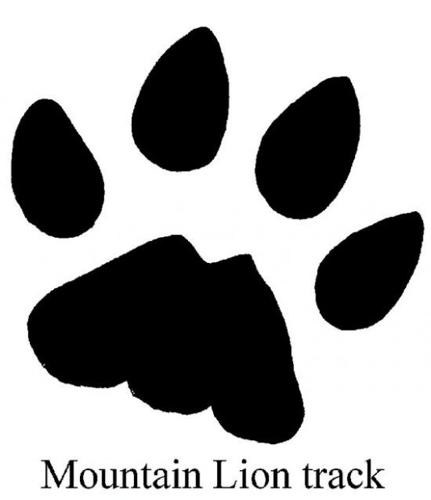
Now let me tell you — there's nothing artificial about my tracks, and they are paw-sitively impressive! Each shows four toes and a large, three-lobed, planter pad. My front-feet prints are approximately 3 1/2 inches wide, and those of my back feet are slightly smaller. My claws are retractable – I can pull them back in – so they don't usually show in my tracks.
You can learn to track animals by recognizing their tracks and signs they leave behind. Tracking can tell you a lot about an animal: what it eats, where it sleeps and why it visited a particular place. You become a detective, solving mysteries by reading the clues written on the ground.
People are also reading…
The shapes of tracks can tell you what animal or type of animal made them, the direction in which the animal was moving and the direction from which it came. They may also tell you if the animal was strolling, running, hopping or leaping.
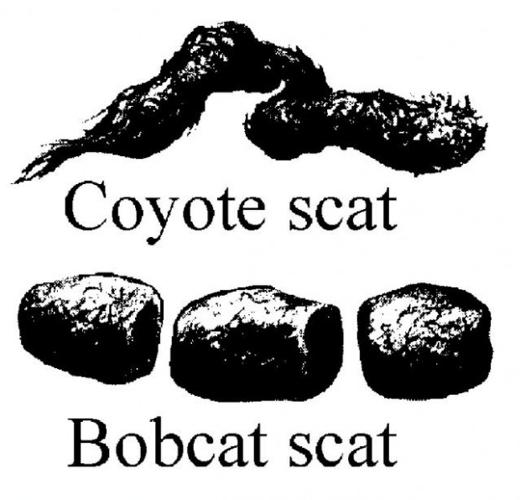
Animals also leave behind other evidence of their lives. Droppings, or "scat," may tell you what the animal has been eating. Scat from each type of animal usually has a unique shape. For example, coyote scat is often full of hair and bones, and may have distinctive long, tapered "tails" on the ends.
Other evidence an animal leaves behind may include fur or feathers where it made a kill, bits of fur snagged on vegetation it brushed against, or flattened vegetation or a hollow in the ground where it stopped to rest. Some animals leave scratch marks on trees.
You might see where an animal scraped away dirt. Look carefully where the dirt was scraped. A coyote kicks up dirt with its hind feet, whereas a bobcat scrapes soil toward itself, using its front paws. Or a trail may lead you to an animal's nest or burrow entrance. And if you're lucky, you may even see the animal you are tracking! Just be sure to keep your distance so you don't scare it.
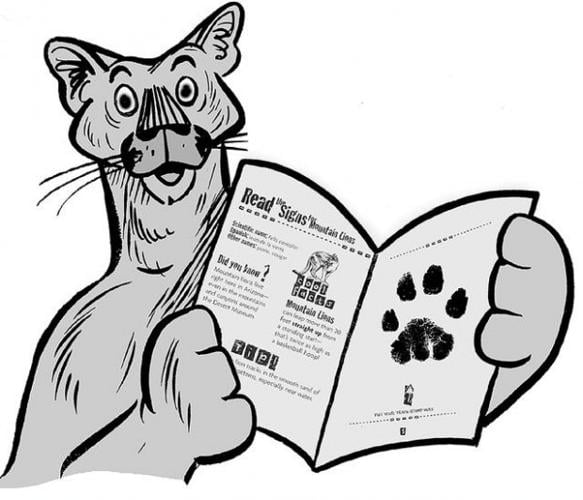
To help you get started with tracking, I advised some talented people at the Desert Museum about the various types of tracks one might find in the Sonoran Desert. They placed ink pads and stamps of various animals' tracks along the museum's paths and printed a booklet in which you can stamp the tracks of more than a dozen desert animals. They even put my picture on the cover! So next time you're out at the museum, track down a copy at the front entrance.
FABULOUS FACTS: TRACKING
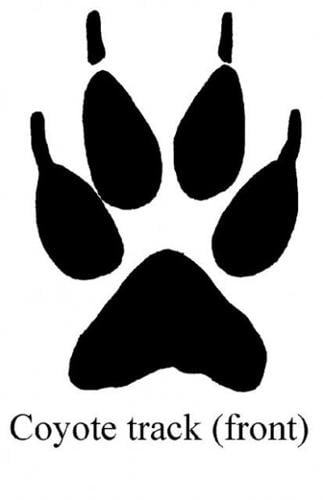
Coyote tracks are among the most common tracks to be seen in the Sonoran Desert. About 2 inches long, the hind print is smaller than the front, and the inner two toes are smaller than the outer two.
From its tracks, it can be hard to tell which way a roadrunner was traveling, since two toes point forward and two backward. This is why some American Indians use a roadrunner track design to ward off evil spirits, believing the tracks will confuse them.
Javelina and deer tracks look similar, but deer tracks are more pointed and almost twice as large.
Frog tracks sometimes show the outline of the animal's entire body, belly and all. Their hind feet are bigger than the front ones and show five toes.
The front feet are turned inward and show four toes.
Quail and dove tracks are very hard to tell apart, but the tracks of quail may show a little web between the toes. Look for dove and quail tracks in sandy washes, dirt roads or other dusty areas. Sometimes you may even see a small depression where one has taken a dust bath.
Look for mountain lion tracks in the smooth sand of washes and canyon bottoms, especially near water.
SCAT FACTS
Bobcat scat has constrictions like a Tootsie Roll. If dry, it separates at these joints. The ends are usually blunt.
Javelina scat looks similar to deer pellets, but is much larger. All the javelina in a herd tend to defecate in the same spot, while deer scatter their scat all over.
It's not easy to tell the difference between jackrabbit and cottontail scat. Both are small, slightly flattened balls about the size of a plain M&M.
Horned lizard scat is distinctive. These lizards eat quantities of ants and leave a pellet composed mostly of the hard, indigestible parts of ants.
Clip 'n' Save Tracking Tips
Animal tracking is fun. Here are some tracking tips to help you get started.
1. Start early, when tracks are fresh. Many animals are active at night and at dawn. Long morning shadows also make the tracks easier to see.
2. Don't step on any of the tracks you are following. If you lose the trail, go back and review the tracks again to find the next track.
3. Look carefully at each track. Overlooking even one might make you miss important information. Make a careful sketch, with measurements, to help you notice details.
4. Look at the whole trail. Each track is like a word in a story — when the "words" are put together in the correct order, the "story" will tell about the animal's habits and activities.
5. Think like an animal. Imagine being the creature that made the tracks. If you lose the trail, ask yourself where you would go if you were the animal. Are you looking for food? Water? A place to hide? What do you need to survive?