

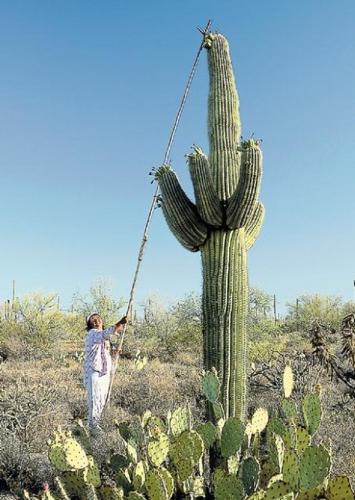
They've appeared in more Western movies than John Wayne. They're the prickly main attraction at a national park on the edge of Tucson. An image of one of them graces the front page of the Arizona Daily Star every day.
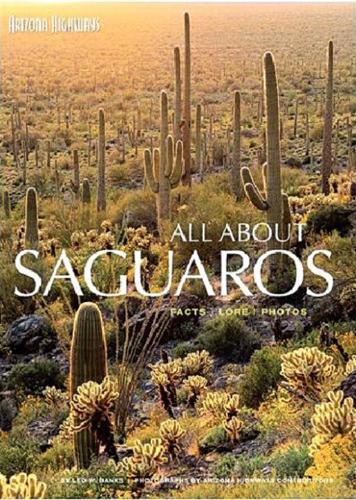
Now these wonders of nature — saguaro cacti — are featured in a new book by Tucson author Leo W. Banks.
"All About Saguaros: Facts, Lore, Photos" ($19.95, published by the Book Division of Arizona Highways magazine) is a concise, thorough guide to the superstar species of the Sonoran Desert. It's lushly illustrated with color photos by Arizona Highways contributors.
"The saguaro has become a familiar, all-purpose symbol of the West and the frontier," says Banks, who has written five previous books and contributed to publications such as the Los Angeles Times Magazine, The Wall Street Journal, Sports Illustrated and Arizona Highways.
People are also reading…
"And yet there is a bit of mystery around saguaros," Banks says. "They've been studied to death for many, many decades, but there are still many things about them that we don't know" — such as why they seem to grow better on slopes than on flat terrain, or exactly why the skin of some saguaros changes from green to brown.
Banks conducted extensive research on the natural history of saguaros, legends and lore surrounding the big cacti and possible threats to the species. He relied on several prominent scientists — including renowned botanist Raymond M. Turner — for information and technical reviews of the text.
The book is available in some stores and Internet sites such as www.amazon.com.
The saguaro mystique
The book notes that saguaros have long attracted, fascinated and even sustained people — including the Tohono O'odham Indians, who have used saguaro fruits as a source of food and saguaro ribs for building materials.
Saguaros also have given rise to a rich trove of legend and lore — often depicting the big cacti as possessing special powers.
Some people, meanwhile, are so smitten with the grandeur of saguaros that they make a pastime of searching for the tallest or most spectacular examples of the species.
"Saguaros attract followers like Bigfoot," Banks says. "I just like the idea that there are people out there who spend their free time going out into the desert hunting for the tallest saguaro. They're almost like inspectors or something."
One indication of the saguaro mystique and its role as a symbol of all things Western is that saguaros often show up in movies set in locales where they don't grow. Directors include footage of the cacti shot elsewhere to add a "Western feel" to the movies.
Banks cites one example:
"Humorously, the saguaro has shown up in films set in Monument Valley (in Northeastern Arizona). You don't find saguaros growing there."
Book highlights
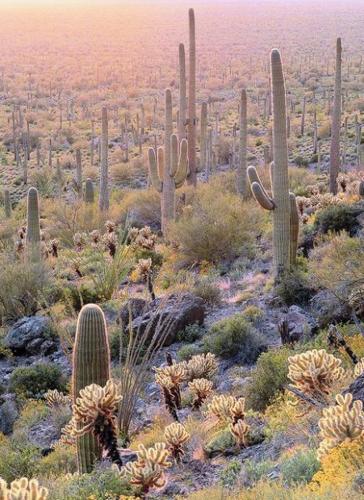
"All About Saguaros" begins with a portfolio of photos that show off saguaros in all their splendor against backdrops of dazzling sunsets and grand desert vistas.
In an opening essay on "What the saguaro means to us," Banks writes:
"From man's first recorded encounters with this so-called monarch of the Sonoran Desert, we have viewed it as more than a plant.
"It's one of us, not just living, but alive with its own personality, character, and means of communicating."
A section on basic facts about saguaros notes their great size, with some specimens growing to heights of 45 feet or more, and age, with some of the "great-grandpappies making it well past 200 years."
To put the age matter in perspective, Banks notes that it's possible to find yourself standing beside a thriving saguaro that was alive in 1807, when Thomas Jefferson was president.
In another section, the book examines the life of saguaros from germination and early growth to grand maturity and death.
Among the fascinating revelations is that the spines on a young saguaro are thicker than those on an older plant — and they provide critical shade.
"Hard as it is to believe," writes Banks, "those spines can keep a young saguaro as much as 70 percent in the shade."