

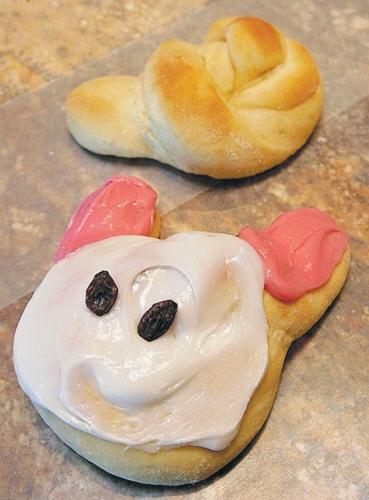
Some folks color eggs at Easter time. Some insist on scalloped potatoes, strawberry shortcake or spiral-sliced ham. In my household, there's only one requirement: On the Easter buffet, there must be bunny rolls.
For as long as I can remember, the women of my family have baked them: sweet, buttery pastries shaped and decorated to look like the faces of bunny rabbits. When my grandmother was living, she did the honors. Then my mother took over. Now the mantle has passed to me.
The fragrance of the yeasty rolls baking wafts through my house, evoking memories of Easters gone by, of my grandpa helping grandma with the frosting, letting me lick the sticky spatula afterward. When they're fresh from the oven, there is no sweeter taste. It melts on the tongue - tenderness, tradition and love.
How the tradition started, no one really knows. I like to imagine bunny rolls coming over on the boat from Sweden, spirited in my great-grandmother's satchel, perhaps, or smuggled past inspectors in a steamer trunk. In reality, their origins are probably much more mundane - the recipe shared among members of my grandmother's church circle in the tiny town of Primghar, Iowa, or published in the O'Brien County Bell, from which she faithfully transcribed it.
People are also reading…
The recipe calls for seven simple ingredients: milk, yeast, sugar, flour, eggs, butter and salt. But the process is infinitely more complicated. It's an all-day affair, a veritable rite of spring.
You start by heating the milk just until bubbles form around the edges of the pan. I don't know why, exactly. Milk was scalded in the days before pasteurization to retard spoilage, but it's hardly necessary now. It would be quicker and easier to heat it in the microwave, but that would be a desecration.
The liquid must then cool somewhat. I learned this lesson the hard way when I was 9 years old and making my fledgling attempt at bunny rolls. I added the yeast when the milk was too hot, killing its action, producing rolls that had the weight and density of lead. My dad, an avid fisherman, teasingly dubbed them "sinkers." I never heard the end of it.
My mom could always check the milk's temperature by placing a drop on her wrist, a skill no doubt honed through years of testing baby bottles. Not having any children myself, I've come to rely on a candy thermometer. The optimal temperature is 115 degrees.
In a large bowl, you next add the sugar, along with half the flour. The covered mixture rises roughly 45 minutes, until it begins to resemble the surface of the moon. During this interval, I recommend grabbing a shower or running to the supermarket for those eggs you've probably forgotten. Beaten until light, they will be added next. Then comes the butter, a full half-pound. My Swedish ancestors apparently were never concerned about cholesterol.
After folding in the salt and the remaining flour, you allow the dough to rest, covered snugly in an even larger bowl, for an hour and a half. (You may need a rest yourself by now.) The dough is rather like that mythical phoenix. You punch it down, but it will rise again.
Originally, none of these instructions was recorded anywhere. My grandmother never needed any. Women of her generation baked bread and rolls every day; they simply knew how to do it. When it came my mother's turn, she jotted down such intricacies as oven temperature (350 degrees) and approximate baking time (eight to nine minutes). She also once had the nerve to use a bread machine!
Since then, I've added notes of my own. For example: You must knead the dough several times after it has risen, incorporating more flour; roll it out on a lightly floured surface into a 30-by-9-inch rectangle; and then cut it into 1-by-9-inch strips. You'll be glad you took that geometry class in high school! The strips are then tied into knots, with the ends sticking up to resemble bunny rabbit ears.
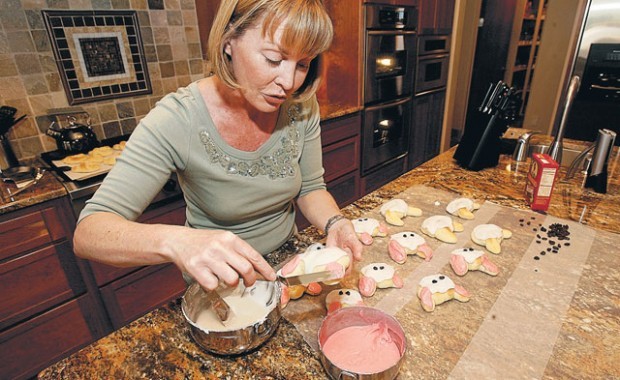
Still, there are some secrets that no recipe can tell, such as how the dough should feel in your hands - soft and elastic, but not too sticky - or how to blend the powdered-sugar frosting: white for the faces and pink for the ears. These skills are best learned at the hands of a loving mother, grandmother or aunt - though with yearly practice, you can acquire them yourself.
I once invited a girlfriend over to share in the bunny-roll ritual. What a disaster! She was a graphic designer, one of those creative types. She wanted to cock the ears in different directions and frost some of their faces gray. Now I assure you, that kind of thing may occur in nature, but it never will happen in my kitchen.
Selecting and placing the raisin eyes is the final touch in the bunny-making process, the pièce de résistance. I've always thought the proper eyes were what conferred the rolls' distinct personalities. You must spread the raisins on a countertop, sort them into matched sets - big plump ones for the biggest bunnies, tiny shriveled ones for the small. Then stick them to the frosted faces, neither too close together nor too far apart. Like Goldilocks' porridge, they must be just right.
Some people find bunny rolls too sweet or rich to enjoy with their Easter dinner. To them I say what my grandmother used to, "Pshaw!" My ex-husband had a habit of scraping off the frosting before consuming the little creatures. That may explain why he's my ex.
My current husband and I will host Easter for the family this year at our home in Tucson. We giggle about it - that we, the greatest cynics of the clan, should inherit this least cynical of holidays. Yet whether you believe in the Easter Bunny, whether your celebration is spiritual or secular, isn't Easter about rebirth - about the hope and renewal that springtime brings?
The last time I sat next to my grandmother at the Easter table, I remember her eyes lighting up when the bunny rolls were brought before her. She reached out a hand, the fingernails still polished red after 91 years, and said, "Daylanne, Daylanne, look!" There was childish delight in her voice, and awe.
She had retired from baking bunny rolls years earlier, her hands no longer steady enough, her arms too weak to knead the dough. But still, she remembered. And now my own mother has retired. Not too many years from now, I know it will be my turn to hang up the baking utensils. It's all in the cycle of things.
I feel a certain sadness in not having a daughter, or even a son, to pass this legacy along to, to teach the skills of mixing and kneading and rolling, to teach the patience required to wait and wait and wait as the bunny rolls rise, and rise again.
Yet I take comfort in the knowledge that I'm a writer. Surely I'll manage to find a way. After all, bunnies do have this uncanny way of multiplying!
Bunny Rolls
Makes: about 30 rolls.
• 1 1/2 cups whole milk
• 2 cakes yeast
• 1 cup sugar
• 6 cups flour, divided
• 4 eggs
• 1/2 teaspoon salt
• 1 cup butter
• About 1/2 cup raisins (reserve for eyes)
Heat milk and cool to approximately 115 degrees. Then stir in yeast, sugar, and 3 cups of flour. Cover this mixture and let rise 45 minutes.
Beat eggs until light. Add beaten eggs, along with salt and butter, to yeast mixture. Then stir in remaining flour. Turn dough into a large greased bowl, cover, and allow to rise 1 1/2 hours or overnight in the refrigerator. (Refrigeration allows for easier shaping and handling of dough.)
On a lightly floured surface, knead dough briefly and roll out into 30-by-9-inch rectangle. Cut into 1-by-9-inch strips (a silicone pizza cutter works well for this), and tie each strip in a knot with ends extending upward to resemble bunny ears. Place on parchment-lined baking sheets, 2 inches apart. Cover and let rise for another hour. Meanwhile, preheat oven to 350 degrees.
Bake rolls for 8 to 9 minutes or until lightly browned. Cool and frost with high-gloss glaze, white for faces and pink for ears. Before glaze dries, place 2 raisins on each face to resemble bunny eyes. Best when fresh and gently reheated so as not to melt frosting, but may be stored in tightly sealed container for up to 3 days or frozen for up to a month.
High-Gloss Glaze
• 1/2 cup plus 1 tablespoon water
• 6 tablespoons corn syrup
• 1 tablespoon vegetable shortening
• 8 to 9 cups powdered sugar
In small saucepan, combine water, corn syrup and shortening. Heat until shortening is melted; do not boil. Remove from heat and stir in powdered sugar to desired consistency. Beat until smooth. Spread on rolls: uncolored for faces and tinted pink with food coloring for ears. Makes approximately 3 cups, plenty for frosting rolls and enough left over for young bakers to lick from beaters or spatula.
Recipes form Daylanne Markwardt
Daylanne Markwardt is a Tucson-based writer.