

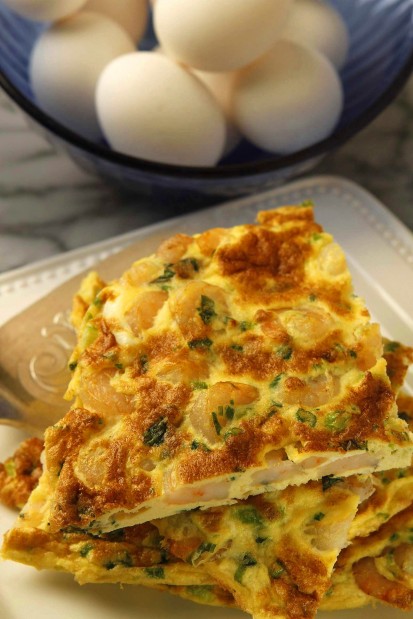
Dinners at this time of year make me cranky. Most of the time when I get home from work, the house is too hot to cook, and besides that, I usually have neither the patience nor the energy to fix much of anything. But tonight I'm not worried. I've got two frittatas waiting in the refrigerator.
We just about live on them. Cut a couple of slices and bring in some tomatoes from the garden, and that's dinner. Add a couple of glasses of rosé and that's a feast.
The odd thing is that frittatas aren't more popular. Or maybe that's not so strange after all. The standard definition is "a flat omelet," which, I suppose, is accurate, as far as it goes - both are made from eggs, which form a base for delivering ingredients as diverse as cheese and spinach.
But once you get beyond the obvious, the two couldn't be more different, and the frittata suffers in the comparison.
People are also reading…
An omelet is a thing of fragile beauty, depending on quick, careful cooking and immediate eating. It can take years to master making them, and to be appreciated at its best, an omelet must be consumed within minutes.
The frittata is a much friendlier beast, more accommodating in both preparation and service. While you wouldn't wish leftover omelet on anyone, frittatas are as good at room temperature the next day as they are piping hot out of the oven. Best of all, they couldn't be easier to make - as long as you're willing to disregard the standard instructions.
Read most cookbooks, in either English or Italian, and they'll tell you to fix a frittata pretty much the same way you'd fix an omelet, stirring and scrambling and lifting the cooked egg to let the raw slide through. Then when the eggs have just firmed, turn them over to cook the other side, either with a flip and a flick of the wrist, or by inverting them onto a plate or a lid and sliding them back into the pan.
The first requires a certain gymnastic ability and a dead aim (or a dog that will clean up any eggy misses off the floor). The latter is just plain messy.
Looking for a frittata recipe, I turned to Marcella Hazan, the queen of Italian cooking. It was reading over the basic technique in one of her books that turned my head around. Hazan's way of cooking a frittata is utterly simple: Rather than all of that stirring and scraping of the eggs as they cook, she simply leaves them to set over a very low heat. Then instead of flipping the frittata, she just runs it under a hot broiler to set and brown the top.
Not only is her way easier, but when I tried the same recipe using both techniques side by side, it made a frittata that was moister and more tender.
The only refinements I'd add are that it cooks best if you cover the pan during the stovetop cooking to trap the heat, and that it unmolds easiest if you use a nonstick skillet.
The key to getting it exactly right is letting it cook slowly on top of the stove until there is just a shallow puddle of raw egg left on top, and then sticking it under the broiler for only a couple of minutes. If the top colors before it is firm, just remove it from the broiler, replace the lid and let it sit for a few minutes to finish cooking.
Probably the hardest part is unmolding the frittata from the pan; even in a nonstick, eggs will want to adhere. So use a small spatula to free the edges, then rap the pan hard a couple of times on the cutting board. It'll bang really loud, but the bottom of the frittata should pop free. Then you just need to slide it onto a plate for serving.
Frittatas and egg safety
Despite the recent massive recalls of eggs due to salmonella contamination, frittatas are thought to be safe because the eggs are thoroughly cooked. To be even safer, avoid eggs that were packed by the involved farms; they may be sold under a range of labels including Lucerne, Albertsons, Mountain Dairy, Ralph's, Boomsma's, Sunshine, Hillandale, Trafficanda, Farm Fresh and Kemps. Keep eggs refrigerated, and don't use eggs with cracked shells. And keep all work surfaces clean and wash your hands well after using raw eggs.
Prosciutto and Onion Frittata
Servings: 6 as appetizer, 4 as main course
• 3 tablespoons butter
• 1 cup thinly sliced onion
• 1/8 teaspoon salt
• 3 thin slices prosciutto (about 1 1/2 ounces), cut crosswise in 1/4-inch slivers
• 6 eggs
• 2 tablespoons chopped parsley
• 1/4 cup plus 2 tablespoons grated Parmigiano-Reggiano, divided
Heat the broiler. Melt the butter in a 10-inch nonstick skillet over medium-low heat. Add the onion and salt, then cover the pan and cook until the onions have softened, about 5 minutes. Remove the lid and continue to cook, stirring occasionally, until the onions have lightly browned, about 10 minutes. Stir in the prosciutto and cook until softened, 2 to 3 minutes.
While the onions are cooking, beat the eggs with a fork in a mixing bowl just until the yolks and the white are thoroughly mixed, but don't overbeat, which can make the frittata dry. Beat in the parsley and 1/4 cup Parmigiano-Reggiano.
Add the egg mixture to the pan with the onions and prosciutto and stir well to combine. Reduce the heat to low and cover the pan. Cook, without stirring, until the eggs have set, leaving only a top layer uncooked, about 10 minutes. Sprinkle remaining Parmigiano-Reggiano on top. Place under the broiler until the top is browned and puffy, 1 to 2 minutes.
To unmold the frittata, let it cool slightly in the pan. Use a spatula to loosen it along the sides, and then bang it firmly on a cutting board to release the underside. Slide it out onto a serving plate. Serve either hot or at room temperature. If you're going to refrigerate the frittata, let it warm to room temperature before serving.
Each of six servings: 164 calories; 8 g protein; 2 g carbohydrates; 0 g fiber; 13 g fat; 7 g saturated fat; 237 mg. cholesterol; 1 g sugar; 289 mg. sodium.
Shrimp and Basil Frittata
Servings: 6 as appetizer, 4 as main course
• 2 tablespoons butter
• 1/2 cup thinly sliced green onions (both green and white parts), about 4 onions
• 1/2 pound peeled small shrimp (70 to 100 per pound)
• 6 eggs
• 1/4 teaspoon salt
• 8 to 10 leaves of basil, torn into small pieces
Heat the broiler. Melt the butter in a 10-inch nonstick skillet over medium low heat. Add the green onions and cook until they've softened slightly, about 2 minutes. Add the shrimp and cook until they are firm, about 5 minutes.
While the onions and shrimp are cooking, beat the eggs, salt and basil with a fork in a mixing bowl just until the yolks and the white are thoroughly mixed, but don't overbeat, which can make the frittata dry.
Add the egg mixture to the pan with the onions and shrimp and stir well to combine. Reduce the heat to low and cover the pan. Cook, without stirring, until the eggs have set, leaving only a top layer uncooked, about 10 minutes. Place under the broiler until the top is browned and puffy, 1 to 2 minutes.
To unmold the frittata, let it cool slightly in the pan. Use a spatula to loosen it along the sides, and then bang it firmly on a cutting board to release the underside. Slide it out onto a serving plate. Serve either hot or at room temperature. If you're going to refrigerate the frittata, let it warm to room temperature before serving.
Each of 6 servings: 148 calories; 14 g protein; 1 g carbohydrates; 0 g fiber; 9 g fat; 4 g saturated fat; 279 mg. cholesterol; 1 g sugar; 225 mg. sodium.