

SAN CRISTOBAL DE LAS CASAS, Mexico — Rick Bayless examined the dusky brown disk, about the size of a quarter and several times as thick, in a zip-top plastic bag. It was the last of more than a dozen unfamiliar foods he intended to identify for the group of travelers.
"What is this?" he said. Everyone in the room laughed. Stumping Bayless, renowned Mexican-food authority, in a market-day show-and-tell was something participants would revel in for the rest of the trip.
Bayless leaned toward two women who work in the kitchens at Na-Bolom, a museum and research center where Bayless was teaching the class. In flawless Spanish, Bayless asked what the bag held.
"She says it's something called 'a thousand virgins,'" he said. "I've never heard of that. I have no idea what it is. ¿Señora: Mil virgenes?"
The two women exploded into giggles as their hands flew to cover their mouths. A burst of Spanish followed.
People are also reading…
Now it was Bayless' turn to laugh, his cheeks reddening.
"Oh! Not a thousand virgins! I misunderstood. It's a candy made from miel virgen — virgin honey, raw honey."
The 22 travelers seated shoulder-to-shoulder in the main Na-Bolom kitchen roared in amusement and applauded.
Bayless' blue eyes sparkled. A warm and relaxed teacher, he enjoyed the joke on himself. Eventually, the mood turned more serious and Bayless turned to teaching a trio of favorite dishes from San Cristobal's region, Chiapas.
The trip was a busman's holiday for Bayless, a working trip that got him out of his Chicago restaurants Frontera Grill and Topolobampo. For Bayless, temperamentally still the curious graduate student he was when he visited Chiapas the first time, the best reason to travel is to talk with the people he meets along the way.
"Everything I learn from them — what they had for dinner last night, what they cooked for their mother's birthday last week — helps me understand how the food fits into their everyday lives," he said. "At the restaurant, I need to get some of that (understanding) on the plate, of course, but oftentimes, it's so far away that it's easy to forget its cultural context."
Chiapas is one of Mexico's southernmost states. Bayless had arrived the day before to teach two days of classes.
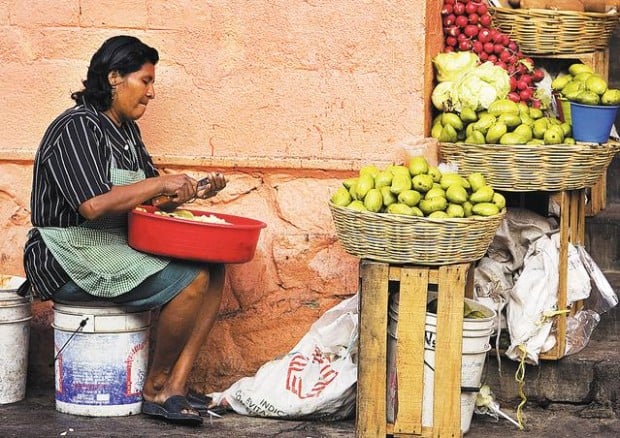
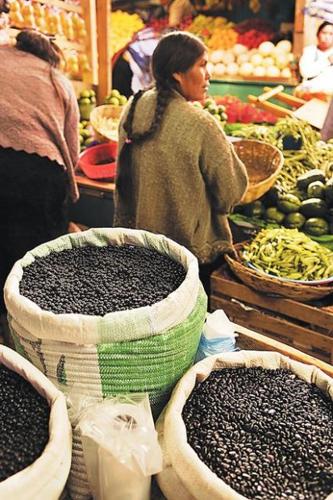
The foods of Chiapas aren't as familiar to the American eye and palate as those of other Mexican states, Bayless said. "Foodwise, the most exotic place is definitely Chiapas." In markets in Tuxtla Gutiérrez, the capital of Chiapas, and San Cristobal, mysterious greens, unidentified herbs, novel chiles and myriad tropical fruits foreign to American eyes spilled out of booth after booth.
Cooking methods in Chiapanecan cooking are simple and rustic, but sauces from moles to salsas are complex, and tamales appear in dozens of variations.
Bayless and Brian Enyart, managing chef at Frontera and Topolobampo, who assisted Bayless in teaching, had a busy morning planned at the market in San Cristobal. While trip participants divvied up to explore the market in smaller groups, Bayless and Enyart peeled off to shop for ingredients for their first class and dinner that evening. The pair had drafted a rough menu, Bayless later explained, but its particulars depended on what looked good at the market that day. They were fleet, bantering and bartering with vendors, asking questions and snapping pictures (of the produce, not the vendors; many Chiapaneco Indians do not wish to be photographed). They returned to a spot where a few members of the group had clustered, then unloaded purchases and dashed back into the serpentine market.
The market was a swirl of activity. The women from the mountain village of San Juan Chamula wore heavy, hairy (from goat hair) black skirts fashioned from cleverly tucked lengths of fabric. The women of Zincantan, an even smaller village, wove a stunningly beautiful pink and purple fabric from which they made garments. In this culture, the individual is far less important than the collective identity of the village.
Men lugged crates of pineapples balanced on one shoulder, or pushed long, low two-wheeled carts laden with boxes and burlap sacks. Here and there, market vendors offering live chickens, the birds hanging upside-down from their wings, waited for appreciative buyers. An aging blind woman, perhaps too poor to afford the stall rent, sang in a clear mezzo-soprano as she simultaneously dangled a small child and arranged and rearranged her few offerings on a mat in an aisle. Nearby stall-holders helped her make change for customers.
Later, back at Na-Bolom, Bayless and Enyart went to work, prepping their purchases for the evening's class. Na-Bolom is the 19th-century residence that Swiss conservationist and photographer Gertrude Duby Blom and her husband, Danish archaeologist Franz Blom, occupied before turning the place into a museum and study center in 1951. Na-Bolom means "House of the Jaguar" in a local Mayan dialect, a phonetic play on the Bloms' last name.
After the show-and-tell, Bayless began the class of Chiapaneco favorites.
"I don't know why it is," Bayless said, as he started to gather the ingredients for sopa de pan Chiapaneco, a rustic bread-and-vegetable dish, "but people's eyes just light up when you mention sopa de pan. It doesn't have anything fancy in it. It's not hard to make. But when you say the name, people get so happy."
The dish layers toasted bread slices, hard-boiled eggs, carrots, zucchini, green beans, plantain and tomatoes flavored with oregano, cinnamon and pepper, then lightly bathed in rich chicken broth. The mixture is baked until the bread and vegetables drink up most of the broth, leaving the dish just barely saucy — hence the name sopa seca, or "dry soup."
He also prepared a festive special occasion rice flavored with poblano chiles and cilantro, a boneless pork shoulder braised with roasted tomatoes and greens and a seasonal fruit crisp. When all were well under way, Bayless booted the observers out of the kitchen, shooing them into Na-Bolom's handsome dining room. Its long, heavy table easily accommodated the travelers and some additional guests — some 28 people.
Murmurings up and down the table during the meal suggested that diners were beginning to understand why the people of Chiapas get so happy at the notion of sopa de pan. When Bayless came out of the kitchen to answer questions, a cheering ovation greeted him.
Again his cheeks reddened: "I didn't come out here for that . . . I, uh, just wondered if anyone had questions."
And again his blue eyes sparkled with pleasure.
Green Poblano Rice
(Arroz verde al poblano)
Yield: 4 servings. Preparation time: 15 minutes Cooking time: 31 minutes
"There are many versions of special-occasion green rice in Mexico," Rick Bayless said. "My current favorite is this one, green with the richness and welcoming spiciness of poblano chiles, backed up by herbal cilantro and sweet onion and garlic."
* 1 1/2 cups chicken broth or water
* 1 large poblano chile, stemmed, seeded, roughly chopped
* 12 sprigs cilantro, plus more for garnish
* 1/2 teaspoon salt
* 1 tablespoon vegetable or olive oil
* 1 cup medium-grain rice
* 1 small white onion, cut into 1/4-inch dice
* 4 cloves garlic, chopped
Combine the broth and chile in a large saucepan; heat to a boil over medium heat. Lower heat to medium-low; cook until chile is very soft, about 10 minutes. Pour into a food processor; add cilantro (stems and all). Purée; press through a medium-mesh strainer into a bowl. Stir in the salt; set aside.
Add the oil to the same saucepan; heat over medium heat. Add the rice and onion; cook, stirring often, until the rice looks chalky and the onion is soft, about 5 minutes. Stir in the garlic; cook 1 minute.
Add the chile purée to the hot rice; stir. Cover; cook over medium-low heat until almost tender, 15 minutes. Turn off the heat; let stand, covered, 5-10 minutes to complete the cooking. Fluff with a fork; spoon into a serving dish. Garnish with cilantro sprigs.
Nutrition information per serving: 254 calories, 16 percent of calories from fat, 4 g fat, 1 g saturated fat, 0 mg cholesterol, 46 g carbohydrates, 6 g protein, 616 mg sodium, 1 g fiber.