


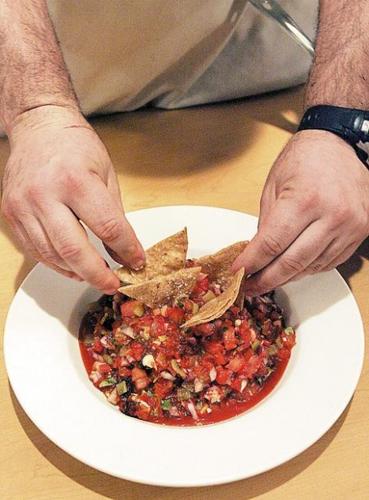
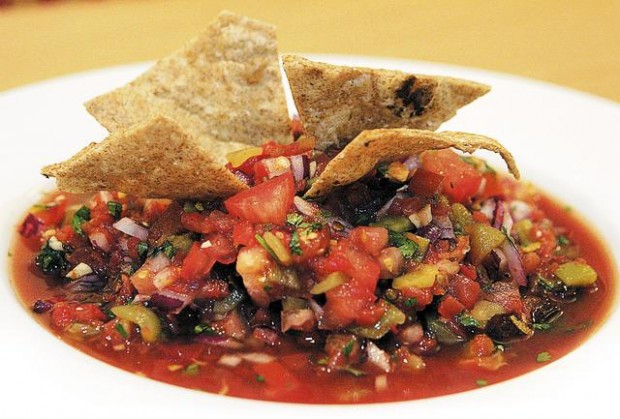
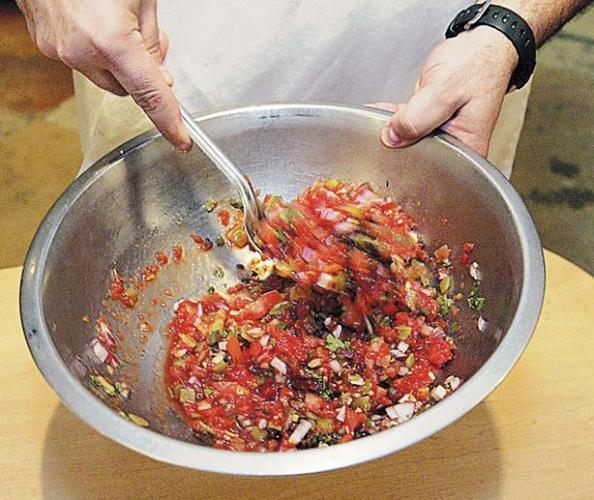
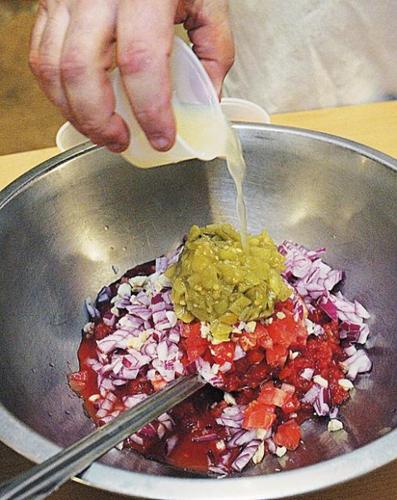
Today we feature that good old American culinary standby, salsa.
What's that you say? Salsa isn't an American food?
Ah, but it is.
True, its roots lie in Latin American countries, but salsa — like pizza and chow mein — is 100 percent American these days.
Consider this: As of August 2007, according to the Star's Business section, in this country salsa outsold ketchup $462.3 million to $298.9 million.
And that's just the commercially produced salsa. Salsa recipes abound everywhere. You find them in magazines, online, from your best friend.
The good news is that salsa is very low in calories and essentially fat- and cholesterol-free.
What follows is a bit of lore and history, as well as some tips from the pros.
People are also reading…
Basically, it comes down to this: Given the right ingredients, it's probably impossible to make a bad batch of salsa.
Ah, but with a tweak here and a touch there, "good enough" becomes "sabrosa!" — a truly memorable salsa.
Recipe merely a 'starting point,' chef stresses
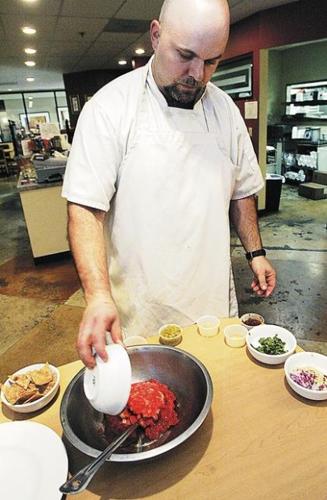
Chef John Mertes, who frequently conducts cooking classes at the Tucson Botanical Gardens, loves to cook.
Which is a good thing, because he's been doing it for at least 20 years.
He has been executive chef at some well-known restaurants, including Tucson's Soleil Restaurant and Miguel's at La Posada, and Denver's Loews Giorgio Hotel.
Now he is in business for himself. He owns A-Z Eatery & Catering in the Bank of Tucson Building, 4400 E. Broadway.
This summer, as part of TBG's continuing cooking class series, Mertes taught interested Tucsonans how to make different salsas — from a fiery hot variety to a chilled fruit salsa.
We asked him to share a couple of recipes, to explain some salsa basics and offer a few tips.
What chiles do you prefer using?
"I use a variety — chipotles, Hatch, Anaheims, sometimes jalapeños, serranos, even Thai and Korean chiles. It depends."
What are the other ingredients you use in most of your salsas?
"Onions — red ones, sometimes yellow sweet onions, mostly.
"Maybe the little green onions. But I'm not a big fan of those. Sometimes the flavor is overpowering.
"I also use cilantro, garlic, lemon juice — sometimes lemon zest. Sometimes I use limes or orange juice.
"I really have no preference; it's more of what is handy. Also, lemons don't go bad as fast as limes."
What type of tomatoes do you prefer?
"I use canned tomatoes. Nine months out of the year, that's the best."
(Mertes says fresh and homegrown are good, but too often commercially grown tomatoes lack flavor.)
What types of fruit work best in salsa?
"It depends a lot on what is in season, for the fruit and for the onions.
"I like mango salsa because you can always make it with fresh or frozen fruit.
"Strawberries are also good, and most of the stone fruits — plums or peaches. You can also use citrus if you want to go through the work of getting the white pulp cleaned off the sections.
"But I also make a good salsa with dry fruit — apricots, cherries, cranberries. Sometimes I use a hodgepodge of whatever I have on hand, then cook it down. It's great because it can be preserved and used later."
Is there a particular chile that goes best with fruit?
"I usually try to focus on the flavor and not make it as hot. I like to chop up a chipotle because it gives you a smoky flavor. It's not hot, just a little more flavorful.
"I use chipotle in a lot of other salsas for that same reason."
Last words of advice?
"Remember — the recipe is the starting point. If you don't want to use 10 chiles, use three."
(In other words, trust your taste-testing and be ready to modify.) El Parador Salsa Co.'s owners share their tips
It's nice to know that when you don't have time to whip up a batch of fresh salsa, you're not left in the lurch.
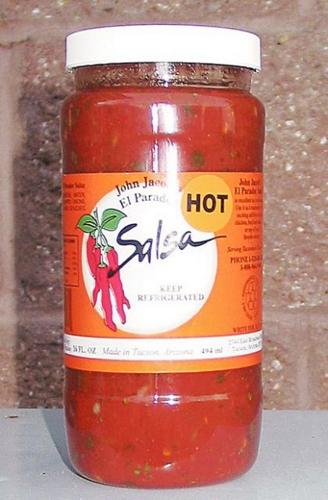
Just head to the grocery store and look for a jar of John Jacob's El Parador Salsa. That's a salsa made as close to home as you can get without making it yourself.
It's made in Tucson by El Parador Salsa Co.
Owned by the Jacob family and managed by twin brothers Donald and Daniel Jacob and their sister Loretta Jacob Carlson, the company also owns El Parador Restaurant, 2744 E. Broadway.
The business was started by their dad, John Jacob, in 1975. It was his salsa recipe featured then, and it is the same recipe featured now.
"Our salsa is tomato-based," explained Donald Jacob, adding that they make several kinds.
The Pico de Gallo is traditional, he said, with "freshly diced tomatoes, garlic, green onion, yellow onions, green chiles, chile tepin, jalapeño and cilantro."
El Parador salsas emphasize flavor, as opposed to the spicy heat that makes salsa burn as you swallow.
"We would rather have people come back for the flavor," Donald Jacob said.
El Parador began its manufacturing division in 1995 after first getting FDA and USDA certification.
Its salsa sells under the Shamrock Foods label in 11 Western states and is distributed to restaurants and casinos, even in Tucson.
Locally, El Parador sells its salsa under its own name at Albertsons, Safeway, Sunflower Farmers Markets and Wal-Mart, as well as to individual gift-basket companies.
Donald Jacob offered some tips for using and making salsa:
● The many culinary uses for salsa are "incredible." Example: Mix a cup in rice for a great side dish or add some salsa to chicken soup for a new take on an old classic.
Better still, try using it as a marinade for meats. Wow!
● Keep it simple. The best salsa recipes are the most simple.
● Make just enough salsa to last a week at the most. Then make another batch.
The reason: "The longer you keep it (fresh, homemade salsa), it loses its integrity," Jacob said.
Salsa history
In simple terms, salsa means sauce in Spanish. But sauce doesn't begin to do justice to the popular condiment we call salsa.
A sauce can be anything: made of cream, cooked with wine, resembling a gravy. But ask anyone to describe salsa and the responses are pretty much the same: "Made with tomatoes and onions and chiles . . ."
You can thank the indigenous people of Central and South America for that, says Karen Hockman, editorial director of The Nibble, an online gourmet magazine.
Before the Spaniards conquered their lands, the Aztecs, Maya and Inca were mixing wild tomatoes with chiles, squash seeds and toasted beans in a sauce the Spaniards called "salsa."
Here's more salsa history from Hochman and The Nibble:
• Domesticated chiles date to about 5000 B.C.
• In 1807, the first bottled hot sauce, made from cayenne chiles, appeared in Massachusetts.
• In 1868, Tabasco pepper sauce went on the market.
• Pace Foods began making salsa in Texas in 1947.
• In 1975, Patti Swidler launched Desert Rose Salsa in Arizona.
• From 1985 to 1990, Mexican salsa sales jumped 79 percent.
• In 2000, more U.S. households bought salsa than ketchup.