

Q Any info on a set of old Czech canisters? Included are vinegar and oil decanters, six spice containers and four larger canisters.
— Grace, Bangor, Maine
A I'll bet many readers remember, or still have, ceramic kitchen sets made in Czechoslovakia. Painted in bright colors, they were a kitchen staple of the 1920s through '40s. Decorations ranged from hand-painted florals to decals or geometric designs, and each piece bore the name of the condiment or spice inside.
Some sets involved up to 15 pieces. The ceramics were not of high quality, and many were broken in use. The reader is fortunate to have so many surviving examples.
Larger canisters typically held oatmeal, flour, rice, sugar, tea or coffee. Smaller boxes held everything from allspice to cloves. Decanters such as the reader's and a wall-hanging salt box completed large sets.
People are also reading…
Though numerous, the containers were not large. By today's standards, a 7.5-inch flour canister is puny. Spice boxes averaged 4 inches high.
Imported by boatloads, the kitchen sets were common. Today, pieces are collected as curiosities and accents. Because of size, not many are bought for use. Too small to be functional, sets or individual pieces are bought for a distinctive period "look." Bright hand-painted Deco flowers trump a stenciled geometric pattern any time. A large set, in excellent condition and highly decorated with a Deco look, might retail at less than $100.
FYI: Now out of print, the two volumes of "Made in Czechoslovakia" by Ruth A. Forsythe cover Czech glass and pottery.
Q Looking for info on a souvenir thermometer on a replica of some monument. Do these have value?
— Lee, Newport News, Va.
A Yes, souvenir thermometers are collected, depending on subject, aesthetics, material and age. Yours, standing about 4 inches high on a base, might be from a collected site but must be identified if you intend to market it.
Mercury thermometers are going the way of the dodo, which adds to their appeal. I'm talking souvenir types, not medical examples. The white plastic you mention could be new or old, and age matters. Early versions of plastic (examples go back to the early 1900s) are collectible.
At any rate, don't plan a vacation on the profits of a sale. Such items typically sell for less than $5, unless special.
Q A friend has a Last Supper painting given to her many years ago by an old gentleman from the old country. It appears to be signed by Leonardo da Vinci. How do we find out more?
— Julia, Tucson
A Leonardo, the scientist, inventor and artist, painted "The Last Supper" as a mural. What are the odds of his repeating it as a painting — and not having scholars beating the bushes for centuries to find it?
There is a lesson for smart collectors here. Sometimes, lore and romanticizing an item cause one to lose perspective. Receiving an item from an "old gentleman" from the "old country" does not make it valuable. It's the same with family say-so. Aunt Blanche's recollection that a vase came over on the Mayflower and is immensely valuable may or may not be valid.
I exaggerate, but you get the picture. If you sincerely believe the painting (is it indeed an oil on canvas?) is authentic, take it to a local gallery that deals in fine art and pay for an appraisal.
Q I have a fife my mother says was played by a relative in the Civil War. It is still in its case. How do I find value? Also, we have a lot of Nancy Drew, Hardy Boys and Little Pepper series books, printed in wartime. Any value?
— Marysue, Lima, Ohio
A On the first question, see previous on family lore. Your job is to link that fife to the individual and the time frame. Documentation is vital. Musical instruments have intrinsic value (some more than others), but provenance pays off.
For book values, search individual titles at www.book finder.com and www.abe books.com. Remember, in paper goods, condition is everything.
● Send e-mail to smartcollector@comcast.net or write Danielle Arnet, c/o Tribune Media Services, 435 N. Michigan Ave., Suite 1400, Chicago, IL 60611. Please include an address in your query. Photos cannot be returned.
The Smart Collector
By Danielle Arnet
» AUCTION ACTION
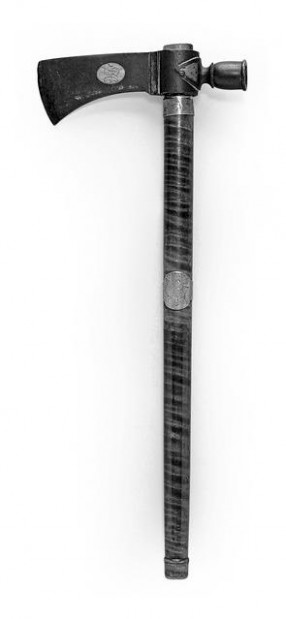
Discovered in a 2004 Boston taping of "Antiques Roadshow," a circa-1790 presentation pipe tomahawk was appraised by military arms expert William Guthman at $150,000. That is exactly the price realized when it sold in a recent Bonhams & Butterfields sale in New Hampshire. With an inlaid silver oval monogram reading "GW," the piece is thought to have been made for presentation to George Washington.